Showing posts sorted by date for query white women. Sort by relevance Show all posts

Saturday, October 25, 2025

The House of Blue Rape Culture

oh, those wacky hijinks

I'm a big fan of Tony Kushner, as can been seen over the past almost 20 years of this blog. Although to be completely honest, I'm more a big fan of Angels in America and his screenplay for the movie Lincoln. I'm much less impressed by other Kushner work, but still, he's my favorite living playwright and I almost always enjoy his interviews like this one with the goddess Rachel Maddow.
 
Clearly there's something wrong with me and my taste in theater, because I hate almost every play I see, and over the course of this blog I've trashed the works of Mac Wellman, David Mamet, Edward Albee, Adam Rapp, Tom Stoppard, Chekov, Strindberg and especially Landford Wilson.

It hasn't been all negative, I've said some positive things about the work of Annie Baker, and I loved FUN HOME (the musical based on the comix of Allison Bechdel) and I love Peter Shaffer's Amadeus. 

I am a fan of WAITING FOR GODOT in spite of Beckett having been a misogynnist - his everymen protagonists must never be women, since after all, this is a play about the human condition. I have tickets for tomorrow's performance of the production with Alex Winter and Keanu Reeves.

But I'd say that at best I enjoy only one out of every thirty plays or musicals that I see or read. I like a handful of contemporary plays, plus OUR TOWN and a half-dozen of Shakespeare's best plays: HAMLET, ROMEO & JULIET, KING LEAR, A MIDSUMMER NIGHT'S DREAM, AS YOU LIKE IT and HENRY V. And that's pretty much it. It's depressing.

And here we go again. 

I follow Tony Kushner's husband on Bluesky - I almost always like his posts because I agree with his political views - so I reflexively clicked the likey for his post about the Kushner-edited collection of the plays of John Guare: "He's one of our most important, funny, and original playwrights."

And then I made the mistake of reading THE HOUSE OF BLUE LEAVES. You can read it for free on Archive.org.

The play is over fifty years old but here is a SPOILER ALERT anyway.

I like Britannica's summary of the play: "In 1971 Guare earned critical acclaim for The House of Blue Leaves (filmed for television, 1987), a farce about a zookeeper who murders his insane wife after he fails as a songwriter." 

In the Archive.org version of the play the blurbs include one from the leftist magazine The Nation: "full of waggish merriment..."; the Village Voice: "Guare knows there is nothing funnier than the clash between American dreams and the American way of death..."; USA Today: "a woozy, fragile, hilarious little heart-breaker..." 

Although I guess you could defend the humor on the basis of it's funny 'cause it's true - men do murder their wives, insane or not, all the time. And when THE HOUSE OF BLUE LEAVES premiered in 1971, domestic violence wasn't considered an important issue.

Of the six women in the play, four are dead by the end: the crazy wife, two nuns and a deaf "aging film starlet." All defective or unavailable for sex, and so not much value for the men. The starlet's boyfriend mourns her for ten minutes before convincing the hero's mistress to fly away with him. The surviving nun rejects celibacy, and so avoids being offed by Guare. The hero's mistress, while an obvious bitch because she refuses to cook on demand, is at least worth raping.

Of course I knew that rape was considered a hoot back in those days, since Bill Cosby was killing it in 1969, with his hi-larious bit about drugging and raping women. But still, I was amazed to read the hero's monologue:

It's kind of funny, a chimpanzee knocked me in the back and kinked my back out of whack and I went to this health club to work it out and in the steam section with all the steam I got lost and I went into this steam room and there was Bunny—yeah, just towels-I mean you could make a movie out of this, it was so romantic— She couldn't see me and she started talking about the weight she had to take off and the food she had to give up and she started talking about duckling with orange sauce and oysters baked with spinach and shrimps baked in the juice of melted sturgeon eyes which caviar comes from—well, you know me and food and I got so excited and the steam's getting thicker and thicker and I ripped off my towel and kind of raped her... and she was quiet for a long time and then she finally said one of the greatest lines of all time.... She said, "There's a man in here."

There's no "kind of" rape - she doesn't even see him until he's raping her. You see, that's why it's so hysterically funny - she realizes "there's a man in here" because she was just raped by one. 

The Clive Barnes New York Times review of the premier of THE HOUSE OF BLUE LEAVES in 1971 does not mention the rape. Artie is everyman and we are meant to sympathize with him, because straight white men had it the worst in the middle of the twentieth century:

Artie's troubles are manifold: His mistress won't cook for him, his songs are rejected, his wife is as nutty as a Thurber cartoon, his best friend is as crazy as a Feiffer cartoon, and he is invaded by nuns, two of whom are blown up by his son, who clearly has an unfortunate genetic disposition. 
 
Yet Artie keeps on smiling. He believes that one day he will wake up over the rainbow in Los Angeles and find himself as famous as Bob Hope. He keeps on smilingly right until just before the end. 
 
Mr. Guare has a telling way with the karate chop. His black inversions have a Joe Orton air to them, but his tone is all‐American emanating from a mind riotously littered with the detritus of a civilization, its comic books, its radio serials, its movies, indeed all of its advertisements—to steal and adapt Norman Mailer's phrase for itself.

In his review of the 1986 production, Frank Rich says:

By evening's end, Bananas has actually become one of her husband's animals. Bananas likes animals, she has explained, because they're not famous and because they represent to her the buried feelings that her fit-regulating pills usually restrain. Miss Kurtz's metamorphosis brings the theater to a shocked hush. Her slender hands become paws dancing in the air, her voice trails off into a maimed puppy's whimper. As Bananas nuzzles helplessly against her husband, Mr. Guare's inspired image of the all-American loser acquires a metaphorical force as timeless as West's locusts. Where once there was a woman with stars in her eyes, we see a battered mutt, the forgotten underdog that the bright lights of our national fairy tales always pass by...

Then the all-American everyman puts the mad dog down, like Old Yeller. But the play is no longer quite as funny as it was fifteen years before:

Yet a funny thing has happened to ''Blue Leaves'' ...The play no longer seems all that funny, and it's none the worse for the shift in tone. While some of Mr. Guare's jokes are indeed dated remnants of the 60's, his characters and themes have gained the weight and gravity so lacking in his more pretentious recent plays. Time hasn't healed the wounds described in ''Blue Leaves'' - it's deepened them. One still leaves the theater howling at Mr. Guare's vision of losers at sea in a materialistic culture, but the howls are less of laughter than of pain.

He doesn't mention the rape. 

In a recording of that 1986 production by the American Playhouse, now on YouTube  the line "kind of raped her" gets a solid laugh as the character played by Christine Baranski covers her face with her hands. It's extra creepy that it's Frasier's dad confessing to raping Christine Baranski.

A September 2008 review of an Orange County California production entitled ‘House of Blue Leaves’ will leave you blue Paul Hodgins writes:

Almost four decades after it turned its author, John Guare, into a name playwright, “The House of Blue Leaves” seems like both an ossified artifact of the ’60s and creepily relevant to our own troubled times.

I certainly get the "ossified artifact" part, but I'm not sure about the relevance to our own troubled times. Later he says:

In the end, it’s too much – but that, of course, is Guare’s point. The promises, priorities and threats of the modern world have unhinged us, and nobody’s acting sensibly anymore. It’s a warning that’s more urgent now than it was when the play was written.

Why is it "more urgent now?" From what I remember of September 2008, the big issues were the financial crisis and Barack Obama was recently nominated to be the Democratic candidate for president. Neither of those things would seem to have any connection to the issues of this play - but maybe for Hodgins, Obama's nomination was a sign that the whole world had gone insane. 

Looking back, it was a blessed time in comparison to the state of our country now.

Hodgins refers to the protagonist of the play as an "everyman" in spite of the protagonist being a rapist, but then again, why not? If Guare wrote a zany farce based on the rape of Gisele Pelicot by a parade of everymen, would it be much different?

Sheila O'Mally, writing about the 2011 production in Politico also fails to mention the rape and is annoyed that the audience does not react the way she feels they should, because in her opinion, if you don't anticipate this humorous farce ending in murder, you are insane:

I felt the audience resisting Ben Stiller (as the hero) in the part. They laughed at everything he said, whether it was funny or not, seeming to need him to be the clown at their birthday party that they expected. Their laughs were insistent, rather than reactive, almost trying to push him where they wanted him to go. In the final harrowing moment, when it becomes clear what Artie is doing, a couple of people around me gasped. This is a good response, obviously, and appropriate, but based on all that had come before, I felt the audience turn on the play in that moment. They had been expecting a Ben Stiller laugh-riot, and instead they were given this? The play is so hilarious that the ending, which any sane person could see coming from a mile away, hurts. Good. It should hurt. But I felt the resentment in that well-dressed crowd. I felt them withhold their approval.

The 2011 review in Vulture by Scott Brown is the only one I have found so far that mentions the rape monologue, but only in passing:

Hovering in the wings is Artie’s ten-clawed climber of a mistress, the fierce Bunny Lingus (Leigh). (Guare, whatever your overall opinion of him, is one of the great moniker-makers of the postmodern stage.) The pair met when Artie “kind of raped her” in a health-club steam room, and since then, she’s been convinced of his indomitable drive, even as his lingering attachment to his invalid wife has her wondering...

To be fair this was still the early days of the #MeToo movement, before Harvey Weinstein made Hollywood and the theater world realize that maybe it's not a good idea to be casual about rape. Damn I am so mad I missed the reading of A PLAY ABOUT DAVID MAMET WRITING ABOUT HARVEY WEINSTEIN back in June. I hope it comes around again soon.

Brown has an epiphany at the end:

This is a furious play, a vicious and ungenerous play, and we should be made to feel that. I got it in gentle waves, but never in hurricane-force slaps. Perhaps it’s just the passage of time: House was written back when the grand promises of the Great Society and Vatican II were decaying even faster than the Star System of Old Hollywood, and no purposeful revolution could cohere or find secure footing. “When famous people go to sleep at night, it’s us they dream of, Artie,” chants Bunny, without rue or irony, in a kind of lullaby. “The famous ones, they’re the real people. We’re the creatures of their dreams.” A line like that ought to galvanize us, the passive patsies out in the gallery. Instead, I felt a gentle perplexity. Sometimes, sitting out there in the dark, watching these famous people mount a case for the violent, oppressive absurdity of fame, I felt like a creature of their dreams. And I wondered, Inception-like: Who needs to wake up? Me or them? 
 
The flip side of all the famous people who have performed the play are all those community theater actors who have performed the play. It's certain that at least some of them dreamed of greater fame than treading the boards at the Playcrafters Barn Theater. 

Assuming that, like most who've experience the play, apparently, they don't think the protagonist being a rapist makes him any less of an all-American everyman - do they feel targeted by the play as it mocks this old old man - 45! - because he still has dreams of something beyond his day job? 

In the 2024 review of the Playcrafters Barn Theater production Madeline Dudziak writes:

Maybe Guare’s writing just isn’t particularly funny to me. Perhaps the script, like Banana’s moniker, hasn’t aged well, or the other patrons on Saturday were as confused as I was … but it just wasn’t humorous. Sure, a few good one-liners elicited laughs, but in truth, the show was completely depressing. Honestly, when Landuyt (playing "Billy Einhorn") finally arrives and sobs uncontrollably for a few minutes, it makes perfect sense, because it is all simply sad. Even the asides were woeful. Nearly every character had a moment to chat with the audience to let us in on what was going through their heads – a moment of connection, if you will. These flashes of personal insight into the characters could have shifted the dark tone to one slightly funnier, but they simply reiterated how broken all of these people were.

I don’t know what genre I’d lump The House of Blue Leaves into. This production may defy genre altogether, but it’s far from a miss; the entire talented cast performs beautifully, salvaging the sorrowful script, and the set is lovely. The unsettled ending certainly doesn’t clear anything up. But maybe you’re the kind of theatre-goer who doesn’t need closure to your questions.

It's astounding that even in 2024 the rape goes unremarked, as if it is a very minor detail of the story, just an odd little quirk in the protagonist's meet-cute story.

I will be on the lookout for reviews of any future productions of "The House of Blue Leaves." I wonder if they'll leave the rape line in, and if they do, what the critics will say about it - if anything.

Sunday, October 05, 2025

Black Woman Genius ~ a call for monologues

I don't think I've ever had a post that was suitable for all three of my websites: this one; the one that critiques race pseudoscience; and the theater one. But today is the day for this first ever cross-over post.

I was especially happy to have another chance to promote Murderbot. 

Any playwrights out there, consider submitting your monologue, the winner gets $100 and anybody from anywhere in the world can submit their work.

NYCPlaywrights seeks monologues.

THE DEADLINE IS SUNDAY NOVEMBER 30, 2025 at 11:59 PM.

The theme is "Black Woman Genius."

In November 2024, NYCPlaywrights began the "Resisting Fascism" project. The winning piece was a monologue, THE 92% by Bryan-Keyth Wilson that highlighted the fact that 92% of Black American women voters did not vote for Trump - and their intelligence and wisdom are increasingly clear.

The murder of Charlie Kirk was horrific, but that does not erase the fact that  he said hateful things like this:
“If we would have said three weeks ago [...] that Joy Reid and Michelle Obama and Sheila Jackson Lee and Ketanji Brown Jackson were affirmative-action picks, we would have been called racist. But now they're comin' out and they're saying it for us! They're comin' out and they're saying, "I'm only here because of affirmative action.

Yeah, we know. You do not have the brain processing power to otherwise be taken really seriously. You had to go steal a white person's slot to go be taken somewhat seriously.”
Kirk dropped out of community college to become a full-time political pundit, while the Black women he attacked graduated from Harvard and  Princeton and Yale.

And so this call for submissions seeks monologues on the theme of Black Woman Genius. 

SEMI-FINALIST SCRIPTS

NYCPlaywrights will select as semi-finalists as many of the scripts that we like and which meet the submission guidelines.

The semi-finalists will be listed on this blog and an excerpt from each monologue (if permission is granted by the playwright) will be displayed in a blog post, one per day, along with any website links or other contact information the author wishes to share. 

The semi-finalist script selections will be announced Sunday, January 4, 2026. 

THE WINNING MONOLOGUE

The winning monologue will be selected from the semi-finalist monologues. The winning monologue will be recorded with an actor and an excerpt of the recording will be posted on NYCPlaywrights.org and on the NYCPlaywrights YouTube channel (if permission is granted by the playwright) along with author and actor contact information, biographies, etc.

The author of the winning monologue will receive an award of $100. 

The award-winner will be announced Sunday, January 18, 2026. Excerpts from the semi-finalist scripts will begin posting that day one monologue per day, and the winning monologue will be posted after all the semi-finalist monologues have been posted.

💡 THE SUBMISSION GUIDELINES 💡

Failure to follow guidelines will result in your script being rejected.

As always, there is no fee for submissions. 
  • The deadline is November 30, 2025 at 11:59 PM EST.
    • All rights will remain with the playwright.
    • Monologues must be no more than two pages long, using standard 12-point text size and line-spacing.
      • Send only one monologue script per author to genius@nycplaywrights.org.
        • The monologue script must be submitted by the author of the script, no agents or others may submit. 
      • The monologue script submission should be sent by email, with the script itself as a file attached to the email.
      • The file format of the monologue script should be .pdf because it will retain your original script formatting.
      • Make sure you have your name and your email address on the script.
      • Plays can be submitted by anybody, from anywhere in the world but must be primarily in English (a few non-English phrases are acceptable, but the phrases must include English translations in production notes or stage directions.)
      • A play that has had a production is acceptable.
      • A play that has been published is not acceptable.
      • There will be no money awarded for selected scripts except for the winning monologue.
      • NYCPlaywrights' decisions are final.
      • Any questions email info@nycplaywrights.org
      PLEASE NOTE: when you submit your play, you should get an automatic response that says:

      ***
      Thank you for sending your monologue to the NYCPlaywrights “BLACK WOMAN GENIUS” project.

      The semi-finalist script selections will be announced Sunday, January 4, 2026.

      The award-winner will be announced Sunday, January 18, 2026.

      Nancy at NYCPlaywrights

      ***

      If you don't receive the automatic response, email us at info@nycplaywrights.org to check if we received your script.

      Please note:

      • The monologues must be dramatic - we love facts, but the monologue must not simply be a lecture on some aspect of history or current events. A dramatic monologue should have an emotional impact and often will tell a story. We'd like to see creativity and invention.
      • The call for submissions is open to any person, anywhere in the world. 
      • Although the theme is Black Woman Genius, the character speaking in the monologue does not necessarily have to be a Black woman.
      • Although this is a serious subject, you do not have to be grim. We welcome humor and playfulness, and we are just as interested in hopeful monologues, and anticipating a brighter future as much as we are in the injustices of the past and present.


      DATE RECAP
      • November 30, 2025 - submission deadline
      • January 4, 2026 - semi-finalists announced
      • January 18, 2026 - the winning monologue will be announced and then each day an excerpt from one of the semi-finalist monologues will be posted. 
      Some genius prompts:

      Thursday, August 03, 2023

      La chambre bleue - happy centennial

      One of Suzanne Valadon's most celebrated paintings, The Blue Room (La chamber bleue) was painted in 1923, so it's one hundred years old now. 


      Wikipedia has a very good entry about the piece:

      In contrast to Valadon's depiction of the female form, artists such as Titian, Ingres, and Manet depicted female nudes with idealized womanly features. For example, the Grand Odalique, Olympia, and Venus of Urbino underscore a gendered role of women with full female exposures atop beds—as something separate from the model—creating an imbalanced power dynamic between the artists and subject.[5] The Blue Room is a response to these paintings as well as others, such as Matisse's Blue Nude and Félix Vallotton's The White and the Black.[citation needed] Substituting a cigarette for Ingres's hookah and taking Matisse's bold outlines, among other traits from the aforementioned works, Valadon creates a "startlingly contemporary" lounger, capturing a depiction of everyday life which is entirely her own.[1] Valadon's subversion and appropriation of her predecessor's techniques ultimately instigate a new trajectory for future depictions of the female form.

      Fun fact - it was painted two years before The Great Gatsby was published, to give some context. 

      Friday, February 24, 2023

      Hudes or Change: purple prose and nostalgia


      This is how Jenn/Kathy's death is described in Hudes' "Daphne's Dive":
      DAPHNE: Do you know what self-immolation means? (Silence) Do you know what self-immolation means?
      (Daphne pulls a newspaper clipping from her purse)
      UPenn did a little write-up.

      RUBY: Get that paper out of my face. Speak.

      DAPHNE: Tuesday, at the LOVE statue. Jenn poured gasoline over her head, lit a match, and started dancing. A few people tried to douse the flames but she went quickly.
      I found the NYTimes review of Daphne's Dive, and it is wild that the accurate description of Jenn/Kathy's death is described as "a little contrived."
      Not all that takes place in “Daphne’s Dive” strikes me as entirely credible — or free of a sprinkling of sentimentality. The fate of Jenn, for example, who dies in spectacular circumstances midway through the play, seems a little contrived. Acosta’s rise from businessman to powerful local politician, on the other hand, is more persuasive.
      I appreciated that Hudes didn't simply portray Chang as a hero, and the most decent characters in the play argue against it:
      PABLO: Jenn was not a hero. 
      RUBY: Yes she was. 
      PABLO: No, Ruby 
      DAPHNE: She was sick/She needed treatment. 
      RUBY: Unrelated/Unrelated.

      I wanted to see what else Quiara Alegría Hudes had to say about Kathy Chang so I listened to all ten hours of her memoir "My Broken Language." Hudes does the reading herself and I really wished she didn't because she reads in a relentlessly chirpy manner, like her audience is in kindergarten. 

      Also that woman loves a metaphor. I would estimate that she averages at least one metaphor per page. 

      She also loves lyrical bordering on cringe like "the wind caressed my shoulder blade." Her lyricism for anything to do with learning or playing music is so extreme that I set the audio playback rate to 2.0 times normal speed once she got to Yale to study music. 

      Hudes turned the memoir into a play and in the New Yorker review Vinson Cunningham said:

      ...there are places where the Author’s voice goes mawkish and her prose crosses that often untraceable line between lyricism and purpleness. 

      Yes, exactly. Thank you.

      And then there is Hudes' religiosity. In her 2018 musings on the theater Hudes says:
      I struggle increasingly with the atheist white male aesthetics I inherit. These include:
      1. That love is dead, romance is transactional, and sex is not a source of pleasure but a race to the bottom.
      2. That children hate their parents and vice versa. The suggestion of familial love implies idiocy on the part of the playwright.
      3. That wealth is either neutral or a hardship to the wealthy.
      4. Regarding God: You’re kidding, right?
      5. Joy is sentimental, harmony a falsehood. Harming others is the single human truth.
      6. Genius is a male attribute. Intuition is a female attribute.
      I was in agreement with five out of six items on her struggle list. But I take exception to "Regarding God: You're kidding, right?"

      I'm not sure what she wants. There is a currently-playing musical, HADESTOWN, full of Ancient Greek gods. And ANGELS IN AMERICA not only contains plenty of discussions about faith and religion, especially Mormonism and Judaism, but there's even a big scene where Louis, with the help of the ghost of Ethel Rosenberg, says Kaddish for Roy Cohn.

      But her view of religion is strongly informed by the fact that when she was a teenager her mother held spirit-possession rituals in their West Philadelphia twin row home that included animal sacrifice. She mentions a chicken, a frog and a goat. And I thought my mother was a religious fanatic. At least she never sacrificed a goat. As far as I know.

      Hudes seems to think her mother is a goddess of wisdom, so she's hardly going to accuse her of being a fanatic. She at least acknowledges that it's a strange dichotomy, that her very literate, social-welfare agency employed mother spent her free time performing rituals involving animal sacrifice.

      I hated Hudes portraying Gloria Steinem as an elitist racist, because in the 1980s she had a meeting with bigwigs at the social services agency her mother worked for, and her mother wasn't invited to the meeting. If you know anything about Steinem's life you know that not only has she always been very conscious of making connections with non-white feminists, she is every bit as respectful of Native American traditions as Hudes' mother with her love of the bloody Sundance ceremony. 

      One thing I absolutely do love about the book is her trashing The Bell Curve. But on the other hand, Hudes seems to indulge in her own ethnic essentialism, similar to that in The Bell Curve, throughout the book, using "white" and "whiteness" as insults. Her father is Jewish, but she's more likely to describe him as "white" than as Jewish, I assume because insulting someone by calling them a Jew is considered far more bigoted than insulting someone by calling them white. 

      Hudes spends Chapter 22 mocking her father and his wife Sharon as right-wing reactionary libertarians who hate each other and consider city people "rats." Now I'm sympathetic, I despise right-wing reactionary libertarians. But elsewhere in the narrative, Hudes acknowledges how deeply homophobic her Puerto Rican relatives are, so much so that one of her relatives ran away to New York City to die alone on a mattress rather than tell any family members he had AIDS. Surely Hudes must consider homophobia as bad as being a right-wing reactionary libertarian, but she never mocks her homophobic Puerto Rican relatives. 

      And because Hudes hates Sharon so much, and because Sharon is white, Hudes decides that you can't be both white and Puerto Rican, you have to pick a side. This might not seem so remarkable coming from the teenager she was when she chose this simple-minded way to be in the world, but then she writes:
      They left me two options that night in the living room. Be white or be Puerto Rican. Their rules, they forced my hand. Fine. My heels dug further into North Philly. My soul took a side that lasts to this day.
      Really? You're not seventeen anymore. Sharon no longer has power over you. Hell, you're being paid to talk shit about Sharon now. You went to Yale, you're in your forties, white people come to see your plays produced in the Anglophone theater tradition. 

      Hudes is no blood relation to Sharon, so her whiteness comes from her Jewish father. But Hudes doesn't express it as Puerto Rican versus Jewish.

      Maybe Hudes publicizes this attitude as a way to shore up her career brand as a specifically Latina playwright. I hope so, because the alternative, that she sincerely believes in such an extreme dichotomy, is depressing. In the 2020 census more than half of all Puerto Ricans living outside Puerto Rico identified as white. Even more living in Puerto Rico identify as white.

      But while her lyricism and essentialism alienated me, Hudes' litany of place names made me nostalgic for Philadelphia and its suburbs. She mentions the Philadelphia Art Museum, Giovanni's Room, the Schuykill Expressway, the Italian Market, Six Flags Great Adventure and the Cherry Hill Mall. And the rail line between 30th Street and Malvern, which coincidentally I had taken my one and only time this past October to go to a funeral for an artist friend who had lived out there. Hudes took the same line to see her father after her parents split up.

      She even describes participating in a Quaker meeting at the Quaker headquarters on 15th Street and Cherry Street, or as my ex-husband called it, when he was working in their cafeteria, "The Quaker Kremlin." I never participated in a Quaker meeting myself but the building was familiar to me since my daughter was eligible for Quaker daycare at a steep discount while my ex was working there. Our paths criss-crossed, Hudes and mine, all over the Delaware Valley, and not just because of Kathy Chang.

      And by the way, unless I missed it, and I don't think I did, even at 2.0 speed, the memoir does not include a discussion of Kathy Chang. This is strange because Hudes says she knew her:
       Some of those initial molecules, for me, in this play was someone I knew growing up named Kathy Change—I knew her as Kathy Chang, she changed her name later—who was a kind of activist and performance artist and I admired her. Many people didn’t like her and thought she was a nuisance. There was something about her that fascinated me—how did she do what she did? She went out to these Philadelphia street corners and danced and waved these flags with her ideals, and I thought that was fascinating. 
      I mean, Hudes goes into fine detail about the lives, body types, drug problems and eating habits of dozens of relatives, so you'd think she could spare a few paragraphs in her memoir for someone she admired. 

      But her inclusion in the play is certainly a coup for Chang, on top of decades of inspiring less-established artists. Her Wiki page notes:
      • A memorial is held in her honor every year on October 22 at the peace sign sculpture on the University of Pennsylvania campus where Kathy died. The memorial attracts artists, activists and performers, among others.[10]
      • Percussionist/composer Kevin Norton wrote a suite for Kathy Change entitled Change Dance (Troubled Energy) in 2001 and was released late in 2001/early 2002 on the Barking Hoop label.[11][12]
      • Industrial metal band Fear Factory wrote the song "Slave Labor" referring to her suicide; it was included in the 2004 album Archetype.
      • Drummer Tyshawn Sorey composed and performed "For Kathy Change," a quintet in her honor, in March 2011.[13]
      • Soomi Kim wrote and performed in the biographical play "Chang(e)", directed by Suzi Takahashi, which premiered in 2013 and has had multiple performances since then,[14][15] including New York City[16] and Portland, Oregon.[17]
      • Pulitzer Prize-winning playwright Quiara Alegría Hudes's 2016 play "Daphne's Dive," based in Philadelphia, features a character closely resembling Kathy Change.[18][19] The play is dedicated "in memory: Kathy Chang(e)."[20]
      • Actor (and writer) Shin-Fei Chen portrays "Peace Activist Kathy Change" in Andrew Repasky McElhinney’s 2019 film Casual Encounters: Philadelphia True Crime Confessions. Her scenes were shot on 35mm Kodak film, September 2018 in West Philadelphia.
      She's mentioned in a poem published in The New Yorker, in 2008; the subject of an article in The Drama Review in 2011; and the subject of a collage from 2004 at my alma mater (did not graduate) the Pennsylvania Academy of the Fine Arts. The very biographical song about Chang recorded by Todd Young and His Rock Band, is called "Kathy Change."

      I especially understand why Asian women artists are inspired by Chang and want to perform her as a character. The Western theater tradition has not been exactly over-stuffed by highly individualized Asian woman characters. Whatever else you can say about Chang, she was highly individualized.

      Thursday, February 23, 2023

      Hudes, or Change: deadbeat dads and allegory


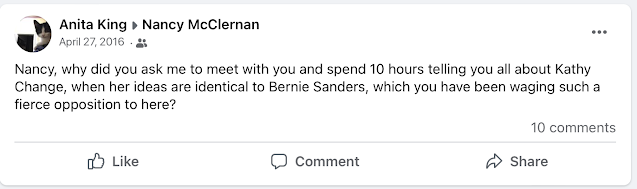
      I think people in the arts are fascinated by Kathy Chang because she was a big talker. That's the reason why people in the arts and on the Left are fans of Bernie Sanders. He talks big, like the time, during his 2016 presidential campaign, when he told the New York Daily News he wanted to "break up the banks" but when pressed for details on how to do that, he had nothing. Which doesn't seem to bother Sanders fans, which includes Chang's friend Anita King, who never shut up about how corrupt Hillary Clinton and the Democrats were during the 2016 presidential campaign until I unfriended her on Facebook.

      While we were still speaking, King attested to the political affinity.


      Bernie Sanders has something in common with my ex - they were both, at least for periods of time in their lives, deadbeat dads. Sanders' ex-girlfriend and child ended up receiving welfare, although Sanders, a white man with a college degree could certainly have found a job that paid well enough to support his kid. But, like my ex, Sanders preferred to devote himself to politics. 

      Unlike my ex, Sanders eventually found himself a living-wage career through politics. Although I will say, there are few people who live to see their fondest dream come true, like my ex did when marijuana began to be legalized all around the United States.

      Chang may be considered a performance artist, but her art was almost always in the language of politics. For example:

      I am running on a platform of complete social transformation.
      The problems we are faced with today: crime, unemployment,
      poverty, battered women, abused children, pollution,
      environmental degradation, national insolvency, and budget
      deficits, and so on, cannot be solved within the present
      economic and political framework, because that framework
      is in itself the fundamental problem and the cause of all the other
      problems. The present government is so corrupt and tied
      up with anti-democratic procedures that it cannot reform
      itself. The only way to reform the system is to simply
      dissolve the system and start all over with a great national
      conference to create a new society...

      "...simply dissolve the system and start all over with a great national conference to create a new society."

      It's perfect that sentence contains "simply." 

      Hudes' play includes Kathy/Jenn's death, which is not shown on stage, and then later one of the characters has a magic realism moment with an apparition of Jenn, during which Jenn says some Kathy Chang style things. Huldes also directly quotes Chang:

      RUBY: Jenn should have held up. Occupy would've been her moment. I dug up one of her old banners: "In case of financial collapse, party in the streets!" 

      It's true that Occupy was a lot like Chang: a big-talking public nuisance that did nothing to actually improve the lives of others. But got a lot of attention.

      But indirectly thanks to Chang, I came to rely on the very real social safety net that had existed for fifty years, because the Democratic Party made it happen, through boring old non-revolutionary politics. The same Democratic Party that many Bernie Sanders supporters disparage as identical to Republicans.

      That is why I dislike the use of Chang and her death as a symbol for hope and for positive social change. I believe Chang killed herself, at age 46, because the rewards for her performances were fading and she did not want to, or could not do anything else. And because no goddam person in her life would help her with her dental problems. 

      Fun fact: dental care is part of Obamacare, which exists thanks to the Democratic Party. But the far Left hates Obama for not achieving the completely socialized healthcare of their dreams, so they don't care how many lives were saved by Obamacare. 

      So really you could say Occupy was Kathy Chang's moment, since Obamacare first appeared in 2010, just ahead of Occupy in 2011. She could have partied at Occupy without tooth decay.

      Chang did not only do protests, she was involved in theater, at least to the extent that she had performed in a production of "The Year of the Dragon" written by her then-husband Frank Chin, a fairly well-known playwright. Her response to the end of their 5-year marriage was to try to kill herself.


      Chin and Chang in performance 1978

      And Chang wrote a play which was performed and videotaped in 1991. It's called The Transformation and it's as allegorical as a medieval morality play. There's Uncle Sam, there's a character representing third-world poverty, there's Mother Nature, the Military-Industrial Complex, etc. It has all the coherence and self-discipline of her speeches, that is, very little. 


      But it's interesting that she wrote it and I'm impressed she got anybody to perform it. I've watched it and the basic plot starts from the clash of these various Humors but then evolves into sex bringing characters together and by the end of the play the cast is semi-naked and chanting and dancing in a circle.

      At the end of the play, Chang displays her extremely romanticized view of pre-Industrial Native American society.

      MOTHER EARTH 
       
      Think back. Think back. Before the Europeans landed. There are no skyscrapers and streets. No highways and electric wires. No, just trees and forests everywhere. Forest full of wild animals. Coyotes. Dear. Bear. Bobcats. Wolves. Natives. Lenni Lenape. Algonquin.  Hopi. Cherokee. Chippewa. The streams are jumping with fish. You hunt with bow and arrows. No guns. You live off fruits and berries and herbs. You grow corn and squash and peas. You worship the earth and are careful not to bite the hand that feeds you. You don't squander my resources.

      I don't know if Chang was completely ignorant of the fact that pre-European contact North America was not a peaceable vegetarian kingdom, and that indigenous people ate meat, sometimes human meat and warred against each other plenty without the aid of guns, or if she just doesn't care. But what she is advocating is "going back in time" to this Garden of Eden fantasy.

      If Chang had not killed herself, she would be 72 years old now. If she hadn't killed herself when she did, the way she did, I doubt people in the arts would care about her. 

      My ex wrote on his blog:
      Kathy killed herself on the University of Pennsylvania campus in 1996. Visually and physically like the Buddhist monks of Vietnam, she poured gasoline over herself and her robes and set herself on fire. The political effect was unlike that of the monks. The world did not sit up and take notice. The country did not erupt into revolution.
      My ex seems to believe Chang's rhetoric, that she killed herself in that way to bring on the Revolution, and he mourns that she did not achieve her goal.  

      I think she killed herself that way so that people would remember her, and in that she has been wildly successful. Being included in a play by a Pulitzer-prize winner is probably her greatest success yet.

      More about that in the next post.

      Tuesday, February 21, 2023

      More theater thoughts

      I have written quite a bit about theater on this blog over the years, although very little in the past few. 


      One of my earliest Heavens to Mergatroyd blog posts was a defense of Our Town. Five years later I said it was a better play than Hamlet. 

      I have had thoughts about the work of Annie Baker, Tom Stoppard's ARCADI, Adam Rapp, Bruce Norris and Tony Kushner. I was not thrilled with Kushner's THE INTELLIGENT HOMOSEXUAL'S GUIDE TO CAPITALISM AND SOCIALISM WITH A KEY TO THE SCRIPTURES, but in general my love for Kushner is second only to my love for Shakespeare and Thornton Wilder, primarily because of Angels in America and the screenplay for the movie Lincoln. 

      And of course I've written about how much I hate David Mamet.

      Anglo-Irish playwright Martin McDonough has always gotten on my nerves, much like Tracey Letts does, and for the same reason - for their plays that traffick in female suffering for the entertainment value. I've complained about them both.

      Although to be fair, the helpless suffering of women has been a staple of The Theatre since The Trojan Women. You kind of can't go wrong with women wallowing in squalor.

      Way back in 2005 I was thrilled by a take-down of McDonagh by Charles Isherwood in The New York Times. Re-reading it now, I am struck by how much our current moment of "woke" theater is the pendulum maxiuma from the nihilistic anti-political theater of two decades ago:
      Mr. McDonagh's view of theater is all about the medium, not the message. Here's Katurian again: "I say, keep your left-wing this, keep your right-wing that and tell me a story!" (I've elided one of Mr. McDonagh's trademark expletives.) "No ax to grind, no anything to grind. No social anything whatsoever."

      This is a popular idea at a time when many serious artists seem to have ceded the landscape of ideological entertainment to the likes of Mel Gibson and Michael Moore. It is taken for granted that a movie's opening weekend box office, its stylistic allusions to other movies or the potential romantic alliance of its stars are more relevant topics for discussion than any artistic aspirations it might have. The same mindset infects Broadway, now a tag-along, unhip member of the culture clan, on a smaller scale.

      But is this a healthy ideal? Entertainment can, after all, aspire to do more than merely serve up narratives diverting enough to keep us hooked for a couple of hours. (Or in the case of the egregiously overwritten "Pillowman," three.)
      And recently I read one of the best descriptions of McDonagh of all time, written by Mark O'Connell for SLATE:
      And this is characteristic of McDonagh in general; for all its reputation for darkness and perversity, his work is expertly crafted light entertainment passing itself off, sometimes almost convincingly, as provocative, serious art.

      Fortunately women have made progress in the theater since two decades ago, although the window for white women was from about How I Learned to Drive to The Flick. Since then, white women have been pretty much lumped in with white men as beneficiaries of ages of white privilege in the theatrical Anglosophere, who should step aside now. Of course it's true that non-white playwrights have been shut out for centuries - it's just that white women have too, and a couple of decades of white women writers being in vogue isn't quite enough to make us the dominant demographic.

      I'm certainly not the only woman in theater who has complained about men running the show. Theresa Rebeck has courageously gone into battle on behalf of women, time and again.

      More recently, well, 2018, Quiara Alegría Hudes has had interesting things to say: https://www.americantheatre.org/2018/09/27/high-tide-of-heartbreak/

      I've gotten interested in Hudes recently because she included a character, based on a woman I knew, Kathy Chang, in a play of hers called Daphne's Dive, and I've been thinking about writing a play about my misspent youth, including the impact that Chang had on my life, for over a decade now.

      I should be interested in Hudes because she won the Pulitzer Prize in Drama in 2012 for a different play, Water by the Spoonful, but I'm terrible at keeping track of which playwright won which award when. 

      I'll have more to say about Hudes soon, specifically her memoir, "My Broken Language."

      Wednesday, February 16, 2022

      I'm Waiting for the Man in the supermarket

      I walked to the supermarket, enjoying the first day of Sprinter 2022.

      Back in ye olden days, when you went into the supermarket, you heard muzak. You can hear a selection of supermarket muzak on Youtube.

      Eventually supermarkets began to play pop tunes, often considered "oldies" by the time they were played there. I discussed some of my favorites ten years ago.

      Today in the supermarket I heard the Velvet Underground's 1967 "I'm Waiting for the Man," Lou Reed's ditty about going to Spanish Harlem to score heroine. The 4/5/6 subway line in Manhattan has a stop at Lexington and 125th Street.

      A live version of the song can be heard on The Quine Tapes.

      If the supermarket ever plays Sister Ray or Black Angel's Death Song, you'll know that things have gotten really weird.


      I'm waiting for my man
      26 dollars in my hand
      Up to Lexington 125
      feelin' sick and dirty more dead than alive
      I'm waiting for my man

      Hey white boy, what you doin' uptown
      Hey white boy, you chasin' our women around
      Oh pardon me sir, it's furthest from my mind
      I'm just lookin' for a dear dear friend of mine
      I'm waiting for my man

      Here he comes, he's all dressed in black
      PR shoes and a big straw hat
      He's never early, he's always late
      first thing you learn is that you always gotta wait
      I'm waiting for my man, ah, work it now

      Up to a brownstone, up three flights of stairs
      Everybody-body's pinned you, but nobody cares
      He's got the works, gives you sweet taste
      ah, then you gotta split because you got no time to waste
      I'm waiting for my man

      Baby don't you holler, darling don't you ball and shout
      I'm feeling good, you know I'm gonna work it on out
      I'm feeling good, I'm feelin' oh so fine
      until tomorrow but that's just some other time
      I'm waiting for my man, walk it home

      Sunday, September 30, 2018

      Why is Cathy Young still obsessed with Zoe Quinn & Anita Sarkeesian?

      When Cathy Young blocked me on Twitter she complained that "She's obsessed w/critics of progressive ideology & follows them around, smears them as "alt-right" 

      Now given how much Cathy Young is obsessed with smearing women via Gamergate it's odd that she would point at others who are "obsessed" but really it's not so odd when you consider that Young, who makes a living as a public intellectual, is a thin-skinned hypocrite. 

      And of course by "follows them around" she means I occasionally look at their Twitter feeds and make critical comments. This kind of activity is probably 30% of all Twitter activity and engaged in, of course, shamelessly & hypocritically by Young herself.

      Young clashes with left-wing Noah Berlatsky frequently. Their recent exchange demonstrates I'm not the only one who thinks Cathy Young is alt-right as well as demonstrating Young's ongoing dislike of Anita Sarkeesian.


      The alt-right, or alternative right, is a loosely-connected and somewhat ill-defined[1] grouping of white supremacists/white nationalists, neo-Nazis, neo-fascists, neo-Confederates, Holocaust deniers, and other far-right[2][3][4] fringe hate groups.[5][6]
      Alt-right beliefs have been described as isolationist, protectionist, antisemitic and white supremacist,[7][8][9] frequently overlapping with neo-Nazism,[10][11][12][13] identitarianism,[14] nativism and Islamophobia,[15][16][17][18][19] antifeminism, misogyny and homophobia,[10][20][21][22][13] right-wing populism[23][24] and the neoreactionary movement.[7][25]
      So opinions vary on what exactly counts as the alt-right. Apparently Cathy Young is of the opinion that she is the final arbiter of who is and isn't alt-right.

      In an interesting twist, Cathy Young herself is cited in the same Wiki article on the alt-right:
      The alt-right has been said to include elements of white nationalism,[10][11][23] white supremacism,[8][9][66] antisemitism,[10][11][12] right-wing populism,[23] nativism[15] and the neoreactionary movement.[25] Andrew Marantz includes "neo-monarchists, masculinists, conspiracists, belligerent nihilists".[28] Newsday columnist Cathy Young noted the alt-right's strong opposition to both legal and illegal immigration and its hard-line stance on the European migrant crisis.[67] 
      Now I haven't looked into Cathy Young's position on immigration, but it's absolutely clear that she is a masculinist, anti-feminist and misogynist. The Wikipedia entry on her notes:
      Young has defended the social media campaign Women Against Feminism.[6]
      and
      frequently agreeing with men's rights activists
      The entry doesn't discuss her personal involvement in Gamergate but rather quotes her opinion of it.
      Describing the Gamergate controversy in relation to feminism, Young has stated that she believes that Gamergate is a backlash against feminism, but "it's a backlash against a particular kind of feminism, one that has a tendency to look obsessively for offences, read ideology into everything, and demonize male sexuality under the pretext of stamping out 'the objectification of women'."[7]
      It isn't clear how many of the beliefs ascribed to the alt-right one must have in order to be alt-right - nobody knows. But given how ferociously Cathy Young hates feminism, I'd say that qualifies her.

      It isn't clear who Young means when she claims I smear "them" - I've previously discussed how Young falsely claimed I've called Steven Pinker a white supremacist. It's possible that yet again she is claiming something false about me, perhaps suggesting I've called Steven Pinker a member of the alt-right. I haven't done any such thing, although I have pointed out that he has connections that would fairly, by most definitions, be called alt-right. And of course there was Pinker's infamous remarks about the alt-right, defended by Cathy Young's buddy Jesse Singal. The remarks were given as part of a Spiked Magazine Unsafe Space series - Spiked Magazine is, like Cathy Young and Steven Pinker, relentlessly anti-feminist. Although Pinker and Young like to try to brand Young's anti-feminism as "equity feminism" - a favorite term of Koch brothers hacks.

      Now whether I'm right or not about Cathy Young being alt-right or Steven Pinker having alt-right connections, the fact remains that Cathy Young supported a mob-rule phenomenon, Gamergate, which put women's lives in danger and she still attacks the very same women who were the targets.

      The worst that Cathy Young has to endure from me is the possibility of being mislabeled alt-right when she's simply a far-right Koch brothers hack libertarian.

      Neither Zoe Quinn nor Anita Sarkeesian have done anything to justify Cathy Young's bitter hatred and obsession with them - Quinn was the target of an unhinged ex-boyfriend, and Sarkeesian has made videos criticizing the sexist attitudes in video games.

       But far from admitting she was wrong about her support of Gamergate in which women's lives were threatened Young is doubling down on her support right up to the present time.

      Here's Cathy Young, just a few days ago, once again defending Eron Gjoni and smearing Zoe Quinn.

      Why does Cathy Young hate these women so much? Why can't Cathy Young admit that Eron Gjoni is a horrible person who committed a calculated violation of another person's privacy for the purpose of throwing her to a misogynist mob?

      Why can't Cathy Young let Gamergate go, even though her support of Gamergate reflects so badly on her?


      Shameless, thin-skinned hypocrite Cathy Young attacking Zoe Quinn yet again.


      Friday, September 21, 2018

      The Quillette sausage party

      I was reviewing my blog post All aboard the wingnut welfare gravy train with alt-right Claire Lehmann & white supremacist Jared Taylor because a pseudonymous person online referenced it by my name over a month ago.

      "slphil"  starts by quibbling about whether or not Claire Lehmann is alt-right, as if there are official rules for who qualifies as alt-right. I don't see much difference between the alt-right and the far-right so it's not worth the effort to get into the issue.

      I stand by what I said on the post except for one thing:
      And it's mostly men, the ratio of men to women writing for Quillette is at best 10:1. This is no doubt partly due to Claire Lehmann's raging, obsessive, unhinged hatred of feminism.
      The average ratio for the past month is 7:1.

      However, this week's ratio is an astounding 22:1.


      Thursday, September 13, 2018

      Meet Sonia Gupta, bigot and misogynist

      Greetings Twitterers 
      Some other content for your consideration:
      And FYI - I am anti-hereditarian - which means that I don't agree with those, like Sonia Gupta, who seem to believe that you can judge human beings by knowing nothing more about them than their gender and ethnicity. 
      Thanks for visiting my site.

      Wow thanks to my writing about toxic bigot Ruby Hamad, I also discovered toxic bigot Sonia Gupta, who agrees with Ruby Hamad that white women are the devil.

      After some exchanges with her I was set upon by the misogynist crew who admire her. One of them wouldn't stop sending misogynist trope gifs to me until I blocked him, another one just sent me a string of pointless insults until I blocked him. Then there's this charmer, Andy DeBroux, telling me where I should and should not express my opinions. What is it about developing software that attracts so many misogynists?

      Please note that Gupta approved of this comment because of course she would.


      Of course DeBroux's tweet did inspire me to write this blog post, so I hope he's happy about that.

      Gupta makes clear on her Twitter account that she's not a big supporter of feminism since her devotion is to hating white women. 


      I hope to god no white women have to work with Gupta or DeBroux at their software companies, that won't end well.

      Gupta describes herself as a lawyer turned software developer, so I've no doubt she has more money than I'll ever see in my lifetime. And yet she seems to consider her struggles in life similar to the struggles of African Americans. She seems to believe that all forms of being non-white are equally oppressed.


      Sonia Gupta really really hates white women though. I guess she figures if the computer programming career doesn't pan out, she can get a third career devoted to her resentment and hatred of white women - all the other privileged extremists can contribute to her career via Patreon.

      I just hope that Gupta doesn't think she's going to parlay her hatred of white women into a lucrative career as a mainstream writer - Mikki Kendall already tried that but got stopped cold thanks to The Nation. On the other hand, it seems to be working out for Ruby Hamad. 

      Fun fact - ole Sonia "I hate white women with the heat of a thousand sounds" Gupta and I have a mutual connection on Linked In - small world!

      I really have a hard time believing that people like Gupta and Hamad are for real. They seem like caricatures invented by some Koch brothers-funded think tank to try to portray the social justice left as vicious and hateful and simple-minded bigots, who come from privilege but claim to be as oppressed as the decendents of 300-plus years of slavery and apartheid and abuse. 

      But seriously, Gupta is obsessed with her hatred of white women.


      The caricature image of "white women" as a snarling witch-type character with an exaggerated hook nose ratchets up the misogyny - and possibly anti-Semitism   an extra notch.


      Must attack feminists of course.


      This tweet probably explains why misogynists flock to her.


      And of course can't forget to attack liberals. It's absolutely stunning how much more often these alleged social justice people attack feminists and liberals than they do conservatives.


      Gupta hasn't only gotten pushback from white women though - apparently she has or at least had, at one time, white friends.


      Apparently those wacky white people don't enjoy being friends with someone who constantly makes extremist, essentialist declarations about them based on their ethnicity. How does Sonia Gupta withstand such unbearable oppression?