Showing posts sorted by date for query Mac wellman. Sort by relevance Show all posts

Saturday, October 25, 2025

The House of Blue Rape Culture

oh, those wacky hijinks

I'm a big fan of Tony Kushner, as can been seen over the past almost 20 years of this blog. Although to be completely honest, I'm more a big fan of Angels in America and his screenplay for the movie Lincoln. I'm much less impressed by other Kushner work, but still, he's my favorite living playwright and I almost always enjoy his interviews like this one with the goddess Rachel Maddow.
 
Clearly there's something wrong with me and my taste in theater, because I hate almost every play I see, and over the course of this blog I've trashed the works of Mac Wellman, David Mamet, Edward Albee, Adam Rapp, Tom Stoppard, Chekov, Strindberg and especially Landford Wilson.

It hasn't been all negative, I've said some positive things about the work of Annie Baker, and I loved FUN HOME (the musical based on the comix of Allison Bechdel) and I love Peter Shaffer's Amadeus. 

I am a fan of WAITING FOR GODOT in spite of Beckett having been a misogynnist - his everymen protagonists must never be women, since after all, this is a play about the human condition. I have tickets for tomorrow's performance of the production with Alex Winter and Keanu Reeves.

But I'd say that at best I enjoy only one out of every thirty plays or musicals that I see or read. I like a handful of contemporary plays, plus OUR TOWN and a half-dozen of Shakespeare's best plays: HAMLET, ROMEO & JULIET, KING LEAR, A MIDSUMMER NIGHT'S DREAM, AS YOU LIKE IT and HENRY V. And that's pretty much it. It's depressing.

And here we go again. 

I follow Tony Kushner's husband on Bluesky - I almost always like his posts because I agree with his political views - so I reflexively clicked the likey for his post about the Kushner-edited collection of the plays of John Guare: "He's one of our most important, funny, and original playwrights."

And then I made the mistake of reading THE HOUSE OF BLUE LEAVES. You can read it for free on Archive.org.

The play is over fifty years old but here is a SPOILER ALERT anyway.

I like Britannica's summary of the play: "In 1971 Guare earned critical acclaim for The House of Blue Leaves (filmed for television, 1987), a farce about a zookeeper who murders his insane wife after he fails as a songwriter." 

In the Archive.org version of the play the blurbs include one from the leftist magazine The Nation: "full of waggish merriment..."; the Village Voice: "Guare knows there is nothing funnier than the clash between American dreams and the American way of death..."; USA Today: "a woozy, fragile, hilarious little heart-breaker..." 

Although I guess you could defend the humor on the basis of it's funny 'cause it's true - men do murder their wives, insane or not, all the time. And when THE HOUSE OF BLUE LEAVES premiered in 1971, domestic violence wasn't considered an important issue.

Of the six women in the play, four are dead by the end: the crazy wife, two nuns and a deaf "aging film starlet." All defective or unavailable for sex, and so not much value for the men. The starlet's boyfriend mourns her for ten minutes before convincing the hero's mistress to fly away with him. The surviving nun rejects celibacy, and so avoids being offed by Guare. The hero's mistress, while an obvious bitch because she refuses to cook on demand, is at least worth raping.

Of course I knew that rape was considered a hoot back in those days, since Bill Cosby was killing it in 1969, with his hi-larious bit about drugging and raping women. But still, I was amazed to read the hero's monologue:

It's kind of funny, a chimpanzee knocked me in the back and kinked my back out of whack and I went to this health club to work it out and in the steam section with all the steam I got lost and I went into this steam room and there was Bunny—yeah, just towels-I mean you could make a movie out of this, it was so romantic— She couldn't see me and she started talking about the weight she had to take off and the food she had to give up and she started talking about duckling with orange sauce and oysters baked with spinach and shrimps baked in the juice of melted sturgeon eyes which caviar comes from—well, you know me and food and I got so excited and the steam's getting thicker and thicker and I ripped off my towel and kind of raped her... and she was quiet for a long time and then she finally said one of the greatest lines of all time.... She said, "There's a man in here."

There's no "kind of" rape - she doesn't even see him until he's raping her. You see, that's why it's so hysterically funny - she realizes "there's a man in here" because she was just raped by one. 

The Clive Barnes New York Times review of the premier of THE HOUSE OF BLUE LEAVES in 1971 does not mention the rape. Artie is everyman and we are meant to sympathize with him, because straight white men had it the worst in the middle of the twentieth century:

Artie's troubles are manifold: His mistress won't cook for him, his songs are rejected, his wife is as nutty as a Thurber cartoon, his best friend is as crazy as a Feiffer cartoon, and he is invaded by nuns, two of whom are blown up by his son, who clearly has an unfortunate genetic disposition. 
 
Yet Artie keeps on smiling. He believes that one day he will wake up over the rainbow in Los Angeles and find himself as famous as Bob Hope. He keeps on smilingly right until just before the end. 
 
Mr. Guare has a telling way with the karate chop. His black inversions have a Joe Orton air to them, but his tone is all‐American emanating from a mind riotously littered with the detritus of a civilization, its comic books, its radio serials, its movies, indeed all of its advertisements—to steal and adapt Norman Mailer's phrase for itself.

In his review of the 1986 production, Frank Rich says:

By evening's end, Bananas has actually become one of her husband's animals. Bananas likes animals, she has explained, because they're not famous and because they represent to her the buried feelings that her fit-regulating pills usually restrain. Miss Kurtz's metamorphosis brings the theater to a shocked hush. Her slender hands become paws dancing in the air, her voice trails off into a maimed puppy's whimper. As Bananas nuzzles helplessly against her husband, Mr. Guare's inspired image of the all-American loser acquires a metaphorical force as timeless as West's locusts. Where once there was a woman with stars in her eyes, we see a battered mutt, the forgotten underdog that the bright lights of our national fairy tales always pass by...

Then the all-American everyman puts the mad dog down, like Old Yeller. But the play is no longer quite as funny as it was fifteen years before:

Yet a funny thing has happened to ''Blue Leaves'' ...The play no longer seems all that funny, and it's none the worse for the shift in tone. While some of Mr. Guare's jokes are indeed dated remnants of the 60's, his characters and themes have gained the weight and gravity so lacking in his more pretentious recent plays. Time hasn't healed the wounds described in ''Blue Leaves'' - it's deepened them. One still leaves the theater howling at Mr. Guare's vision of losers at sea in a materialistic culture, but the howls are less of laughter than of pain.

He doesn't mention the rape. 

In a recording of that 1986 production by the American Playhouse, now on YouTube  the line "kind of raped her" gets a solid laugh as the character played by Christine Baranski covers her face with her hands. It's extra creepy that it's Frasier's dad confessing to raping Christine Baranski.

A September 2008 review of an Orange County California production entitled ‘House of Blue Leaves’ will leave you blue Paul Hodgins writes:

Almost four decades after it turned its author, John Guare, into a name playwright, “The House of Blue Leaves” seems like both an ossified artifact of the ’60s and creepily relevant to our own troubled times.

I certainly get the "ossified artifact" part, but I'm not sure about the relevance to our own troubled times. Later he says:

In the end, it’s too much – but that, of course, is Guare’s point. The promises, priorities and threats of the modern world have unhinged us, and nobody’s acting sensibly anymore. It’s a warning that’s more urgent now than it was when the play was written.

Why is it "more urgent now?" From what I remember of September 2008, the big issues were the financial crisis and Barack Obama was recently nominated to be the Democratic candidate for president. Neither of those things would seem to have any connection to the issues of this play - but maybe for Hodgins, Obama's nomination was a sign that the whole world had gone insane. 

Looking back, it was a blessed time in comparison to the state of our country now.

Hodgins refers to the protagonist of the play as an "everyman" in spite of the protagonist being a rapist, but then again, why not? If Guare wrote a zany farce based on the rape of Gisele Pelicot by a parade of everymen, would it be much different?

Sheila O'Mally, writing about the 2011 production in Politico also fails to mention the rape and is annoyed that the audience does not react the way she feels they should, because in her opinion, if you don't anticipate this humorous farce ending in murder, you are insane:

I felt the audience resisting Ben Stiller (as the hero) in the part. They laughed at everything he said, whether it was funny or not, seeming to need him to be the clown at their birthday party that they expected. Their laughs were insistent, rather than reactive, almost trying to push him where they wanted him to go. In the final harrowing moment, when it becomes clear what Artie is doing, a couple of people around me gasped. This is a good response, obviously, and appropriate, but based on all that had come before, I felt the audience turn on the play in that moment. They had been expecting a Ben Stiller laugh-riot, and instead they were given this? The play is so hilarious that the ending, which any sane person could see coming from a mile away, hurts. Good. It should hurt. But I felt the resentment in that well-dressed crowd. I felt them withhold their approval.

The 2011 review in Vulture by Scott Brown is the only one I have found so far that mentions the rape monologue, but only in passing:

Hovering in the wings is Artie’s ten-clawed climber of a mistress, the fierce Bunny Lingus (Leigh). (Guare, whatever your overall opinion of him, is one of the great moniker-makers of the postmodern stage.) The pair met when Artie “kind of raped her” in a health-club steam room, and since then, she’s been convinced of his indomitable drive, even as his lingering attachment to his invalid wife has her wondering...

To be fair this was still the early days of the #MeToo movement, before Harvey Weinstein made Hollywood and the theater world realize that maybe it's not a good idea to be casual about rape. Damn I am so mad I missed the reading of A PLAY ABOUT DAVID MAMET WRITING ABOUT HARVEY WEINSTEIN back in June. I hope it comes around again soon.

Brown has an epiphany at the end:

This is a furious play, a vicious and ungenerous play, and we should be made to feel that. I got it in gentle waves, but never in hurricane-force slaps. Perhaps it’s just the passage of time: House was written back when the grand promises of the Great Society and Vatican II were decaying even faster than the Star System of Old Hollywood, and no purposeful revolution could cohere or find secure footing. “When famous people go to sleep at night, it’s us they dream of, Artie,” chants Bunny, without rue or irony, in a kind of lullaby. “The famous ones, they’re the real people. We’re the creatures of their dreams.” A line like that ought to galvanize us, the passive patsies out in the gallery. Instead, I felt a gentle perplexity. Sometimes, sitting out there in the dark, watching these famous people mount a case for the violent, oppressive absurdity of fame, I felt like a creature of their dreams. And I wondered, Inception-like: Who needs to wake up? Me or them? 
 
The flip side of all the famous people who have performed the play are all those community theater actors who have performed the play. It's certain that at least some of them dreamed of greater fame than treading the boards at the Playcrafters Barn Theater. 

Assuming that, like most who've experience the play, apparently, they don't think the protagonist being a rapist makes him any less of an all-American everyman - do they feel targeted by the play as it mocks this old old man - 45! - because he still has dreams of something beyond his day job? 

In the 2024 review of the Playcrafters Barn Theater production Madeline Dudziak writes:

Maybe Guare’s writing just isn’t particularly funny to me. Perhaps the script, like Banana’s moniker, hasn’t aged well, or the other patrons on Saturday were as confused as I was … but it just wasn’t humorous. Sure, a few good one-liners elicited laughs, but in truth, the show was completely depressing. Honestly, when Landuyt (playing "Billy Einhorn") finally arrives and sobs uncontrollably for a few minutes, it makes perfect sense, because it is all simply sad. Even the asides were woeful. Nearly every character had a moment to chat with the audience to let us in on what was going through their heads – a moment of connection, if you will. These flashes of personal insight into the characters could have shifted the dark tone to one slightly funnier, but they simply reiterated how broken all of these people were.

I don’t know what genre I’d lump The House of Blue Leaves into. This production may defy genre altogether, but it’s far from a miss; the entire talented cast performs beautifully, salvaging the sorrowful script, and the set is lovely. The unsettled ending certainly doesn’t clear anything up. But maybe you’re the kind of theatre-goer who doesn’t need closure to your questions.

It's astounding that even in 2024 the rape goes unremarked, as if it is a very minor detail of the story, just an odd little quirk in the protagonist's meet-cute story.

I will be on the lookout for reviews of any future productions of "The House of Blue Leaves." I wonder if they'll leave the rape line in, and if they do, what the critics will say about it - if anything.

Tuesday, February 21, 2023

More theater thoughts

I have written quite a bit about theater on this blog over the years, although very little in the past few. 


One of my earliest Heavens to Mergatroyd blog posts was a defense of Our Town. Five years later I said it was a better play than Hamlet. 

I have had thoughts about the work of Annie Baker, Tom Stoppard's ARCADI, Adam Rapp, Bruce Norris and Tony Kushner. I was not thrilled with Kushner's THE INTELLIGENT HOMOSEXUAL'S GUIDE TO CAPITALISM AND SOCIALISM WITH A KEY TO THE SCRIPTURES, but in general my love for Kushner is second only to my love for Shakespeare and Thornton Wilder, primarily because of Angels in America and the screenplay for the movie Lincoln. 

And of course I've written about how much I hate David Mamet.

Anglo-Irish playwright Martin McDonough has always gotten on my nerves, much like Tracey Letts does, and for the same reason - for their plays that traffick in female suffering for the entertainment value. I've complained about them both.

Although to be fair, the helpless suffering of women has been a staple of The Theatre since The Trojan Women. You kind of can't go wrong with women wallowing in squalor.

Way back in 2005 I was thrilled by a take-down of McDonagh by Charles Isherwood in The New York Times. Re-reading it now, I am struck by how much our current moment of "woke" theater is the pendulum maxiuma from the nihilistic anti-political theater of two decades ago:
Mr. McDonagh's view of theater is all about the medium, not the message. Here's Katurian again: "I say, keep your left-wing this, keep your right-wing that and tell me a story!" (I've elided one of Mr. McDonagh's trademark expletives.) "No ax to grind, no anything to grind. No social anything whatsoever."

This is a popular idea at a time when many serious artists seem to have ceded the landscape of ideological entertainment to the likes of Mel Gibson and Michael Moore. It is taken for granted that a movie's opening weekend box office, its stylistic allusions to other movies or the potential romantic alliance of its stars are more relevant topics for discussion than any artistic aspirations it might have. The same mindset infects Broadway, now a tag-along, unhip member of the culture clan, on a smaller scale.

But is this a healthy ideal? Entertainment can, after all, aspire to do more than merely serve up narratives diverting enough to keep us hooked for a couple of hours. (Or in the case of the egregiously overwritten "Pillowman," three.)
And recently I read one of the best descriptions of McDonagh of all time, written by Mark O'Connell for SLATE:
And this is characteristic of McDonagh in general; for all its reputation for darkness and perversity, his work is expertly crafted light entertainment passing itself off, sometimes almost convincingly, as provocative, serious art.

Fortunately women have made progress in the theater since two decades ago, although the window for white women was from about How I Learned to Drive to The Flick. Since then, white women have been pretty much lumped in with white men as beneficiaries of ages of white privilege in the theatrical Anglosophere, who should step aside now. Of course it's true that non-white playwrights have been shut out for centuries - it's just that white women have too, and a couple of decades of white women writers being in vogue isn't quite enough to make us the dominant demographic.

I'm certainly not the only woman in theater who has complained about men running the show. Theresa Rebeck has courageously gone into battle on behalf of women, time and again.

More recently, well, 2018, Quiara Alegría Hudes has had interesting things to say: https://www.americantheatre.org/2018/09/27/high-tide-of-heartbreak/

I've gotten interested in Hudes recently because she included a character, based on a woman I knew, Kathy Chang, in a play of hers called Daphne's Dive, and I've been thinking about writing a play about my misspent youth, including the impact that Chang had on my life, for over a decade now.

I should be interested in Hudes because she won the Pulitzer Prize in Drama in 2012 for a different play, Water by the Spoonful, but I'm terrible at keeping track of which playwright won which award when. 

I'll have more to say about Hudes soon, specifically her memoir, "My Broken Language."

Wednesday, December 07, 2016

Mac Wellman wants to slap the audience in the face

Almost five years ago I noted that Mac Wellman likes to talk about how much most American theater sucks, but he refrained from naming names - although the interviewer of this American Theatre piece claims otherwise, but this is the first time I have ever seen it:

(Wellman) ...I never wanted to write the American kind of “play.” Some of my plays are disguised—they have five legs instead of four legs. Some of them have tusks. 
(Interviewer) Oh, I know your plays are multi-limbed! 
Careful! 
When you say you’re not interested in writing the American play—what does that mean to you? 
Ooh, I wouldn’t want to list all the plays that I hate! I mean, I’m not a big fan of Arthur Miller or even Eugene O’Neill, though I think he knew a lot about theatre. O’Neill is a great person but you put him next to Strindberg and he disappears. I don’t particularly care for Tennessee Williams. I think, really, American playwriting began to get interesting in the ’60s with Shepard and Fornes. Before that, it’s screenplays that are great. 
I actually think the great period of playwriting is now. The problem is there just aren’t enough theatres willing to do plays. As well you know. 
Aye. 
In New York everything has to make money and be corporate. So it’s hard. But it continually evolves, so I don’t know where it will be in 10 years. 
Looking back at your texts and essays, you never seemed afraid to name names, as in your disinterest in Edward Albee, O’Neill. 
I mean, I like Albee. He likes to think he’s like Beckett, but he’s not like Beckett at all. You can’t imitate Beckett but you can imitate Albee and a million people have, and they aren’t as smart or interesting as he is—it’s hard. I mean, that’s why I always try to get my students to read foreign plays. This country is very cut off, I think.

So Wellman doesn't like the work of O'Neill or Miller or Albee or Williams. And yet audiences persist in wanting to see their work, those plays which invoke unsightly human emotions.

The interview continues...

You often encouraged us to let the play reveal itself, or let the structure reveal itself. Will you talk a little bit about that in comparison to the idea of conflict and resolution? 
In American theatre, structure is just a set of clichés. Plays are not about plots. They are about moments. And moments are about epiphanies when something happens that wakes you up. But mainstream plays are about reaffirming what the audience thinks it already knows. And I think that’s a waste of time. Why do that? Why not give them a slap in the face? Actually the most interesting playwrights I know are practicing a slap-in-the-face kind of theatre, whether they know it or not. I used to have students write a play with no structure.
As Theresa Rebeck said:
I seem to be constantly confronted by theater professionals who are more or less annoyed by the prospect of structure. One time I was at a wedding reception, for crying out loud, and I got seated at a table with a really famous genius of the contemporary American theater who had directed a play I admired. He had deconstructed a well-known play but the essence of the original story was still there, and the artistry and strangeness of his interpretation was beautifully balanced within the original tale. When I told him so, he went into a drunken rage. "All that structure, all that story," he growled, pouring himself more wine. "What a nightmare." 
"I love structure," I confessed. "I think it's beautiful." 
"Yeah, the audience loved it too," he sneered.

I don't know if she was speaking to Wellman in this story, but I wouldn't be surprised if she was.

Wellman doesn't like "cliches" and "plots" because he doesn't see the point of coherent structure that invokes the human sympathetic response. Human emotions aren't progressive - humans respond to various stimuli as they always have since before the theater of ancient Greece.

Mac Wellman should have had a career in technology or mathematics or anything that doesn't involve working with people and their stupid feelings. His current profession must be incredibly frustrating for him. He uses a metaphor of physical assault because he has no empathy for the audience. Or as Donald Trump fans would say: fuck your feelings.

But he is adored in American theater anyway, because many theater writers (critics, interviewers for American Theatre, etc.) are postmodernist pseudo-intellectuals who also feel similar contempt for theater audiences and have a constant yearning for plays that "break the boundaries" as I documented five years ago here - and as this recent review of Wellman's THE OFFENDING GESTURE demonstrates:
One of the many wonderful things about Mac Wellman’s work is that there are no boundaries to where he takes us. Sure, we can be on earth sometimes, but he’d rather not stay anywhere too recognizable for very long, and he would much prefer to be in space or on a different planet (often one of his own creation). Who can blame him? Earth is pretty awful. You know what/who else is awful? Hitler.
But every now and then there will be a critic who isn't as reverential as the rest and refuses to be baffled by Wellman's bullshit, as with these two:
David Barbour in  Light and Sound America: 
Yet these elements somehow fail to add up to a satisfying evening. Wellman's dog's-eye view of the semiotics of power seems awfully thin on ideas; it dawdles, it meanders, it pauses for passages of vocalizing, and scenes seem to repeat endlessly. Even the ravishing musical scenes (composed by Alaina Ferris and beautifully sung by the Mooncats) come to seem like so many interruptions. A last-minute reference to the Bush Administration's invasion of Iraq comes out of nowhere in a strange attempt at capping off the show. It is merely mystifying; the circumstances of Hitler's brief and unconsummated flirtation with that country (which was encouraged by anti-British Iraqis) was nothing like the long-running calamity of Bush's Middle East misadventure. If this is the punch line to the joke, it's little better than Noble Wolf's snapper about Goering.
Christopher Kompanek in the Village Voice:

A third pooch, a bulldog named Wuffles who belongs to Winston Churchill, remains offstage (and is solely an invention of the playwright). He's used as a way to introduce Churchill's creation of Iraq (combining the Sunnis, Shiites, and Kurds — or, in doggyspeak, "Sunfish, Shits, and Turds"). This sort of wordplay appears frequently and amounts more to a source of annoyance than humor. Likewise, Layla Khoshnoudi plays Hitler (named Noble Wolf, the English translation of Adolf) with a farcical abandon, but the material is too opaque for any real levity to land...

...Wellman writes with a unique blend of poetry, puns, and non sequiturs that confound more than they illuminate and never fail to feel written. "I do the gesture as it gives me a please, a pleasure in the right front foot department," is one of Jackie's most straightforward lines, and it could easily have been lopped in half. While the title gesture is repeated throughout and mentioned ad nauseam, the actual offense is that it never rises to more than a background din. The final moments attempt to spell out a theme that should have been gradually building throughout, and only in the last line does Wellman finally pose a question worth asking.
Wellman and other postmodernists have their own cliches - the obsessive need to play with form and word salad at the expense of content, and macho bad-boy posturing, imagining violence upon the audience. Basically the angry young men of the theater, except the men haven't been young since the 20th century.

But you'll never get them to believe they are rehashing the same old shit - they will go to their graves believing they are the last word in daring, novel rebellion.

More and more Mac Wellman sounds like the Darren Nichols character from Slings and Arrows.

Wednesday, September 21, 2016

The feelz

Say what you want about the self-indulgent pauses and lack of drama (except the feelz) of the plays of Annie Baker, thanks to their skimpy dialog it's a freaking snap to read them. I've saved some serious dough ray mi by reading her plays in the bookstore.

Recently it was THE ALIENS which, like every other thing she's written, the critics are delirious over, exactly the same way they are for everything written by Mac Wellman (who? yeah, he was fashionable twenty years ago), as I discuss here. Wellman is apparently Baker's mentor. It took me no more than fifteen minutes to read ALIENS.

I thought it was OK. It was about young menz having intense but understated feelz. And I was spared the necessity of following the stage directions at the top in which Baker states that the play will consist of one third to one half silence.

At the end of the play there was something that I am beginning to think of as a Bakerism - appropriating another work of art in order to punch up her own decorous low-keyness with some actual drama.  In the case of THE FLICK it was reciting the entire Ezekiel 25:17 monologue from Pulp Fiction. In the case of THE ALIENS it was having a character sing "If I Had a Hammer." Here I was feeling guilty because I have a character performing a few lines of HAMLET in my JULIA & BUDDY. Guess I need to get over that.

Monday, September 05, 2016

Horse Eats Hat

I recently stumbled on this striking if literal poster for a WPA Federal Theatre project written by Orson Wells and Edwin Denby, called HORSE EATS HAT. It was produced in 1936, and never again since then, going by the Playbill Vault.

I've never heard of this play before and so far have been unable to track down the script online.

Other than the fact that it has a huge cast, the play sounds like something Mac Wellman would write, based on the description in the NYTimes review, but in 1936 this approach to playwriting did not automatically merit the designation "genius."

The review, signed by "L.N." says:

…It was as though Gertrude Stein had dreamed a dream after a late supper of pickles and ice cream… As to what they were getting at, this corner wouldn’t know, but there has been nothing quite like it since Miss Stein’s trophy, “Four Saints in Three Acts,” a few artistic seasons ago... Probably it is bad, certainly it is not good in the usually accepted sense of the theatre... It has no beginning or end, and lacks rhyme and reason. It tells of a horse that eats a hat, and the owner of the horse must get the owner of the hat another hat because she can’t go home to her husband without it. Because - well, Edwin Denby and Orson Wells have adapted the play from a French farce, and French farces are what they are. They are so much so, in fact, that the WPA, in a throwaway leaflet, issues a sort of quit claim, pointing out that the original “has been studied in school.” It is, in other words, sturdy. On top of this framework, the authors have added various private flights of fancy: actors make speeches to the audience, actors falling over chairs, a fountain which sprays the cast, schemes that are early Joe Cook or late Rube Goldberg.

This one production had a cast of 22, including Mrs. Wells, Joseph Cotten, and Arlene Francis, whom I will always know as that lady on What's My Line.

They never mentioned this play in Tim Robbin's movie "Cradle Will Rock" which you can still watch for free - thank you socialism! - on Youtube.


Tuesday, April 21, 2015

More something awful

So what's Andrew Bellware up to these days? Long-time readers of this blog will know him as the misogynist who attacked me personally because I blogged about his casting calls which require nudity but offer no pay.

Bellware is a good buddy of some actors I used in a production a few years ago, who turned out to be just awful people. As of his latest endeavor, Bellware has used all four of them in his movies.

OK, now, I despise these actors, absolutely. But even I wouldn't wish a Bellware movie on them.

Although at this point it's their own fault for agreeing to work for him, most likely for the usual fee of bupkis. By now it's a foregone conclusion that his movies will get scathing reviews. Although nothing quite as extreme as the hysterical commentary from Something Awful. And no, I had absolutely nothing to do with Bellware's work being brought to their attention, and I only discovered the SA reviews by lucky accident. I think they found him because he's rapidly becoming second only to Tommy Wiseau for bad director infamy.

Take the reviews for his latest movie, "Robot Revolution". Here is one example:
3 of 3 people found the following review helpful
Worst movie I ever saw! By Amazon Customer on March 11, 2015
Format: DVD
This movie makes PLAN 9 FROM OUTER SPACE look like an Academy Award winner. I couldn't take more than 15 minutes of it.
One thing I really like about reading these reviews, besides naturally, the shadenfreude, is the fact that other people find Bellware's movies incoherent, as in a true epic saga of a review at Amazon, which concludes:
...As usual, there a lot of exposition, but most of it is incoherent. Only die-hard sci-fi fans may salvage something from this nonsense. If you're looking for a gory, shoot'em up saga with lots of profanity and nudity, you will definitely be disappointed by this one.
I had seen a couple of Bellware movies as well as read at least one screenplay, and I thought they were incoherent, but I also thought it was possible it was just me. Maybe I fast-forwarded too much. But no, it seems that Bellware simply just cannot tell a coherent story.

I wonder if it's his theater connection that is to blame. Many people in the theater world have no problem with plays that are incoherent. Hell, Mac Wellman has made a career of incoherence. But movie viewers are much less forgiving than theater audiences. They expect to have some clue what is going on.

Perhaps the saddest thing is the last sentence from the epic review. "If you're looking for a gory, shoot'em up saga with lots of profanity and nudity, you will definitely be disappointed by this one."

Wow. How bad is it when you can't even deliver gore, profanity and nudity in sufficient quantities? Not even nudity? What is he not-paying these people for?

Wednesday, April 15, 2015

The Daily News asks her for the dope, she says man, the dope's that there's still hope

Still hope for the theater that is. The Mac Wellmanesque musical IOWA was roundly trashed by every theater critic I've read so far, like the Daily News:
“Iowa” is like spaghetti.
Throwing everything against the wall to see what sticks seems to be the approach in this abstract play with music.
Unfortunately, little sticks.

Jenny Schwartz and Todd Almond must be very confused. Wellman is almost universally praised for this kind of thing. But Schwartz and Almond's get trashed by Isherwood in the NYTimes:
The scatterbrained and self-involved Sandy doesn’t really take in much. Minutes later she continues her mother-daughter talk with this stream of unconsciousness, after Becca glumly wonders why her mother is planning marriage when she’s going through menopause. Answers Sandy: “Perimenopause. Sad face. One can still get pregnant. As long as one still gets one’s period. Are you writing this down? Becca? Need a pen? Lesson Two. Your body will betray you. Embrace it. Delete. Don’t let yourself go. Men are very visual. You wouldn’t understand. You’re a lesbian. Lucky duck. I have a wedgie. Don’t gloat. Moms can too wear hot pants. Says me. That’s who.” 
Given Sandy’s attention-span problem, it’s hardly surprising that she announces she and Becca will be moving to Ohio, only to have Roger pipe up that it’s actually Iowa. “What’s in Iowa?” the bewildered Sandy asks. 
“Corn, cattle, caucuses, me,” comes the answer. 
“I’m a sucker for a caucus,” barks Sandy. “Say no more. Enough said.” 
Rather more than enough, really. It’s only a few minutes into “Iowa,” which is directed at a choppy pace by Ken Rus Schmoll, that Ms. Schwartz’s babbling dialogue, delivered at warp speed, begins to grate. You also wonder why the sensitive, sensible Becca hasn’t had her mother locked up in a mental institution, since her endless narcissistic chatter tends to fly off in crazy directions. 
In a conversation with Becca’s best friend, Amanda (Carolina Sanchez), Sandy delivers a nonsensical meditation on Islam, ordering Becca to buy her a burqa. “Try Amazon,” she says. “Dot-com. I said, a burqa. And while you’re at it, get me a Quran. Preferably paperback.” (Later she actually starts calling Becca burqa, and vice versa.)
Nor, alas, is Sandy the only absent-minded blatherer in Becca’s life. When Becca announces she’s not moving to Iowa, but would rather go to London, where her father, Jim (Lee Sellars), lives, he evinces a similar inability to focus. When she tells him, “Mom’s getting married,” he answers in mystification, “Married? That’s impossible. My mom’s dead as a doornail. Doornails don’t get married.”
If you had told me this incoherence and cutesy-wootsey wordplay was written by Mac Wellman I would have believed it - this is just his style. Why the critics would universally praise Wellman for this kind of thing and nobody else is a mystery of the theater. Although few are as harsh about IOWA as the NYPost: Off-Broadway’s ‘Iowa’ is nothing but a flyover play.


Whenever I hear that lyric: "hey busdriver, keep the change, bless your children give them names" I always think of my ex-boyfriend John quipping "as opposed to what, numbers?"

Wednesday, February 25, 2015

The anti-Wellman jihad continues

Yeah yeah, I know, my complaints about Mac Wellman are getting old. What else is there to say beyond the fact that he hates the theater unless it's his kind of "theater" which eschews the expression of strong human emotions and the coherent plotlines that make that expression possible?

But as the world's only living critic of Mac Wellman, I feel it's my duty - if I don't do it, nobody else will, either because they've never heard of him or they're one of his sycophants.

I find it annoying that the New York Times quoted a glowing piece about Wellman from "Postmodern Culture" without mentioning the fact that it's written by a self-confessed "good friend" of Wellman. I guess allowing friends to publish pieces about friends is a very postmodern thing to do:
I am part of this community. I met Mac in a ‘Pataphysics workshop in 2003, after seeing a production of Hypatia and Soho Rep. I went on to study with him in the Brooklyn College MFA program from 2004-6, and he has remained a mentor and good friend.
I believe that I was also in the Pataphysics workshop that year, although I bailed out after the first disheartening session so I don't remember Karinne Keithley Syers any more than she remembers me.

Her piece begins like this, and if it doesn't make you tired then you my friend are ready for the theater of Mac Wellman.
Mac Wellman’s theater is filled by a weird array of voices that are neither strictly human, nor even strictly material. These pseudosolid voices map a topological obsession with holes, hollows, and the filling up of space by emptiness. This essay explores Wellman’s theater as a “strange hole,” where hollow spaces become receivers, openings for something unfamiliar to happen in our thinking, an event Wellman calls “apparence.” In The Difficulty of Crossing a Field, the extraordinary prevalence of holes bespeaks an intensification of a philosophical strand in his writing: a ceremonial concern with a weirdness that is wild, a weirdness gone feral in math-fictional space. This essay explores his strategies for writing us into these registers of thinking by examining two kinds of holes. The first is a “hole poetics”: the deployment of holey strategies in the poetic line. This holed line functions as both a preparation for thinking beyond the already-known, and as a scalar, fractal iteration of the topography of this beyond-space which is the second hole, a ceremonial, nasty, terrifying place that Wellman calls “Hoole’s Hole,” where the non-Aristotelian, non-Euclidian event of apparence happens.

Dear god. 

But of course this is exactly the pointless pseudosolid, pseudo-intellectual scheisse you can expect from an article about Mac Wellman in a periodical called "Postmodern Culture." Obfuscation and mystification are what the postmodernist writer ever strives for and Syers does not disappoint. And no true disciple of Mac Wellman can resist writing about the Master without passive-aggressive jabs at those modes of theater they despise - theater that deals with human emotions:
Wellman is a node of connection within the New York theater community. A loose assembly of younger writers has formed around him, through his MFA program at Brooklyn College, the ‘Pataphysics workshop series, and his generous presence in the scene. His influence is already profound and continues to grow, not as a “school of Mac Wellman,” but as a broadly cast license to think of plays in terms of language, and to value wrongness, ceremony, and a bit of demonism in the theatrical project (contra the overwhelming prevalence of psychological and moralistic drama). 
To the best of my knowledge Wellman has never actually cited the names of these plays that he detests, to make it clear exactly which plays are objectionable. Syers feels that psychological and moralistic drama prevails - so I guess it could be almost anything that is not written by Wellman. I certainly don't see why that couldn't include Shakespeare. I mean, sure, he engaged in plenty of word play, but Shakespeare also included psychological and moralistic drama in his work. Which is why people want to see his work 500 years later.

It's important for Wellman's admirers to let you know that in spite of appearances, Wellman isn't an effete poseur whose only interest is cutesy anal-retentive wordplay, they want you to believe that Wellman (and by associative properties, themselves) is a badass- because Wellman writing a play is like a demonic motherfucking Hell's Angel riding that hog down freedom's highway. Wellman was born to be wild. 

That's because Wellman is a rebel, Dottie:
The well-made play conforms to both psychological realism, which unfolds drama as a series of back-story reveals, and the structure of the dramatic arc as the climax and resolution of a central conflict. But beyond the habit of certain kinds of storytelling, what damns these plays for Wellman is their unwillingness to venture beyond already-known conclusions. In his essay “The Theater of Good Intentions,” Wellman attacks this as a form of high-ground moralism. In “Speculations,” his aphoristic landscape essay on theater’s wild spaces, the “Theatre of the Already Known (AK)” (or Geezer Theatre) appears as a kind of arch-dupe-enemy, hanging onto its “re” spelling as a signal of its unwillingness to abandon the boat of high culture. Instead of finding out once again that incest hurts or that racism is bad, Wellman suggests we allow theater to make us venture into spaces where we don’t already know the answer. If the AK, with its moral and emotional conclusions already on hand, requires no actual thinking, an unknown theater would demand it; the experience would be “open in a sense that is hard to even talk about.”
A play that deals with racism???- been there, done that, since A RAISIN IN THE SUN, and Wellman is too much the with-it hipster to care for your "Geezer Theater."

Strangely enough, although postmodernism is reflexively liberal, Wellman sounds a lot like right-winger David Mamet:
The theatre has become vastly political in my lifetime. Where once we had "weepers" (matinee structures featuring women abandoned, impregnated, deserted by their children or spouse, in a survival of the Victorian sensation novel), in the 1960s we began to see this love of melodrama recast as politics, giving the weeping audience not only the pleasure of a good cry, but also a pat on the back for knowing that group X were people, too. All right. The villain always has a waxed mustache, or can be counted on to stand for social positions that have vanished from our country everywhere but on the stage.

Old style:
"You must pay the rent."
 
"I can't pay the rent."
New style:
"You weak and unacceptable woman, homosexual, African American, go away, I do not want you."
"But, does no one see that we are people, too . . . ?"
 
Same thing. 
It is easy to write this play, as the course of events is known, and one may simply paint in the spaces, according to the predrawn, paint-by-numbers pattern. But the light is not good in the alley. And the alley is the dark, hidden, forbidden human. A trip down into that alley, for the writer or actor, may be disturbing, revolting, frightening – for that is where the monster of our self lives, and there we may find not only the falsity of our constructed personality, but also the truth of our feverishly suppressed perceptions.
Proving that being an asshole knows no partisan bounds.

Syers praises something called "landscape theater" which appears to be, basically, theater where nothing actually happens and says:
(Gertrude) Stein, as the original theoretician of the landscape play, laid a still-relevant and provocative groundwork for this means of composition; indeed, her essay “Plays” might be the most important essay on theater writing since Aristotle’s “Poetics.” 
I find it hard to believe that Syers considers Poetics to be important, other than as something to react against, since Wellman's only interest in the theater is to do the opposite of whatever Aristotle recommends.

Syers' essay is dense with obfuscation, but every now and then she gets out a paragraph that is nearly perfect in its postmodern impenetrability - a miraculous black hole of intraspecies non-communication:
If we accept the axiom that a Wellman hole fundamentally removes us from knowing where we are or where we are going, then the holed line prepares this form of disorientation. Paired with abrupt shifts and slips in the plot’s landscape, Wellman performs a smaller slipping away from the recognizable and stable whole operative at the scale of the sentence. These small slips undermine the stable experience of knowing where we are, and so reduce the friction that might otherwise slow us down when the plot too takes us suddenly to a place we don’t recognize.

One of my favorite aspects of postmodern prose is the way they throw around STEM terminology to gain credibility. That a Wellman hole fundamentally removes... blah blah blah isn't merely an idea - that would be much too peasantish - it's an axiom. You know, like in math. Because Mac Wellman's plays are rocket science.

What all that axiom twaddle means is that Mac Wellman's plots are incoherent. But Syers can't just come out and say that - much better to babble on about holed lines. And if you suspect that what it really means is that Syers has written herself right up into her own postmodern hole, it only proves that you're too stupid to get Wellman.

And that's what Wellman is all about, Charlie Brown.

Tuesday, February 24, 2015

Mac Wellman: "I don't like plays."

"I don't like plays" is not something you expect the Donald I. Fine Distinguished Professor of Play Writing to say. Now granted, Mac Wellman hasn't said that recently, but there's nothing in his body of work that indicates to me that he ever changed his mind.

Once again he reminds me of the Darren Nichols character in "Slings and Arrows." Here is an exchange from S&A
   Geoffrey Tennant 
You know, Darren, your problem is you hate the theater. 
   Darren Nichols 
I don't hate it, I pity it. Sad little medium struggling to be heard. More people listen to the radio than go to the theater and nobody listens to the radio.


NYTimes' latest article about Wellman is one more example of the fact that among theater gatekeepers, Mac Wellman is an untouchable - there is an unspoken rule that he may not be criticized, and the Times complies. Although the headline writer reveals what Wellman is all about:
Mac Wellman, a Playwriting Mentor Whose Only Mantra Is Oddity
Wellman expressed his dislike of plays before some idiot talked him into becoming a playwright. From the Times article:
Mr. Wellman, 69, came to playwriting accidentally. As he explained over a glass of rosé at a cafe near his Park Slope apartment, he was hitchhiking in the Netherlands during a junior year abroad when the Dutch director Annemarie Prins happened to give him a ride. He gave her a few of his poems, and she asked him if he had ever considered writing plays. “No,” he told her. “I don’t like plays.” But she persisted, and he obliged her, writing plays for Dutch radio.
Damn you to hell, Annemarie Prins. Mac Wellman is the ne plus ultra of the dread postmodernism that infected all the American arts beginning in the 1950s. And yes, it is explicitly postmodernism:
He loathes what he calls “the theater of the already known” — the predictable, the formulaic, the tasteful, the complacent. As a consequence, his work is strange. He favors, as an article in the journal Postmodern Culture suggested, “wrongness, ceremony and a bit of demonism.”
By "the theater of the already known" Wellman means human emotions, which have not changed since the days of ancient Greek theater. Human emotions - and so naturally, actual human drama portrayed on a stage - are anathema to Mac Wellman. So instead his work is devoted to inane prissy wordplay:
There’s an exacting attention to language — every sentence, every word, every syllable — that would seem exhausting if the works weren’t so mischievous, so exultant, so fun. (He signed a scheduling email, “See you tamale!” This was not a case of autocorrect.) And he’s fond of impossible stage directions like “something strange happens” or “a furry pause.”
It turns out that there is very little commercial - or any other kind of - demand for Wellman's tweeness, outside of Academia and the more pretentious circle of critics, but that doesn't matter. Wellman is well-connected. And then of course there are his sycophants:
To Mr. Wellman’s annoyance and delight, his students tend to treat him as a cross between a favorite uncle and a minor deity. He teases them, mispronouncing their names or kidding them when they turn serious, but when he offers one of his playwriting koans — “The theater is a very strange and elusive thing to do,” he told his seminar participants — they reach for their notebooks.
I got a snootful of this bullshit myself when I attended one of his seminars and didn't return after the first session.

He seems to be getting credit in this Times puff piece for the success of some of his former students, although there doesn't seem to be any real reason given - and in fact...
...Mr. Wellman’s program has the distinction of turning out audacious writers with very little in common with him or with one another. Try to find the overlap of Ms. Baker’s empathetic neorealism and Mr. Bradshaw’s scabrous provocations. Look for the intersection between Ms. Lee’s canny deconstructions of identity politics and Sibyl Kempson’s rapturous nonsense. Keep looking.
Even Alexis Soloski, an obvious fan of Wellman, can't find his artistic influence on his successful students. So has Wellman had any influence on their careers at all? I suspect he has, but almost exclusively through his contacts -  he's very well connected and ferociously revered and so I'm sure he was able to help his students make the connections they needed to get ahead in their theater careers. This is not spelled out in the article - but then that bit of realpolitik would not fit in well in the standard airy-fairy Wellman hagiography.

Wellman himself is still writing plays, although apparently enough producers are clued in by now that...
Mr. Wellman’s own work no longer receives the attention it once did, although he’s still writing plays, as well as poetry, novels and opera librettos. He’d like to see these new works staged, though he worries about taking opportunities away from young writers like his students.
I think Wellman would do well to avoid having his work produced. He's already been declared a legendary theatrical deity, and he can only go downhill from there. To the best of my knowledge I am his only living critic, although possibly because I'm one of the rare theater people who has heard of him, outside of Academia and theater critics. Whenever I ask actors or other playwrights what they think of Mac Wellman, I get a blank look.

Wellman and his admirers don't like human emotions, and thus they don't like theater - they pity it. And they are attempting to rehabilitate it, to free it from its sad little formal conventions, the ones that allow meaningful stories to be comprehensible to ordinary mortals. Playing with form and with words is all they care about, and fuck your "already known" feelings. Mac Wellman and his followers would like to drive theater into complete irrelevance. Only then can it be pure enough for them not to despise its grubby little earth-borne commonality.

Another Wellman sycophant, Alec Duffy, expresses the pity and desire for rehabilitation of the theater in this way:
Alec Duffy, the artistic director of JACK, enthusiastically described the work that emerges from the program as “plays that don’t really behave like plays, plays that feature an adventure in form.”

Monday, February 02, 2015

CIRCLE.... MIRROR..... TRANS.... FORM................. A.......... TION

I saw my actor buddy Doug perform in a small production of Annie Baker's CIRCLE MIRROR TRANSFORMATION this weekend, and my opinion of the play still stands from a few years ago - another name for the play might be "How We Learned About Ourselves and Each Other Through Acting Games."

I thought I would like the play more, actually, based on reading it. But the pace really dragged - Baker's Pulitzer Prize-winning play THE FLICK was notorious for having incredibly long pauses in the dialog and this play also had incredibly long pauses. Which of course you don't experience in a reading.

I have to wonder if the long pauses are part of Mac Wellman's influence on Baker. Wellman is opposed to what he calls the "sentimental melodrama" of contemporary theater but that's what CIRCLE MIRROR is all about - the stuff of soap operas: romantic relationships and family troubles.

Thanks to Baker's formalist experimentation, with all the pauses and almost complete lack of direct interpersonal confrontation, the emotional quality of the play is muted - and I assume that is the case with THE FLICK too, based on the (mostly glowing) reviews I've read. So I suppose that might be a sign of Wellman's influence. He really hates strong, clear human emotions.

Wellman avoids human emotions in his plays through inscrutable plots which dispense with the cause-and-effect necessary for a satisfying story or for sympathetic characters. Which is why only critics love his plays - and why you can't pay most audiences to sit through his work. Baker has avoided that problem - she provides standard coherent plotlines, which is why people do want to see her work. Audiences fill in the great big blanks left by Baker's plots, because they can see the realistic human scenarios in them. And Baker gets plenty of mileage out of standard tropes - the surly teen-ager who learns a lesson being the main one in CIRCLE MIRROR. It takes very little effort for audiences to fill in the blanks of that scenario.

As I expected, the biggest laugh of the show was the line the critics adored and always mentioned - when the surly teenager asks "are we ever going to do any real acting in this class"?

Kids say the darndest things.

Saturday, January 17, 2015

What I learned from THE FLICK: movies are better than theater

No, I am not kidding.

My company let us out of work early on Friday so I had a couple of hours to kill in Manhattan before my appointment with my therapist. So I went to the Dramatists Bookshop. I had planned to buy both THE FLICK (won the 2014 Pulitzer) and VANYA, AND SONIA AND MASHA AND SPIKE but I was able to read THE FLICK in the bookstore in the time that I had, thus saving myself 7.99.

OK, I'm not saying THE FLICK is as bad as ANNA IN THE TROPICS, which will forever be for me the low-water mark of Pulitzer Prize winners. But it certainly is nowhere near as good as its competition, FUN HOME which I saw a year ago.

Now admittedly, I was not inclined to like THE FLICK and not just because I loved FUN HOME - here I am complaining about it back in September based on the reviews. I feel that part of the play's appeal is the upper classes' nostalgie de la boue.

If anything though, it turned out to be even worse than I thought it would. One of the complaints of those who saw the play was that it was boring - the show presents people working at mundane mindless jobs. Actually, Baker managed to make her characters more boring than people at crap jobs actually are.

Unlike Annie Baker, I have years of crap jobs under my belt - I really should have gone with the plan where I won a Pulitzer by the time I was 33 - I didn't even write my first play until I was 31, and instead was an impoverished single mom working such jobs as:
  • a circular inserter at a small town newspaper
  • a thread cutter at a garment factory
  • an order picker in a health food warehouse
  • a cashier at a liquor store
  • a printing plate developer at a print shop
  • a paste-up artist at a graphics company (this was before everything was done on computers)
  • a driving instructor
And several others. I was lucky enough to get a computer earlier than most people (1989) and was able to ride the personal computer wave into a job as a computer applications trainer and eventually a technical writer. But you never forget those low-paying, mundane, soul-crushing shit jobs. And one thing I remember is that the people who worked them were generally more strange and interesting than the three characters presented by Annie Baker in THE FLICK.

Maybe because the play is set in a movie theater, which is arguably more intellectual than your typical liquor store (I also ran the lottery machine whoohoo) and so the workers are perhaps less bizarre than at other shitty jobs, but I worked with a devotee of the Guru Mahara Ji at the health food warehouse (she sabotaged my work as I wrote about here), and plenty of born-again Christians at the other jobs. Not to mention the hideous family who ran the print shop - the son routinely referred to his mother as a "whore" in front of the employees. Having some semi-autistic, asexual movie buff character who loves "Pulp Fiction" is not even close to that level of bizarreness.

And speaking of which, towards the end of THE FLICK the other characters cajole the semi-autistic asexual into reciting from memory a section of "Pulp Fiction" dialog. It's this:
There’s a passage I got memorized. Ezekiel 25:17. “The path of the righteous man is beset on all sides by the inequities of the selfish and the tyranny of evil men. 
Blessed is he who, in the name of charity and good will, shepherds the weak through the valley of the darkness. For he is truly his brother’s keeper and the finder of lost children. 
And I will strike down upon thee with great vengeance and furious anger those who attempt to poison and destroy my brothers. And you will know I am the Lord when I lay my vengeance upon you.”  
I been sayin’ that shit for years. And if you ever heard it, it meant your ass. I never really questioned what it meant. I thought it was just a cold-blooded thing to say to a motherfucker ‘fore you popped a cap in his ass. But I saw some shit this mornin’ made me think twice. Now I’m thinkin’, it could mean you’re the evil man. And I’m the righteous man. And Mr. .45 here, he’s the shepherd protecting my righteous ass in the valley of darkness. Or is could by you’re the righteous man and I’m the shepherd and it’s the world that’s evil and selfish. I’d like that. 
But that shit ain’t the truth. The truth is you’re the weak. And I’m the tyranny of evil men. But I’m tryin’. I’m tryin’ real hard to be a shepherd.
So what this means is that the most exciting, most compelling dialog in THE FLICK was lifted directly out of "Pulp Fiction."

And consider - while THE FLICK won the 2014 Pulitzer Prize for drama, "Pulp Fiction" did not win an Academy Award for Best Picture. Now I love "Pulp Fiction" but I don't think it's the greatest movie ever made - that would be "Seven Samurai" - but I defy anybody, even the world's biggest theater queen, to watch "Pulp Fiction" and then to watch THE FLICK and tell me that "Pulp Fiction" isn't twenty times more entertaining, enlightening and original than THE FLICK.

Thus proving that movies are better than the theater.

And for the record, this isn't just because movies allow more action - "My Dinner with Andre" is also far more entertaining than THE FLICK. And I didn't even have to sit through a production of the play, which reportedly was filled with lots and lots of mind-numbing pauses. One of the very few non-glowing reviews notes:
These two had some success last season with Ms. Baker’s Circle Mirror Transformation, also at Playwrights in a production which I did not see. But this time out, all I could think, during most of the 180 minutes in my small seat, was that I was watching the Emperor without clothes. 
For The Flick breaks every rule, defies any description of what I was taught makes a good play. It has no dramatic action whatever, its dialogue sounds as though we, the trapped audience, had a microphone hidden somewhere. That the two principal characters, later joined by a third, were inarticulate, emotionally challenged human beings did not help matters. 
Under Sam Gold’s direction, and I assume Ms. Baker’s instructions, one could almost hear the actors being told to “say Mississippi to yourself four times before you respond when asked a complicated question like: ‘Are your parents living?’ or ‘Where were you born?'” The tipoff came at the top, when that movie score went on and on and on, climaxing several times before its finale ultimo brought its blast of clashing cymbals to a sudden halt. 
There is no plot. Well, there is a tiny one and I certainly won’t spoil what there is of it for you by giving it away. All I can say is it’s not worth waiting until deep in the second act to even discover what it is.
I'm afraid this critic only made things worse for future theater audiences.
Saying "For The Flick breaks every rule, defies any description of what I was taught makes a good play" is exactly the kind of thing that Baker and her enablers want to hear. For Baker is a disciple of the dread, anti-drama Mac Wellman, the king of the fuck-the-audience school of theater, and "breaking the rules" (i.e. "breaking the boundaries") is their one and only goal. Breaking the rules of theater convention convinces them (and obviously the Pulitzer committee) that they are a bunch of magnificent genii.
I do wonder how Baker is going to continue her career. If she wants audiences to actually watch her plays, she's going to have to stick with what Wellman calls "melodrama" - like Baker's crowd-pleasing CIRCLE MIRROR TRANSFORMATION. But if she wants awards and reliably worshipful reviews from critics, then she should keep going the Wellman route, with the obnoxious, anti-dramatic, playwright-knows-best attitude towards the audience, whom the Wellman school consider idiots and losers with their pathetic need for emotional resonance and interesting plot.
I'm so happy I read the play, instead of watching it on stage - if I had to sit through all those pauses, on top of the boring characters and situations I would have completely lost it.

Wednesday, June 04, 2014

Slings & Arrows 2/3 - a new appreciation

I recently rewatched seasons 2 and 3 of the legendary Slings & Arrows. And they are both much better than I remembered - although admittedly I didn't remember a whole lot about either of them - I think I just fast-forwarded through season three and didn't even recall that

(spoiler alert!)

Darren Nichols is made artistic director at the end of the season.

But my perspective has changed about many things in the six or seven years since the shows were released - about directing, actors, therapy, all kinds of things.

Part of the problem I think is that season 1 is just so perfect. There's never a dull moment. The only complaint I have is that I was never convinced that Jack Crew (Luke Kirby) became a good Hamlet. His delivery is always extremely flat.

In the TV Tropes entry for S&A, they mention a Leitmotif and say: "Several, particularly ones for Geoffrey's madness/creativity and final performances."

I'd say more than several - every time any character is doing a good acting job you can hear the leitmotif, which is mainly a harp and percussion, used to convey the magic of the thee-ay-tah. And it doesn't have to be a professional actor either - you can hear it in this performance by an accountant around minute 4 in the clip, in a class taught by Geoffrey Tennant. The accountant is played by S&A co-author Bob Martin, who also co-wrote and starred in the musical THE DROWSY CHAPERONE. 

And in season three we hear the leitmotif when an overweight woman in a nursing home is doing a Titania monologue from A MIDSUMMER NIGHT'S DREAM. Which I think is very nice, to use it for the non-professional actors.

I was really surprised when they used a variation of the leitmotif in some exchanges between Richard and the guy from Froghammer, the wacky (and fraudulent) advertising agency that Richard hires to market the New Burbage Festival - you can hear it in this exchange where the Froghammer guy is telling Richard to embrace his right-brained self - at minute 3:30.

It's interesting that the musical production in season 3 seems to be a spoof of RENT - considering how much S&A mocks the show, you'd think they hate musicals - except for the involvement of Bob Martin and Don McKellar (plays Darren Nichols) in DROWSY CHAPERONE. Maybe they just hate bad musicals. 

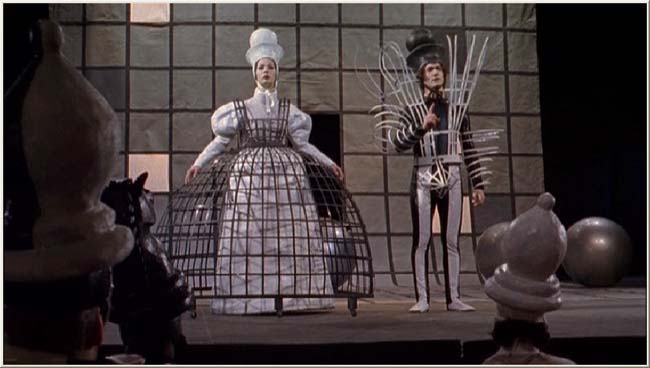
One of my favorite aspects of S&A is the Darren Nichols character and his embodiment of the awful, extreme postmodernist approach to theater - at one point Geoffrey (who hates Darren) says that Darren "hates the theater" - and I suddenly thought of Mac Wellman. Darren's staging of Romeo and Juliet as a chess game is certainly as anti-narrative, anti-emotional, ultra-postmodernist as any play by Wellman. 

There's no excuse for any theater person to have missed Slings & Arrows - the entire thing is available for free on Youtube.

Monday, March 03, 2014

What good is art?

Now that I'm getting serious about producing JULIA & BUDDY this year a recurring question has popped up in my mind - should I really be doing this?

Or rather, with all the good causes and people in need in this world, should I really be spending my time and money in such self indulgence?

But is it really self-indulgence? To a certain extent it must be - there is a certain amount of ego necessary for self-expression. But other people do get something out of one's art, in the best of cases. I've discussed the way that Shakespeare's sonnets have inspired me to write my own sonnets as a way to deal with emotional trauma. And listening to the Beatles music usually raises my spirits - music in general is the cheapest and least dangerous drug ever invented. Where would humans be without it?

It's music though that has set me off on pondering the usefulness of art and the perniciousness of post-modern art. In my music theory class last night we were discussing the uses of fugue-like patterns up to the 20th century and in particular focused on Waltzer by Schonberg. My teacher pointed out that Schonberg had a "eureka" moment when he developed his 12-tone technique and thought it would redirect the entire course of music. Obviously it didn't - it only made classical music audiences reject 20th century classical music. 

So why did 20th century composers persist in using the spasmodic rhythms and dissonant anti-melodies throughout that entire century?

I would suggest it has everything to do with science and its effects on human social hierarchy.

In 1905 Albert Einstein published his Special Theory of Relativity, which is famous for its mass-energy equivalence equation E=mc2. The only physics formula, it is safe to say, known to popular culture. More importantly, Einstein won the Nobel Prize for physics in 1921.

Schonberg invented his 12-tone technique in 1921.

The early 20th century is notable for the dissemination of technological innovations, including the telephone, radio, automobile and airplanes. Science guys were the great heroes, not artsy guys. And you didn't have to risk your life to be a science guy like the Wright brothers, you could just create a theory of relativity and express it on paper. 

Schonberg's "invention" was an attempt to give art the intellectual cachet of the sciences. 

And of course it wasn't only limited to music. All the arts were infested with the social-status-grabbing theories that celebrated intelligence and innovation over sensation and emotion. This made the post-modernist artists famous and celebrated, while it destroyed the entire point of the arts. It made art into pure self-indulgence and pissing contests - who was the most avant-garde of all?

As I've blogged before, presenting art that creates an emotional response has no cachet to the post-modernists - unlike intelligence which can be tested to see who is the smartest, you can't do that with emotions. So reaching audiences emotionally can't demonstrate your personal superiority the way presenting new ideas - or even better, incoherent ideas - can. If you are incoherent enough many people will assume that your work is just too smart for them, like quadratic equations.

I think this review of the work of the dread Mac Wellman gives a good representation of the fear of being thought a dullard if one admits to not liking the work of the post-modernists:
To not "get" a play like this opens one up to feeling as if one's a Philistine, someone who lacks the intellect to wrestle with highly stylized "art." But it's also possible there really is nothing to get in Wellman's play. And that's fine. Plays that stubbornly refuse to give answers and are instead devoted to making the audience ask questions are absolutely worthwhile.
For decades critics of modern classical music have been derided as philistines for failing to grasp the subtleties of the chaotic sounding compositions, but there may now be an explanation for why many audiences find them so difficult to listen to.
It's the dread P word again - Philistine.

To admit to disliking postmodernist art is as good as saying you don't like art at all, according to this mindset.

I disagree. I think that art has two main values - empathy and beauty. Empathy is all about emotions of course. We feel what others are feeling, because we have gone through it ourselves. If you haven't gone through it yourself, it's sympathy, not empathy. Unless you've "gone through it" by watching it happen on stage. After you've seen a good production of KING LEAR you know, at least a little bit, the horror and regret of realizing someone loved you and you didn't appreciate it - and instead preferred people who did not love you and who betrayed you. And then the horror of losing your child. We can't experience everything everybody goes through, and probably couldn't stand it - but you get a sense of what it's like when a skilled playwrights makes you feel some of it.

And then there's beauty. This is partly emotion and partly something ineffable - but which most people need, I believe to "feed their soul" as my therapist says. A hallmark of post-modern art is ugliness. It's almost like a way to haze others - if you can stand to sit through THE PILLOW MAN or look at art made from roadkill or listen to any 20th century classical music, it demonstrates your true cultural worthiness. It's shows you are macho enough to be considered a true connoisseur.

I often think that one reason that ugly art is tolerated is because wealthy people have lives of luxury and ease and can afford to be surrounded by beauty. A little ugliness in a gallery or a museum provides a little frisson in their otherwise routinely pleasant existences.

I've never been that wealthy. So I do still enjoy beautiful art. I think that William Ball said it best in his book on directing, about belief in "the general beauty." He's talking about stage directors here but it extends to all participants in all arts.

The general beauty of a work is the way in which we talk about its worthiness to be seen. The general beauty contains the theme. The general beauty is the reason we feel passionately that an audience should see it. The general beauty is what excites the director and what makes him feel that other people should be excited. A director has to be a missionary. He must feel strongly about the theme of a play - to the extent that he feels it is important for other people to share or to witness that theme...

...the director must believe. We are makers of belief... he has to believe that he could stand on the corner and sell it, that he could market it, that he could convince people of the beauty, that he could stop passersby and say, "Did you ever wonder about the possibility of this? Isn't this beautiful? Doesn't this strike you as something important and marvelous and amazing and peculiar and wonderful?...

...When a director chooses the general beauty he is making a choice on behalf of the audience. The director agrees to represent the public. The identity of the director goes like this: "I am an audience, I am everyman, I am all, I am judge, I am servant, I am listener, I am moderator, I am synthesizer, I am seeker, I am helper, I am child, I am believer, I am maker of belief." 

Monday, January 13, 2014

Is it possible to praise Mac Wellman too highly?

And the answer of course is no. It is absolutely against the code of contemporary theater to say anything bad about Wellman. Here is another ecstatic paen of worship for Mac Wellman.

Meanwhile it seems that The Flea Theater, of which Wellman was a founder (which explains why he was given the job of teaching the worst theater class ever) is doing well these days, thanks in part, by exploiting actors.

The Flea board of directors is full of millionaires. But you can hardly blame them for exploiting young people - it's so easy to do and almost nobody will criticize them for it.

Instead we are expected to bow down and worship them for their generosity in funding the arts.

Monday, May 27, 2013

Mac Wellman wanna-be

The most recent NYCPlaywrghts Play of the Month is the wackiest play we've done yet. I don't know if the author meant to emulate the work of Mac Wellman but if you put this play up under Wellman's name I'd wager that nobody would ever suspect it wasn't him. It has all the hallmarks of Wellman's work: referencing socio-political issues without ever saying anything coherent or incisive about society or politics; lots of repetition - the "hearts beating" phrase comes up a lot in this play; little or no emotional connection between characters, and excessive verbiage.

I originally was going to say that this play indicates that the author has the same problem that so many other writers of 10-minute plays have - he couldn't be bothered to go back and re-work the draft. This is probably the first draft of the play - maybe with a few tweaks here and there. One of my edits in the video recording helped tighten things up - and all I did was leave out the first two sentences.

Why was the edit so helpful? Because the "Dirty Beauty" character starts off talking about how she saw "one of them little buggers." And yet Joseph's first line is: "looks like a bad case of moles to me." Well if she already saw one of them, what's the point of saying that line? Other than it's always better to leave nothing unsaid, and the order in which things are said doesn't really matter.

Cause and effect mean nothing in the universe of postmodernism, which is why it leads to such extremely unsatisfying drama.

An excerpt from the first page of the script:
Thanks. Life's full of surprises. Isn't it. The front lawn's a big surprise. Oh Geez. The neighbors are going to talk about this one, aren't they? I'm sure. My front lawn looks like it has a bad case of acne. It just makes me so sick. It looks like somebody's face. Full of pus. Pus filled chicken poxes. I'm trapped. I don't know what to do, it's like I feel like I'm paralyzed.
Now I happen to like the "bad case of acne metaphor." And the goofy "chicken poxes." And I think it would be better if the passage pretty much stuck to that metaphor instead of throwing in the neighbors and feeling "like I'm paralyzed."

I was originally going to say that the author has a "problem" with not going back and tightening the script, but is it really a problem? Mac Wellman has made a very nice career out of flabby and incoherent and non-dramatic work. Why couldn't this guy?

Although I did discover one reason why Wellman has been able to devote his life to work that most people outside of Academe are not interested in - the New York Public Library inventory of Mac Wellman papers 1959-1999 includes a biographic note that says: The Wellman family already included several inventors, and Mac grew into an inventor and innovator of language.

I'm guessing that, like so many people in theater, Wellman can do whatever he wants because he has a trust fund. And what he wants to do is not actually theater, although he is allowed to call it that:

Here's the second scene from his play CLEVELAND.
Scene 2
(The kitchen. MOTHER is trying to unclog the sink with a  plunger. The sink makes strange noises. JOAN is trying to do her homework at the kitchen table. More nice music.)
JOAN. Mother, how can I concentrate on my homework with you making that noise?
MOTHER. I'm sorry dear. It doesn't drain. Mr. Barfly the plumber was supposed to come fix it, but he never did.
JOAN. But I'm trying to do my homework.
MOTHER. Joanie, there's nothing I can do.
(Pause.)
JOAN. Mother, what's the largest moon in the solar system?
NARRATOR. Why, Triton, dear. A moon of Neptune. Not a very hospitable place. My this sink is hopeless. Miranda's much prettier.
JOAN. Thanks. Mr. Delaplane's science class is really hard.
(Loud crash outside.)
What's that noise?
MOTHER. (Going to look:) Just some commotion in the street.
JOAN. Who is Pope Joan? Bet you don't know.
MOTHER. Haven't the faintest, dear.
(Phone rings.)
JOAN. Oh, God, what if it's Panda Hands asking me to the prom.
(Rings.)
MOTHER. I thought we weren't fashionable enough to be invited.
(Rings.)
JOAN. Well, I still want to go. It depends. You get it.
MOTHER. Silly girl.
(She gets the phone:)
Hello? No, he's dead. That's right. Dead. No, we don't need any. Thank you. Good bye.
(Hangs up. Pause.)
Well, it wasn't Panda Hands.
(Knock at the door.)
Who could that be?
JOAN. If it's Panda Hands I'm not here.
MOTHER. (At door:) Yes? Can I help you?
(A MAN enters.)
MAN. Lady. Your front porch. It ah. Fell into the street. Somebody's underneath. In a car. One of those imports. Squashed flat.
MOTHER. Oh, how terrible. Well, come in.
MAN. Thanks. All you can see is the hubcap.
MOTHER. The phone's right there.
JOAN. Mother?
MOTHER. It's all right, Joanie. The front porch fell into the street and it seems there's a car underneath.
MAN. What's the police number?
MOTHER. Haven't the faintest.
(He reads it off the phone and dials.)
JOAN. Mother, what if Jimmy asks me and not Panda Hands?
MOTHER. Then I expect you should go. Even if we're not fashionable.
MAN. No one answers at the police. Strange. (Hangs up.)
MOTHER. That is strange.
JOAN. Very strange. Hey, can I go look?
MOTHER. If you're careful.
(JOAN skips out.)
MAN. I'll call the wrecking company. You got a Yellow Pages?
MOTHER. Sure, right here.
(Shows him. She goes to the sink and plunger.)
You know, I think I want to go back to school. Learn a skill. I'm tired of being a drudge. And since my husband died. It's rough being alone.
MAN. You're young to be a widow.
MOTHER. He was a Trotskyist.
MAN. (On phone:) Acme Wrecking? Yeah, part of a house's fallen across River Road near Willougby. Traffic's already backed up pretty far. And I think there's someone trapped underneath. Yeah, in a car.
(Hangs up.)
MOTHER. He was a Trostkyist.
MAN. So am I. Thanks, lady.
(He goes out. She goes back to the sink. JOAN enters.)
JOAN. Oh, you should see it. Everything's all smashed. It's real neat. Say, do you suppose someone's dead under all that pile of rubble?
MOTHER. Could be, darling. Could be. Wash up, it's dinner time.
JOAN. If Jimmy calls I'm here. If Johnny calls I'm not. If Panda Hands calls I'm dead.
MOTHER. Yes, dear.
(Pause.)
MOTHER. You know, Joanie. I think I want to go back to school.
JOAN. You'd be a great student. And I'll do the grocery shopping. We'll trade.
(They giggle.)
MOTHER. So. What's the biggest moon in the solar system?
JOAN. Miranda.
MOTHER. Miranda's the prettiest. Triton's the biggest.
JOAN. Darn. Well you tell me who is Pope Joan.
MOTHER. Never heard of her.
(They giggle.)
JOAN. I want to be like Pope Joan. Only I want to be a Trotskyist.
MOTHER. This sink is disgusting.
(The MAN enters again.)
MAN. Lady, can I use the phone again.
MOTHER. Sure.
(He dials. Pause.)
JOAN. If he's on the phone all the time how's Jimmy going to call me?
MOTHER. Ever think it might be Panda Hands?
(They giggle.)
(Blackout.)
Absolutely typical Wellman. It's like a dream - bizarre things happen like a front porch suddenly flies off and lands on top of a person in a car. Except that unlike most people's dreams, there is no emotional resonance from an act of violence. The characters can barely summon up enough interest in an injured or dying person to stop talking about Panda Hands for two minutes. So it's a dream dreamt by a sociopath.

You know how you love to hear some random stranger tell you about his dream, in which implausible violent things happened and nobody cared and they just kept making inane small talk?

Exactly.

Now you may say: "but Nancy, you moron, of course Wellman did this on purpose. He's making A Statement About the Way Things Are in These United States Today. Don't be such a sucker for "Sentimental Melodrama*!"

But the problem is that just presenting humans - in virtually every play he writes - as if a bunch of unfeeling robots isn't enough - there has to be something more. And there never is. What a great job Wellman has though - just throw random sociopathic bullshit on the stage and people - smart people from the university - will invent meaning for it.

And of course being a "Trotskyist" means absolutely nothing in socio-political terms in CLEVELAND. Wellman just name-drops Trotsky, probably because the people who come to see his work will congratulate themselves that they have a vague idea of who Trotsky was - he was the guy who had an ice pick buried in his head by a Bolshevik. They saw that in a short play by David Ives.

And when Wellman attempts actual political satire, well this is what happens:
...A satire about the hypocrisy inherent in right wing American politics, "7 Blowjobs" was written in the early 1990s as a response to senator Jesse Helms’s attack against the National Endowment for the Arts, when he accused the NEA of funding artists whose work he deemed obscene. With so many homophobic and anti-sex politicians scandalized in recent months, it’s no surprise that Theatre on Fire’s artistic director Darren Evans decided to revive the show. What’s surprising is that he imagined Boston audiences would find Wellman’s facile portrait of social conservatives entertaining. 
There are no actual blowjobs in this play, but when a package containing a series of ambiguous x-rated photographs is delivered to Red State senator Bob’s office, his staff of conservative aides is thrown into a sex panic. Their collective sex jitters as they spend most of the play trying to decode the political and sexual meaning of the salacious photos might have been funnier, if the verbal jabs of Wellman’s insipid stereotypes were able to rise above the level of playground polemics. Unfortunately, his dialogue merely sounds like a string of childish partisan text comments posted on You Tube. 
The premise that there’s a pack of horny Chihuahuas humping underneath the rhetoric of anti-sex campaigns is tempting if hackneyed, but the jokes are so bad you’ll end up feeling cheated and embarrassed for the cast, as I did. In the words of two insightful Edge readers I had the pleasure of sitting next to during the show: "This show is an utter waste of time... we were not amused."
Clearly the critic and the reader quoted above don't understand the Wellman play drill - you are not to expect the author to provide insight into the political scenario - just the fact that he used the word "blowjobs" in his title is supposed to be enough to impress you by what a daring maverick Wellman is. You are supposed to provide the political meaning yourself.

I'll let theater impresario Martin Denton demonstrate how it's done:
This is, in effect, all that happens in 7 Blowjobs. Senator Bob seeks advice from a television evangelist named Reverend Tom, whose reaction is pretty similar to Bruce's but whose broader experience in such matters enables him to provide the senator with some valuable strategic/tactical assistance—namely, to pin this and other conspiracies against decency on "fags." Bob, Jr., who one suspects may indeed be a bona fide member of that last-named group, is also interrogated, but to no avail.
The point of all of this non-sequitur lunacy is obvious: playwright Mac Wellman wrote 7 Blowjobs in 1991 in response to the flap on government funding supposedly obscene art by the likes of Robert Mapplethorpe, and he dedicated it to Senator Jesse Helms. Hypocrisy in government not having gone away in the past decade, the play resonates resoundingly; the spectacle of seeing self-appointed guardians of the moral order salivate and drool over dirty pictures feels great and registers as hilarious, scoring points off its lascivious targets all the while.
The play's brilliance is mostly attributable to Wellman's astonishing language, which simply soars with glee as it dances around actually naming whatever it is that might be depicted in those seven pictures. Wellman delights in imprecision here: Reverend Tom declares them "photos of unnatural acts, capable of rendering a full-grown man happy," and that's really as much as we actually know about their content: how much apt commentary on the current state of morality and censorship in America is packed into that?
It should be mentioned that Denton's ecstatic response to Wellman is far more typical of critics than the negative response of the Boston critic I quoted.

So why, exactly, did NYCPlaywrights choose to do a video recording of a reading of a Wellman-esque play? Well first off, you should have seen the competition. And I would have picked the play that had the blow-up doll in it over this one, but I took a vote on the semi-finalists among the people who participated in the script-reading and majority ruled.

But most of all, because it is only ten minutes long. Postmodern plays are bearable in small doses, especially if there are some humorous bits. But as far as I know, Mac Wellman doesn't write ten-minute plays: all his plays are long enough to be considered an entire evening of theater. An entire, mind-bogglingly pointless, undramatic, postmodern evening of theater.

----------

*Mac Wellman in a 2012 edition of the Dramatist Guild's magazine. He's talking to Annie Baker:

Theatre criticism is a remarkable one note only interested in what I call Sentimental Melodrama. They miss any intellectual sharpness, visual or physical acuity. They are only interested in what I call Face Value theatre. What you see is what you get, no time for reflection (incidentally they miss the sharp edges of your work.)