Saturday, December 27, 2014

Peak Car

Like all Americans my age, my life has been greatly influenced by private car ownership - mine even a tad more than usual since I was once a driving instructor.

I've been re-watching Ric Burns' series New York: A Documentary Film, and one of the big themes is the (temporary) decline of New York City thanks to the rise of car ownership, and Robert Moses' attempts to criss-cross highways all over Manhattan. One of my favorite segments of the series is the story of the forces of Robert Moses versus Jane Jacobs and the anti-highway forces headquartered in Greenwich Village.

The car has been such a huge force in my life, it hardly seems possible, and yet empirical evidence seems to indicate that we've passed "peak car." The Atlantic ran an article last year called The Decline of US Driving in 6 Charts.

Here is one of the charts:
The Average Driver Travels 1,200 Fewer Miles Each YearAmericans are also spending far less time in the cars they do own. The average U.S. driver traveled 12,492 miles in 2011, down about 1,200 miles, or 9 percent, from our mid-aughts peak.  

Even with population growth, the country as a whole is barely driving more than during the recession.


So why did this happen? Few articles that I've Googled offer any reasons, but I remember about 12 years ago I was arguing with an ex-boyfriend that the age of the suburbs was over - I maintained that people would start moving back to the city again. And a big reason, I thought, and think, is female economic independence - that factor that is reshaping the world, but which, I believe, gets almost no attention from pundits and sociologists because female economic independence is considered a woman's issue and therefore not of much interest to important people (i.e. men).

Suburban homes are conceived as little kingdoms with each man the king of his domain and the women and children subjects. Female economic independence is a huge contributor to the end of this kingdom concept. Also as suburban houses become larger, they require more and more money and effort to maintain - something only the rich, in McMansions, can afford. Working women no longer have the time to devote to better huge homes and gardens in the suburbs. Also working women have fewer children, so you no longer need a big house and a big yard.

And then there is the cultural wasteland of the typical suburb. When my family moved to Bensalem, PA, a suburb of Philadelphia, there was not even a public library nearby. The first library I ever stepped inside was in northeast Philadelphia, taken by my best friend Laura's mother, the only adult I knew who read for pleasure. My parents were/are both basically hostile to intellectual pursuits - flat out Philistines. The culture-free suburbs are/were their idea of paradise. My mother in particular was very upset when we moved to Pennsauken, a New Jersey town (for economic reasons). But I was thrilled that we moved to a house within walking distance of a library.

My hunch about the decline of suburbs is supported by this article in the Economist:
...the OECD, a rich-country think-tank, expects that by 2050, 86% of the rich world’s population will live in urban areas, up from 77% in 2010.
Another factor in the decline of driving must surely be the rise of the Internet - people can now work from home easily, and although it does threaten the power of middle-managers and so used less than it might otherwise be, there's too much temptation to use it when, for whatever reason, one can't make the commute - and even middle managers take advantage of that option.

When I was growing up, cities were doing so badly that my assumption as a kid was that cities were the places that poor people lived. Rich people lived in the country. But as soon as I was a teenager, my friends and I were always heading off to the nearest big city, Philadelphia, to see free open-air concerts and to go to the art museums and the midnight movies.

The Burns documentary lays the blame squarely on the federal Title One "slum clearing" legislation and the Title Two low-cost, single-family mortgage aid legislation, and the federal highway system. The documentary focuses on New York City, but it's always been said that Camden New Jersey was a vibrant city until the highway system made it possible for Philadelphians to motor right past it and into the farm land of New Jersey where they set up suburban communities - my sister lives in one of these and I was just there for Christmas. A mile from her home there was a highway that contained, one after another of chain stores and fast food places. An absolute suburban wasteland - I don't know why she wants to live there, but then she has about as much use for the arts or culture as my parents, so it makes sense. Of course we had to drive to get there.

Friday, December 26, 2014

I will not buy CFLs if I can help it because they are hazardous

The noble, non-toxic incandescent bulb
I never paid much attention to the new compact fluorescent lightbulbs (CFLs) which are being used more and more in place of the incandescents until I broke a CFL. Then I discovered that CFLs are classified as hazardous waste. So when you break an incandescent bulb, your biggest hazard is glass shards. So you sweep up the shards, throw them in the trash and go on with your life. Not so with CFLs - these are the steps that the EPA itself recommends if you break one:

Before Cleanup

  • Have people and pets leave the room.
  • Air out the room for 5-10 minutes by opening a window or door to the outdoor environment. 
  • Shut off the central forced air heating/air-conditioning system, if you have one.
  • Collect materials needed to clean up broken bulb:
    • stiff paper or cardboard;
    • sticky tape;
    • damp paper towels or disposable wet wipes (for hard surfaces); and
    • a glass jar with a metal lid or a sealable plastic bag.


During Cleanup

  • DO NOT VACUUM.  Vacuuming is not recommended unless broken glass remains after all other cleanup steps have been taken.  Vacuuming could spread mercury-containing powder or mercury vapor.
  • Be thorough in collecting broken glass and visible powder.  Scoop up glass fragments and powder using stiff paper or cardboard.  Use sticky tape, such as duct tape, to pick up any remaining small glass fragments and powder. Place the used tape in the glass jar or plastic bag.  See the detailed cleanup instructions for more information, and for differences in cleaning up hard surfaces versus carpeting or rugs.
  • Place cleanup materials in a sealable container.


After Cleanup

  • Promptly place all bulb debris and cleanup materials, including vacuum cleaner bags, outdoors in a trash container or protected area until materials can be disposed of.  Avoid leaving any bulb fragments or cleanup materials indoors. 
  • Next, check with your local government about disposal requirements in your area, because some localities require fluorescent bulbs (broken or unbroken) be taken to a local recycling center. If there is no such requirement in your area, you can dispose of the materials with your household trash.
  • If practical, continue to air out the room where the bulb was broken and leave the heating/air conditioning system shut off for several hours.
If you have further questions, please call your local poison control center at 1-800-222-1222.
And please note, there is no public service announcement system that I am aware of that lets people even know that the disposal of a CFL bulb is very different from the disposal of an incandescent bulb. Who knows how many people have breathed in and/or disbursed mercury vapors because they had no idea.

And then there's disposal of a burnt-out CFL bulb - again, you are not supposed to just throw it in a trash can, you are supposed to take them somewhere, because they are toxic.
New research from scientists in California and South Korea, published yesterday in Environmental Science and Technology, shows that while compact fluorescent bulbs (CFLs) and LEDs have better energy efficiency than incandescent bulbs, they compare unfavorably when you look at their potential toxicity (at the end-of-life phase) and resource depletion...

I find it appalling that not only are CFLs much more toxic that incandescent bulbs, but that this information is so poorly communicated at a time when incandescent bulbs are being phased out.
Governments around the world have passed measures to phase out incandescent light bulbs for general lighting in favor of more energy-efficient lighting alternatives. Phase-out regulations effectively ban the manufacture, importation or sale of incandescent light bulbs for general lighting. The regulations would allow sale of future versions of incandescent bulbs if they are sufficiently energy efficient.

Thursday, December 25, 2014

Keep Your Skirts Down Mary Ann

Monroe was definitely not a natural blonde. I've never seen such an explicit
image as this one from the subway photo shoot - it's from this German web site.
Another piece of music that I plan to use in my play about Marilyn Monroe is Keep Your Skirts Down Mary Ann, which, although published in 1925, appears to be in the public domain, at least according to archive.org. The song is much less famous than "All By Myself" by Irvin Berlin, and was not recorded by Fitzgerald - it's a slightly risque novelty song, not a classic by an American master - but I think it's pretty appropriate considering that the famous photo shoot of Marilyn's skirt being blown up over the subway grate was considered by many to be a critical component of the demise of Monroe's marriage to Joe DiMaggio - allegedly DiMaggio was very upset by the whole thing - although it appears that it was Monroe who actually filed for the divorce.

I have been unable to find a transcript of the lyrics so I guess I'll have to do it myself. The song is set up as two women with Irish brogues, Mrs. Clancy and Mrs. McCann talk about the daughter of one of them, Mary Ann (so I guess her name is Mary Ann McCann har har) who then shows up herself to argue over her sartorial preferences with her mother:

Mrs. McCann
How do you do, Mrs. Clancy?
 
Mrs. Clancy
I'm well thank you, Mrs. McCann and how is yourself?
 
Mrs. McCann
Sure I'm all in after the week's wash. Me daughter Mary Ann alone gives me enough to break the back of me.
 
Mrs. Clancy
Well after the looks of her today, your wash will be much lighter next week. I'm just half seeing her coming down the street and all I can say is I'm just glad all my girls are boys. Here she comes now.
 
Mrs. McCann
Well well will you look at her. (Unintelligible. "Hand gunner"?)
 
(sings) 
Mary Ann Mary Ann 
Mary Ann
Yeah?
 
Mrs. McCann
I'm ashamed your name's McCann
 
Mary Ann
What's the matter, Mamma dear?
 
Mrs. McCann
Mary Ann come over here. Faith is that the dress your bought?
 
Mary Ann
Don't you know they wear 'em short?
 
Mrs. McCann
You'll get pinched if you get caught.
 
Mary Ann
Well whaddya want from me?
 
Mrs. McCann
Keep your skirts down
 
Mary Ann
Aw
 
Mrs. McCann
Keep your skirts down
 
Mary Ann
Gee
 
Mrs. McCann
Keep your skirts down, Mary Ann
 
Mary Ann
Aw, applesauce
Gee I have a lovely dimple on my knee.
 
Mrs. McCann
Don't I know it.
Faith it wasn't put there for the world to see.
Keep your skirts down. 
 
Mary Ann
Whaddya mean, down?
 
Mrs. McCann
You know what I mean. When you sit down, if you can.
You'd make any man in town a nervous wreck
 
Mary Ann
Why?
 
Mrs. McCann
Remember you can wear your beads around your neck.
 
Mary Ann
Aw Pete's sake
 
Mrs. McCann
Keep your skirts down
 
Mary Ann
They're goin' up
 
Mrs. McCann
Well keep 'em down Mary Ann.
Mary Ann, Mary Ann, sure you'll never get a man.
 
Mary Ann
Oh I'll grab one never fear
 
Mrs. McCann
Mary Ann just listen here
Men like the old fashioned kind
 
Mary Ann
Mamma dear, you're way behind.
 
Mrs. McCann
Sure you'll make em lose their mind.
 
Mary Ann
Well what am I gonna do?
 
Mrs. McCann
Keep your skirts down
Mary Ann
Aw
 
Mrs. McCann
Keep them way down
 
Mary Ann
Gee whiz
 
Mrs. McCann
Keep your skirts down, Mary Ann
 
Mary Ann
You make me tired
I might catch a fellow with my stockings rolled
 
Mrs. McCann
All that you will ever catch will be a cold
Keep your skirts down
 
Mary Ann
Aw whaddya mean down?
 
Mrs. McCann
Keep 'em down, when you sit down, if you can
 
Mary Ann
Nowadays you must dress like this to win a lad
 
Mrs. McCann
Hmm, faith I didn't do it and I won your dad.
 
Mary Ann
Well he was no bargain.
 
Mrs. McCann
Don't get fresh.
Keep your skirts down.
 
Mary Ann
They're goin' up!
 
Mrs. McCann
Well keep em down, Mary Ann
I never really thought about it before, but I was surprised that the phrase "gee whiz" has been around since at least 1925. The song is pretty silly but the graphic that accompanied the sheet music is quite beautiful. It seems that graphic design for sheet music was at a generally high level if this page is to be believed.


Wednesday, December 24, 2014

All By Myself

One of the themes of my play about Marilyn Monroe is solitude. And one of the high points of her life, in my opinion, was her support of the career of Ella Fitzgerald. Put those two things together and throw in the fact that the song "All by Myself" by Irving Berlin was both covered by Fitzgerald and is in the public domain, and I have myself a signature song for this play, which I will have Monroe sing.

My version will be done with a single piano though and not be swinging like Fitzgerald's version.

It has been claimed that Fitzgerald was unable to work at the nightclub The Mocambo due to the color bar, but according to the Wiki on Fitzgerald:

It has been widely reported that Fitzgerald was the first Black performer to play the Mocambo, following Monroe's intervention, but this is not true. African-American singers Herb Jefferies, Eartha Kitt, and Joyce Bryan all played the Mocambo in 1952 and 1953, according to stories published at the time in Jet magazine and Billboard"
The play MARILYN AND ELLA which I discovered via this Wiki article promotes the notion that Monroe helped integrate the nightclub. What Monroe's intervention - she promised the nightclub owner to show up for Fitzgerald's performances - did for sure was help the career of Ella Fitzgerald.


Tuesday, December 23, 2014

More gripes about the Rom-Com project: we must honor the patriarchy

I reviewed another batch of submissions for the NYCPlaywrights Rom-Com project and at this point only 28 plays have made the cut - I had to reject 48 for not being romantic comedies. So almost two-thirds of the submissions are being rejected.

One way I can tell it isn't going to be a romantic comedy is when the playwright attaches the play to an email that says something like "this isn't your usual romantic comedy." That always means it isn't really a romantic comedy but the playwright figured if they call it a romantic comedy they'll fool the reader into believing it is one.

And about a quarter of all the plays have annoyingly specific ages listed for the characters - which happens plenty but much more often if it's a play with a sexual theme - and the man always has to be older than the woman. Not significantly older, more like two or three years older. For instance one play specified the man was 53 and the woman was 50. Now maybe on a cellular level there is a noticeable difference between someone who is 50 and 53, but in terms of anything else there is virtually no difference. Certainly not in casting. Which means the only reason the playwright specified those ages is so it is clear that the man is older. Because in the idiotic, regressive, antiquated mind of the playwright, it can't be a real romance unless the man is older. Even if only by a few years. The rules of the patriarchy must be honored!

God forbid that somebody think that the man was 50 and the woman was 53!

Of course in the world of online dating it does make a huge difference to men, but there the 53 year old men consider themselves slumming if they contact a 43 years old women. Hell, most of them think they're too good for a 33 year old woman. So making the woman a mere 3 years younger is completely pointless.

I was going to say that the big problem as that most of these playwrights don't know what "romance" means - they don't distinguish between love and lust for instance. But actually, they don't know what "comedy" means either. At least not in the Shakespearean sense, in which, even if there aren't a lot of jokes at least there's a happy ending. Half these plays don't even have a happy ending, much less actual comedy. So most of the plays are failing for both reasons - they are neither romantic nor comedic.

At least we have 28 that make the cut. We're only going to pick 10 at the most. And the deadline is almost a month away.

Monday, December 22, 2014

Downtown Train

Too Big To Fail

I finally got around to watching the movie version of Andrew Ross Sorkin's "Too Big To Fail" about the 2008 financial meltdown. Part of my ongoing reference search for my play DARK MARKET.

The movie pretty much aligns with what I understood about the meltdown, but it had some details that I hadn't known about - and I actually thought they might have been placed into the movie for dramatic effect. I'm a little wary of Sorkin after he done Krugman wrong. But after Googling, discovered they were not:

Hank Paulson pukes from the stress as recounted in Vanity Fair:
And with that Paulson ducked into the private bathroom adjoining his office, closed the big paneled door, and audibly, violently, and repeatedly threw up. He emerged a moment later as if nothing had happened, but in a few minutes he did the same thing all over again. I asked if he wouldn’t rather stop, and resume our conversation another time. “That’s O.K.,” he said. “I’m just going to go through this all. I won’t remember it. You know, I barely remember the details now.”
And Hank Paulson literally knelt before Nancy Pelosi:
“I didn’t know I was going to be the referee for an internal G.O.P. ideological civil war,” Mr. Frank said, according to The A.P.Thursday, in the Roosevelt Room after the session, the Treasury secretary, Henry M. Paulson Jr., literally bent down on one knee as he pleaded with Nancy Pelosi, the House Speaker, not to “blow it up” by withdrawing her party’s support for the package over what Ms. Pelosi derided as a Republican betrayal. 
“I didn’t know you were Catholic,” Ms. Pelosi said, a wry reference to Mr. Paulson’s kneeling, according to someone who observed the exchange. She went on: “It’s not me blowing this up, it’s the Republicans.” 
Mr. Paulson sighed. “I know. I know.” 
It was the very outcome the White House had said it intended to avoid, with partisan presidential politics appearing to trample what had been exceedingly delicate Congressional negotiations.
Senator Christopher J. Dodd, Democrat of Connecticut and chairman of the Senate banking committee, denounced the session as “a rescue plan for John McCain,” and proclaimed it a waste of precious hours that could have been spent negotiating.
 
But a top aide to Mr. Boehner said it was Democrats who had done the political posturing. The aide, Kevin Smith, said Republicans revolted, in part, because they were chafing at what they saw as an attempt by Democrats to jam through an agreement on the bailout early Thursday and deny Mr. McCain an opportunity to participate in the agreement.
I remembered what a dumbass move it was for McCain to show up and try to get into the middle of the tense Senate negotiations in order to try to score points for his failing presidential campaign, but this movie makes him out to be an even bigger asshole than I remembered. That was pretty enjoyable.

And the filmmakers clearly love Warren Buffet - they not only cast Edward Asner, everybody's favorite lefty uncle, to play him, but they portrayed him at one point in an ice cream parlor with his grand-daughters, taking a call begging for his help.

I enjoyed other aspects of the casting too - I'm a big fan of Tony Shaloub, who played John Mack of Morgan Stanley, and Dan Hedeya was unrecognizable as Barney Frank - last time I remember seeing him was as the creepy ex-husband of Carla Tortelli on "Cheers." I also did not recognize William Hurt, who played Paulson. He looks more like Paulson than my memory of what William Hurt looked like. And Paul Giamatti looks much more like Ben Bernanke than I would have expected.

I also enjoyed the part of the movie when Paulson was on the phone with Christine Lagarde, then the French Ministry of Economic Affairs, Finance and Employment, and just as Lagarde did in real life in the documentary "Inside Job" the actor portraying Lagarde pronounced is name "honk." It's the little things.

A good deal of the movie takes place in September 2008, and I checked this blog's archives to see if I was talking about it - and I was:
I worked in the investment bank's Compliance department - the department that was charged with making sure that the bank's securities holdings met regulations all over the world. And as I watched the computer programmers wrestle with ways to track the securities holdings, to see if they were in compliance with the regulations I realized that when it came to exotics - they really could not. Because basically an exotic could be virtually anything the investment bank wanted it to be.
It still blows my mind - I had come to this realization about the massive amount of unregulated trading going on a few months before the shit started to hit the fan in March 2008. I was shocked by the idea that a stock market which I thought was well-regulated was in fact the wild west.

Luckily I was reading Krugman's blog religiously even back then, to get some insight into what was going on. And I did email one of his columns to Jamie Dimon in March 2008. I never got a response though.

I also recently saw "Margin Call" which was pretty good, although not as entertaining as "Too Big." It also has a cast of big deal actors like Kevin Spacey and Demi Moore. And in both of these movies - and probably every other movie on the subject, there comes a time when a character is asked to explain what all this trading stuff is all about, "in English." I thought the bit in Too Big was pretty good:

Sunday, December 21, 2014

Men crossing their legs

The movement to get men to stop hogging so much space in the subway by spreading their legs wide has made it to prime time - the New York Times has an article about it - and apparently the MTA is going to do a campaign about it:
Taking on manspreading for the first time, the authority is set to unveil public service ads that encourage men to share a little less of themselves in the city’s ever-crowded subways cars.
The targets of the campaign, those men who spread their legs wide, into a sort of V-shaped slouch, effectively occupying two, sometimes even three, seats are not hard to find. Whether they will heed the new ads is another question.

I was calling it "mansitting" myself but whatever you call it, it is an obnoxious practice. And predictably, some men justify the practice on the grounds that their junk is so huge and delicate. Which inevitably lead to this tumblr:
Men defending their balls - a superpoem.
The following is a crowdsourced poem, its lines excerpted from the messages of men writing in to defend their balls. Please read it as a continuous composition. The poem will be updated periodically. Thank you for your time.
Related to this justification is the notion that men don't/shouldn't/can't cross their legs. I was reading a bunch of comments on an article that the New Yorker posted to Facebook, about some right-wing French creep - here is the article on the New Yorker's site.

One of the Facebook comments critical of the right-wing creep was: Said the Frenchman who crosses his legs like a girl.

Fortunately there is a tumblr presenting evidence that plenty of manly men (and Truman Capote) are capable of sitting with legs crossed without losing their man card.


Saturday, December 20, 2014

Waaaaay down inside....

A pretty righteous cover...

Friday, December 19, 2014

The rich vein of Ayn Rand-based comedy

It's always good fun to parody the "philosophy" of Ayn Rand, although it is really easy, to be perfectly honest. I did it myself in my play DARK MARKET. In fact, it's the first thing she says in the play:

   GREENSPAN
Miss Rand? Are you here to haunt me like Jacob Marley?


   AYN RAND
How dare you! You know I hate “Christmas Carol”! That tale of an heroic businessman, Ebenezer Scrooge, forced by supernatural beings to give his wealth to that moocher Bob Crachett and his family of worthless parasites. 

Good times. And of course Objectivists really do hate "A Christmas Carol" as I documented a couple of years ago.

So of course I enjoyed this recent New Yorker parody. The conceit is that Ayn Rand is reviewing children's movies. My favorite:
“The Muppets Take Manhattan”
This movie was a disappointment. The Muppets do not take Manhattan at all. They merely visit it. —No stars.

What is this song leading to?

Thursday, December 18, 2014

The Rom-Com - in worse shape than I thought

I can't say I'm disappointed in the submissions received (over 50 so far) to the NYCPlaywrights "Take Back the Rom-Com" project - having done calls for submissions before, I am well acquainted with the high percentage of crappy ten-minute plays usually received for these things. It was exactly what I expected.

But what's really annoying is what a high percentage of the plays received are neither comedic nor romantic. I was so exasperated by one submission received yesterday that I broke my own rule about never contacting submitters except to acknowledge receipt of the play. People are mostly not interested in feedback - they want you to tell them how great their play is, and I responded to this guy by asking what he thought was romantic about the play. His response:
I'm sorry? Is The War of the Roses with Michael Douglas and Kathleen Turner not a romantic comedy? Did you want a funny version of a Danielle Steele novel?
As it happens, "The War of the Roses" is classified as a black comedy by Wikipedia. The fact that this person believes that it is a romantic comedy is proof that people don't understand romantic comedy.

We had a nasty little back-and-forth exchange with his refusing to believe that his 10-minute play which consisted entirely of a couple of domestic partners bickering hatefully with each other wasn't the last word in romance and comedy.

And I just rejected another play which was about a bitter ex-boyfriend showing up in a restaurant to tell his ex-girlfriend the guy she was meeting for dinner was a killer. I haven't heard back from the guy, but this time instead of asking what the author thought made it a romanic comedy I simply stated:

"This does not meet the criterion of “romantic comedy.” Humor of course is a matter of personal taste, but this is in no way “romantic.”

If he has anything to say in response I will post it here.

I swear, it's as if any play that involves people who have had sex automatically qualifies as romantic comedy no matter what else happens in the play.

Some other gems:

A play which involves 8 characters (this is a ten-minute play, remember) that isn't romantic so much as a commentary on romantic tropes. Fail.

A prostitute picks up a guy at a bar, and though it's clear she isn't going to charge him for the sex, it's also clear that the only thing that's going to happen is sex. A one-night stand is not "romantic." Fail.

The guy in a hetero couple falls off a ledge and dies at the end. Fail.

A play based on absolute gender essentialism, in which a woman explains to her husband why women just don't like to have sex. Fail.

This is not to say that I love all the plays that do qualify as romantic comedies. I hate several of them. But I will have a bunch of actors to help me determine the best romantic comedies of those that qualify. My job now is to weed out those that do not qualify. Which so far is more than half of all the submissions.

Wednesday, December 17, 2014

Marilyn research

In addition to the second draft of DARK MARKET I am working on the first draft of my play about Marilyn Monroe, Incident at the Payne Whitney
and towards that end I've been doing a bit of research.

I remembered that Gloria Steinem had written a collection of essays about Marilyn - I recall hearing her talking about the book on the NPR show "Fresh Air" with Terry Gross, when it was first published. It's a very interesting book from a feminist perspective.

 I've already read Miller's play After the Fall with a character based on Marilyn, and then I rented the movie "The Misfits", supposedly the character that Monroe played in that movie was based on her. If so, it's a pretty sad commentary on Miller's attitude toward's Monroe - her character is mostly passive and helpless, and cries a lot. Also just a boring movie with lots of roping and chasing horses, I didn't make it all the way through.

While reading up on "The Misfits" I discovered that Miller wrote a play called "Finishing the Picture" which was about the hassle of making Misfits. It was produced in 2004 to fair to middling reviews, but I wanted to read it anyway. Only to discover that it is apparently impossible to get a copy of the script. It appears to never have been published. I wrote to Miller's literary agent to see if it was possible to buy a copy, but so far I haven't heard back.

Tuesday, December 16, 2014

Happy Birthday

Taking back the Rom-Com - NYCPlaywrights edition

Well I finally did it - I posted the NYCPlaywrights call for romantic comedies.

We'll do a reading some time in March.


Monday, December 15, 2014

Private gains, public losses, universally disgusting

From American Banker:
But in finally getting what they wanted, big banks also thrust themselves back into the limelight in the worst possible way, simultaneously reminding the public of their role in causing the financial crisis and in their continuing influence over the various levers of the U.S government. In one fell swoop, they undid whatever recovery to their battered reputation they'd made in the past four years and once again cast themselves as the prototypical supervillain in a comic book movie. 
Observers said the fight was a public relations nightmare for Citigroup and the big banks. 
"They've taken a lot of reputational hits now, a lot of people saying, 'You're trying to blackmail us and not fund our government until you get your way,'" said Sheila Bair, the former chairman of the Federal Deposit Insurance Corp., in an interview on CNBC before the House vote. 
"It's terrible publicity and I just hate to see that because I think the industry needs to be rebuilding trust with the American people right now. You do stuff like this, it just adds to the cynicism about banks, especially big banks."
Many analysts agreed that repealing the swaps provision, which was Section 716 of Dodd-Frank, is likely to only help banks on the margins, since they are allowed to continue engaging in the activity through affiliates. But by fighting so hard, some saw signs of darker motivations. 
"Wall Street's determined lobbying on Section 716 provides compelling evidence that Wall Street's business model depends on the ability of large financial conglomerates to keep exploiting the cheap funding provided by their 'too big to fail' subsidies," said Arthur Wilmarth, a professor of law at George Washington University. "Shame on Congress if it allows megabanks to continue to pursue the same business strategy that brought us the financial crisis."

Citigroup is holding government funding hostage to ram through its government bailout provision. Join me in opposing the

Sunday, December 14, 2014

Worst Christmas party ever

I just escaped got home from the worst Christmas party ever. It took me 90 minutes to get from the depths of Brooklyn back to Astoria, and while the A/C subway line must be the shittiest of all, like waiting in the subway station for thirty minutes and then getting on a smelly crappy train with loud obnoxious people sitting in front of the subway maps, it was worth every minute of not being at that party.

I've been to bad parties before and normally wouldn't bother to mention it, but this was so amazingly, epically bad, I just have to memorialize it on this here blog.

The best part is, it appears to still be going on based on the Facebook photos.

I showed up there with two bottles of a very palatable pinot noir - which was completely unappreciated by the other party guests. The "party" consisted of a tiny living room with a sofa and a coffee table, and the eight of us party attendees sitting around the coffee table playing a hideously crass, stupid card game that advertises itself as being a party game for horrible people which completely lived up to that motto. And of course really bad non-Christmas rock music.

I was there for an hour and a half and that card game is ALL that happened at this party. I would have liked to chat with people a little, but there was no time for that because they had to play this boring, moronic card game. I've never felt so alienated by seven other people in my entire life. I sat there trying to act like I wasn't appalled and when I couldn't take the torture any longer I left there, wanting to kill myself.

Happy holidays!

Saturday, December 13, 2014

Friday, December 12, 2014

Albert Einstein advises Marie Curie


"At the time, Curie was putting up with a lot of ridiculous criticism. Despite winning a Nobel Prize for her pioneering work on radioactivity, in January 1911, her bid for a seat in the French Academy of Sciences had been rejected, likely in part because she was a woman and atheist, and perhaps also due to rumors that she was Jewish — a problem in an anti-Semitic, Dreyfuss affair-era France."

More at VOX

Thursday, December 11, 2014

Like a bicycle-loving fish needs a bicycle

White Palace variations

I went to see White Palace when it was first released, and at the time I was around the same age as the James Spader character, but now I'm older than the Susan Sarandon character. Tempus fugit. I still mostly like the movie, with some reservations, as I discussed a couple of years ago here.

One of the things I had reservations about was that the Nora character basically rapes the Max character. I recently bought a copy of the original novel the movie was based on, also called White Palace and to my surprise it actually uses the word "rape" to describe the encounter. So I'm glad the author, Glen Savan, had that much awareness.

Savan had a cameo in the movie, as can be seen in the first scene in the movie's trailer ("Yo, buddy, I'd like to get my hamburgers.) Poor old Savan died at the age of 49 of a heart attack.

There are several other difference between the novel and the movie, but I haven't found them all yet because I've been too busy to finish the novel.

One fascinating thing I've discovered is that this scene from the movie is hugely popular for "scene study" exercises.


You really appreciate the actorly abilities of Spader/Sarandon when you see these people do the scene:


And even in Norwegian!

Wednesday, December 10, 2014

What Krugman said: American Evil

I will quote the entire thing:
As the Bush administration fades away in the rearview mirror, my sense is that many people — even liberals — are forgetting what it was really like. It becomes, in memory, just another administration whose policies you disapprove of, like the reign of Bush the elder. 
But it wasn’t. It was an administration that deliberately misled us into war, exploiting an atrocity to pursue an agenda that had nothing to do with that atrocity — and causing vast amounts of death and destruction in the process, not to mention undermining American strength. 
And it was an administration under which America became a torturer, with the enthusiastic approval of top officials.
This wasn’t normal. And if it’s going be normal from now on, all the more reason to remember the Bush years with horror.
I first became aware of Krugman soon after 9-11 - he was one of the very few pundits who weren't bowing down to the hysterical xenophobia of the Bush administration. My respect for his straight-shooting made me a big fan. And he is clearly still an eloquent, yet succinct straight-shooter.

Christ, you know it ain't easy...


Yoko Ono was different, so it seemed. Yoko Ono had something that all the others did not: perseverance that bordered on obsession. It was a mixture of guts and gall that went beyond chutzpah into the range of something spooky. By now everyone in the household was a little wary of her. After meeting John at an art exhibit she had been unshakeable…
...in the beginning she showed up at the Apple business offices and demanded to see him… and she once threatened to chain herself to the gates (of the Abbey Road EMI recording studios) in an attempt to get in to see John. Then came a long-distance assault on Kenwood (Lennon’s home.) It began with a barrage of phone calls, and then, when John’s telephone number was changed three of four times, Yoko sent dozens of letters. The letters first insisted, then demanded, John’s support for her arts projects. Cynthia (Lennon’s first wife) intercepted many of the letters and began to save them when they turned dark and despairing, in case Yoko ever followed through on the threats to kill herself. She had already tried to do herself in once in Japan, and the letters sounded sincere. According to Cynthia, Yoko wrote: “I can’t carry on. You’re my last hope. If you don’t support me, that’s it, I’ll kill myself.” 
Very much alive, Yoko began to appear at Kenwood in person, waiting in the driveway of the house for John to come and go. She stood there from early in the morning until late at night, no matter what the weather, wearing the same scruffy black sweater and beat-up shoes, so intense and scowling that the housekeeper was afraid to go nearer. One day Cynthia’s mother took pity on the forlorn figure and let her into the house to make a phone call and have a glass of water. But Yoko only used the occasion to leave her ring behind, which gave her a pretense to return the next day and demand to be let inside. One morning a package arrived from Yoko which Cynthia and her mother opened; it contained a Kotex box in which Yoko had buried a broken china cup painted blood red. John had a laugh about it, but Cynthia and Lillian Powell didn’t find it one bit funny.  
Eventually, Yoko’s dogged pursuit of John became so blatant that it developed into something of a private joke between the married couple. Yoko’s grande atrocity occurred one night when she turned up at the Transcendental Meditation lecture John and Cynthia were attending in London. When it was over she followed them out of the lecture hall and into the backseat of John’s psychedelically hand-painted Rolls-Royce limousine and sat herself down between them. Cynthia and John exchanged embarrassed smiles over her head until the chauffeur dropped her off at Park Row, where she was living with her husband.
From "The Love You Make: An Insider's Story of the Beatles" by Peter Brown and Steven Gaines.

That's the same Peter Brown who got a shout-out in "The Ballad of John and Yoko" - 
Peter Brown called to say
You can make it OK
You can get married in Gilbraltar near Spain.

Tuesday, December 09, 2014

Colbert and Obama were awesome

I LOL'd several times during this - Obama crushed it.

The Colbert Report
Get More: Daily Show Full Episodes,Indecision Political Humor,The Colbert Report on Facebook


The Vulture talks about it.

Sunday, December 07, 2014

DARK MARKET reading

Finally had a reading of my play DARK MARKET - it went pretty well, and the actors seemed to like. As usual poor Miss Willow, my anti-social cat, hid under my bed the whole time. But as soon as the actors left she was back at her post.

Now comes the hard work of rewriting. Oy.

Saturday, December 06, 2014

Cycle Sluts

I've mentioned Cycle Sluts before, it's the hysterical porno that Barbra Streisand's character Doris was in before she met Felix in the movie version of "The Owl and the Pussycat."

Well apparently they did a whole photo shoot in Cycle Slut costumes for promotion - but these images did not make it into the movie. Wheee!

The movie was of course the original inspiration for my JULIA & BUDDY. But there's no porno movies in my play - but there is a video clip of a space cowboy.


Friday, December 05, 2014

Nathaniel Branden is dead

Just as I'm completing the first full draft of my play DARK MARKET, about Ayn Rand's influence on Alan Greenspan, and indirectly, the 2008 economic meltdown, I find out that Nathaniel Branden died on December 3.

Reason, the magazine for libertarians and therefore, worshippers of Rand, said this:
Then, after Rand broke from him and all "official" Objectivists were required to revile him, Branden was a living example that intelligent admiration for and advocacy of Rand's ideas need not be tied in with thoughtless fealty to Rand as a person, or to the pronouncements of those who controlled her estate, with all the attendant flaws and occasional irrationality: that one need not be an official Randian to spread the best of Objectivism. As late as 2010, Branden published print versions of his NBI lectures helping systematize her ideas under the title The Vision of Ayn Rand. 
Branden was a friend to Reason over the years. An interview he gave to the magazine back in 1971 was vital in breaking the then very-small-circulation publication up into the thousands in circulation.
And of course Branden was Rand's boyfriend for several years and she broke with him and cursed him and destroyed his Nathaniel Branden Institute, which was devoted to promoting her work, when he refused to resume having sex with the apostle of reason. According to his memoir:
"Getting tired of a serious, philosophical life?" she asked sharply. "You're on your own now in every way that counts. Unless you mean you want to be rid of me." 
"Free of you? I want us to be friends forever." 
"Friends is not what I'm talking about! What new irrationality is this? Do you think I would have dedicated Atlas Shrugged to a friend? I've told the whole world that you are Objectivism. Do you think I would say that about a friend? What's the matter with you? Don't you attach meaning to the words you speak? Where has your mind gone?" 
The message was clear - if I were not in love with her, that meant my mind was gone and I was a traitor to our philosophy. This was Ayn's notion of giving me every chance to withdrawal from our "romance."

Thursday, December 04, 2014

A moment of art appreciation

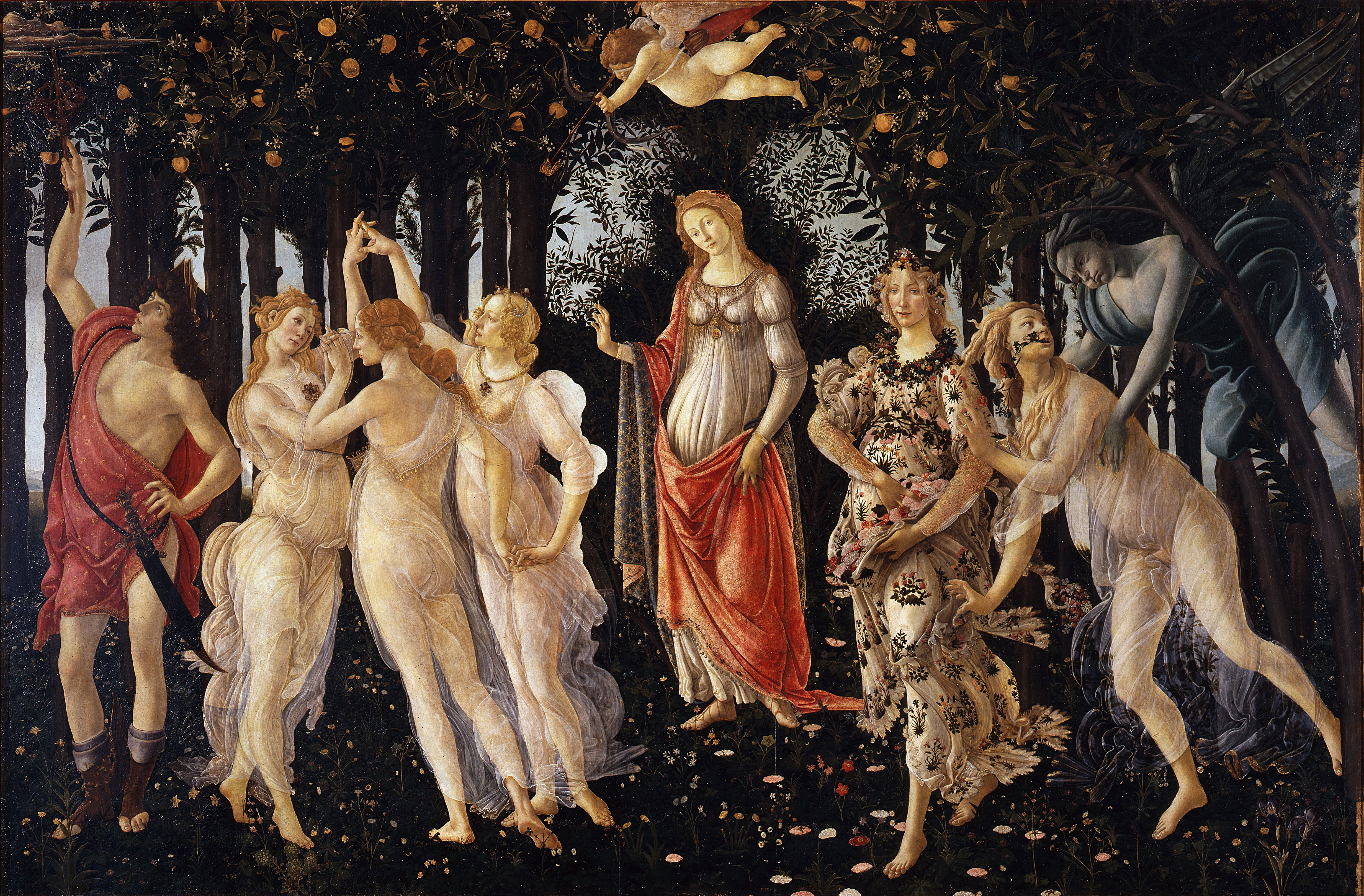
Click to see a much larger version of this painting.
The news lately has been so disgusting, with the killer police and rape colleges, I don't even know what to say about it all.

So it's time for some art appreciation.

Botticelli's La Primavera ("Spring") is one of my favorite paintings for several reasons - for one, it's very theatrical, with the cast arrayed within the setting like a stage, with the diva, Venus, in the center. Also there's the anticipation of action, with Cupid above, about to shoot somebody with a love arrow.

I also like the color composition. I have a copy of this painting in my apartment, although unfortunately the colors on the red end of the spectrum have faded (I guess it was a pretty cheap print) and so the whole thing has turned to blue, and only the drape of Mercury (the stud on the left) and Venus are at all reddish. However, it's not so bad - if this were a painting by Renoir it would be a disaster - his work is mostly about color, but Botticelli was big on line as much as color - so the print can still be appreciated for the grace of the line, which becomes more prominent with the greater color monotony.

Art historians are still not sure exactly what this painting is about, although the most popular is some kind of mythological allegory. As Wikipedia says:

Venus presides over the garden - an orange grove (a Medici symbol).[9] She stands in front of the dark leaves of amyrtle bush. According to Hesiod, Venus had been born of the sea after the semen of Uranus had fallen upon the waters. Coming ashore in a shell she had clothed her nakedness in myrtle, and so the plant became sacred to her.[10]The Graces accompanying her (and targeted by Cupid) bear jewels in the colors of the Medici family, while Mercury'scaduceus keeps the garden safe from threatening clouds.[7][9][8]
The basic identifications of characters is widely embraced,[11][12][13] but other names are sometimes used for the females on the right. According toBotticelli (1901), the woman in the flowered dress is Primavera (a personification of Spring) whose companion is Flora.[14] The male figure is generally accepted as Mercury but has been identified as Mars by Beth Harris and Steven Zucker of SmARThistory.[15]
I've been told I resemble one of the characters in this painting, but I won't say which one. One of the female ones though, fortunately.

Tuesday, December 02, 2014

Myers gives Jerry Coyne a well-deserved thrashing

Jerry Coyne is a proud New Atheist along with misogynists Christopher "women aren't funny" Hitchens, Sam "women have too much estrogen to be skeptical" Harris, and Richard "Dear Muslima" Dawkins, which means that of course his true religion is evolutionary psychology*.

P. Z. Myers, who regrettably has some SJW tendencies like siding with that idiot Suey Park against Colbert, over the Redskins parody, nevertheless is a stalwart critic of the standard inanities of promoters of evo-psycho and responds to Coyne here:
But then Coyne pulls his magic “proof” out of his hat: the existence of sexual dimorphism. Yeah, who has a problem with that? Men and women look different in grand and subtle ways. Some of those differences were almost certainly selected for. Again, I don’t know anyone who denies that, so it’s kind of weird to use it as his triumphant example. Except that he seems to think all those lefty wackos — you know, feminists, apparently — are in the business of denying the obvious.
But the left-wing opposition to evolutionary psychology as a valid discipline in principle, especially when it involves differences in sexual behavior, seems to me based more on ideology than on biology. Ideologues cannot allow any possibility that males and females behave differently because of their evolution. Such people think that this would buttress the view that one sex would be “better” than the other.
I know a lot of modern radical feminists. I’m pretty solidly in the left-wing camp myself. And NO ONEdenies the physical differences between men and women, or claims that evolution could not have played an important role in shaping the diversity of modern humans. Nor do any claim that there aren’t significant behavioral differences — we encounter those every day. What we oppose is the credulous insistence that every single difference is a product of selection, that the influence of culture is noise gently overlaying the purity of the biological signal, and worst of all, the idea that the status quo is justified as a product of biology (which Coyne at least tries to distance himself from at the end).
But please, spare us the simplistic causal explanations for these differences that rely on cartoony, evidence-free speculation, like that men evolved to be bigger than women because they had to punch each other lots in fights for dominance. Perhaps we should recognize that culture creates roles that can generate differential selection pressure on men and women, and that human behavior is far more complex and cooperative than cavemen bashing each other with clubs.


*and Islamaphobia - you pretty much can't be a "New Atheist" unless you consider women to be intellectually inferior to men (not just "different" which they like to pretend is what they're really saying) and consider Islam to be the Great Satan.

Monday, December 01, 2014

Nature is a language - can't you read?


Shyness is nice, and
Shyness can stop you
From doing all the things in life
You'd like to

So, if there's something you'd like to try
If there's something you'd like to try
Ask me, I won't say no, how could I?

Coyness is nice, and
Coyness can stop you
From saying all the things in
Life you'd like to

So, if there's something you'd like to try
If there's something you'd like to try
Ask me, I won't say no, how could I?

Spending warm Summer days indoors
Writing frightening verse
To a buck-toothed girl in Luxembourg

Ask me, ask me, ask me

Because if it's not Love
Then it's the Bomb, the Bomb, the Bomb, the Bomb, the Bomb, the Bomb, the Bomb
That will bring us together

Nature is a language - can't you read?

So ask me, ask me, ask me

Because if it's not Love
Then it's the Bomb, the Bomb, the Bomb, the Bomb, the Bomb, the Bomb, the Bomb
That will bring us together

If it's not Love
Then it's the Bomb
Then it's the Bomb
That will bring us together