I've blogged about Dunning Kruger poster child Conor Friedersdorf before.
And now here they are together.


In the post I mentioned cash compensation; more cash can make people more attractive and better able to afford legalized prostitution. Others have mentioned promoting monogamy and discouraging promiscuity. Surely there are dozens of other possibilities; sex choices are influenced by a great many factors and each such factor offers a possible lever for influencing sex inequality. Rape and slavery are far from the only possible levers!Many people are also under the impression that we redistribute income mainly because recipients would die without such redistribution. In rich nations this can account for only a tiny fraction of redistribution. Others say it is obvious that redistribution is only appropriate for commodities, and sex isn’t a commodity. But we take from the rich even when their wealth is in the form of far-from-commodity unique art works, buildings, etc.Also, it should be obvious that “sex” here refers to a complex package that is desired, which in individual cases may or may not be satisfied by sexbots or prostitutes. But whatever it is the package that people want, we can and should ask how we might get more of it to them.
You have flown so far up your own ass that you have lost all contact with the planet Earth. Everyone has equal access to sex, and most people do have it, provided they are willing to consider a wide enough range of potential partners. If you troubled yourself to learn more about these groups, you’d know that their real complaint is not that they have no access to sex at all, but that they don’t get to have sex with Playboy models and other women they consider sufficiently hot. That cannot be framed as a “right” by anyone.
Furthermore, in the cloud cuckooland you hypothesize, what makes you think that there would be a sufficient number of sex workers to service these guys? Presumably it would be a world where poverty and lack of opportunity would not compel women into the profession? While there are definitely prostitutes who consider their work a vocation or just fulfilling, they are probably not the majority, and nothing guarantees they will be “hot” enough for the incel crowd. Your notion of some vague population of women who would for some reason be willing to have sex with men who feel such obvious contempt and resentment toward women, and who would do so without a significant amount of economic pressure being put on them is insane... well, really just inhuman, which seems to be the defining characteristic of this entire post.

Sims's modern critics have discounted the enormous suffering experienced by fistula victims, have ignored the controversies that surrounded the introduction of anaesthesia into surgical practice in the middle of the 19th century, and have consistently misrepresented the historical record in their attacks on Sims. Although enslaved African American women certainly represented a “vulnerable population” in the 19th century American South, the evidence suggests that Sims's original patients were willing participants in his surgical attempts to cure their affliction—a condition for which no other viable therapy existed at that time.

Trump support was linked to a belief that high-status groups, such as whites, Christians or men, faced more discrimination than low-status groups, like minorities, Muslims or women...
 So Pinker & Lehmann promote the idea that women are intellectually inferior to men, Lehmann's Quillette, enthusiastically supported by Pinker, promotes the idea that blacks are intellectually inferior to everybody else, and McInnes (with help from "new atheists" like Sam Harris) promote the idea that Islam is worse than other religions.

An eyewitness that evening said, "When Lincoln rose to speak, I was greatly disappointed. He was tall, tall, -- oh, how tall! and so angular and awkward that I had, for an instant, a feeling of pity for so ungainly a man." However, once Lincoln warmed up, "his face lighted up as with an inward fire; the whole man was transfigured. I forgot his clothes, his personal appearance, and his individual peculiarities. Presently, forgetting myself, I was on my feet like the rest, yelling like a wild Indian, cheering this wonderful man."
The two threads, titled “WHAT BROUGHT YOU INTO THE MOVEMENT?” and “Path here beginning from Gavin (McInnes),” asked posters to reflect on their own “red pill” narratives and provide tips for converting others. “Here’s the challenge,” a user identified as The Somalisher wrote. “Create a list of succession from the Alt-Light to us. I have friends who like Gavin…But I can’t exactly throw [Andrew] Anglin at them.”
The user continued, “It sometimes requires softer steps to ‘radical’ perspectives.”
...
The number of times each individual or platform was mentioned as an influence was tallied, and those mentioned by three or more posters are listed in the chart below. Disconnected as they might seem, the most cited influences — the “politically incorrect” 4chan board /pol/ and the American Renaissance editor Jared Taylor — hint at two common paths to the alt-right: either through participation in the rampantly racist and misogynistic online trolling culture of 4chan and its offshoots, or through exposure to Taylor’s variety of pseudo-academic “race realism” that couches timeworn racist tropes in the language of science.
Within alt-right spaces like TRS, these two fibers of the movement are woven together — resulting in an ironic, meme-ified version of old-school race science — and embellished with antisemitism.
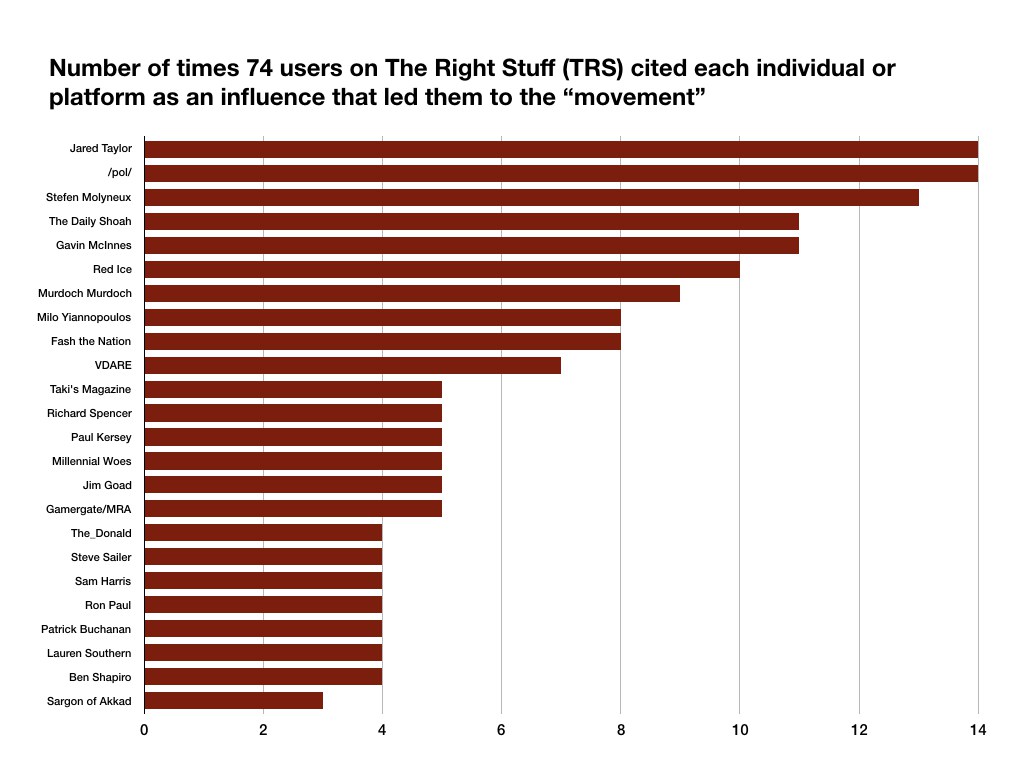


The “skeptics” movement — whose adherents claim to challenge beliefs both scientific and spiritual by questioning the evidence and reasoning that underpin them — has also helped channel people into the alt-right by way of “human biodiversity.” Sam Harris has been one of the movement’s most public faces, and four posters on the TRS thread note his influence.
Under the guise of scientific objectivity, Harris has presented deeply flawed data to perpetuate fear of Muslims and to argue that black people are genetically inferior to whites. In a 2017 podcast, for instance, he argued that opposition to Muslim immigrants in European nations was “perfectly rational” because “you are importing, by definition, some percentage, however small, of radicalized people.” He assured viewers, “This is not an expression of xenophobia; this is the implication of statistics.” More recently, he invited Charles Murray on his podcast. Their conversation centered on an idea that lies far outside of scientific consensus: that racial differences in IQ scores are genetically based. Though mainstream behavioral scientists have demonstrated that intelligence is less significantly affected by genetics than environment (demonstrated by research that shows the IQ gap between black and white Americans is closing, and that the average American IQ has risen dramatically since the mid-twentieth century), Harris still dismissed any criticism of Murray’s work as “politically correct moral panic.”
For posters on TRS, Harris’ work blended easily into that of more overtly racist writers like Paul Kersey, whose popular blog, “Stuff Black People Don’t Like,” is reposted on American Renaissance. The site “really gets the noggin joggin and encourages you to search for answers,” one user wrote. Their “biggest stepping stone” was from Harris’ work to Kersey’s blog: “It was there I learned about race realism, IQ, genetics, bell curves, and the economic/political drivers behind the pushing of ‘diversity.’”

 |
| Puppet Ayn Rand |
About halfway through the play, Musk puts a copy of “Atlas Shrugged” into the Print-a-Friend, and out pops Ayn Rand, wearing the signature dollar-sign pin she favored in real life.I believe she was more likely on the autism spectrum than a sociopath.
Mr. Reyes read Rand’s novel “The Fountainhead” as a teenager, but unsurprisingly is not a fan, though he said he appreciates her theatrical qualities.
“She’s a great character for comedy because she’s a sociopath,” he said. “There are so many very crazy things she said.”

Because it's possible that one of these days his editors will get tired of his habit of turning himself into the story:
Even when they vaguely puzzle out this point, Pinker supporters don’t understand it. What does Jesse Singal say in the New York Times?
(Myers quoting Singal)
The clip was deeply misleading. If you watch the whole eight-minute video from which it was culled, it’s clear that Mr. Pinker’s entire point is that the alt-right’s beliefs are false and illogical — but that the left needs to do a better job fighting against them.
(end quote)
No. He clearly says that the alt-right’s beliefs are the fault of the “PC” Left, which says nothing about making better arguments to oppose them, and is a falsehood. His talk was about doling out the blame to the Left, not about fighting the alt-right. If you listen to the whole 8-minute video, what you hear is Pinker first saying that you can’t voice certain facts on campus, then stating those facts (self-refutation, anyone?), then explaining that his facts are more complex than he let on, which is what the college professors he’s blaming already do. But then this kind of disingenuous denial of reality, of focusing superficially on he said/she said note-taking, is exactly what the New York Times specializes in.

 |
| This cafeteria is where the infamous Cordon Bleu incident occurred. Please note the sign above Macron. |
 |
| Justin Trudeau and wife Sophie |
 |
| So many adorable pix of Trudeau & Obama - this is one of my favorites |
 |
| Very recent Macron pic shared by his official photographer on Instagram |
 |
| Image from We Hunted the Mammoth |
For the reader who does not share the ideology propounded in the book, another curious (and highly irritating) feature is the authors’ ingratiating efforts to co-opt readers into believing their thesis. They appeal to the reader’s vanity with statements asserting that the fact that the reader has waded so far through the book is a sign that the reader has a superior I.Q. Like many of the assertions in the book, one could quite convincingly argue the opposite.

'When all the dust settles, the authors of The Bell Curve are merely saying that the people and groups who dominate our society do so because of their intrinsic ability and merit, that this is the way things were meant to be, and that they and those like them should be benefited even more. When has it ever been an act of courage to assert that those in power have a natural right to that power? True, the authors were subjected to some scorn in the scientific community because of the flaws in their work. But facing those attacks does not imply courage. It takes courage to defend the powerless against the powerful; it merely takes gall to claim courage for defending the privileges of the powerful.

Simply stated, [Murray and Herrnstein’s argument] goes like this: If the variation in a particular individual trait is caused by genes, then the difference in average values of the trait in populations must also be caused by the genes. In the I.Q. debate, this argument takes the following form: variation in I.Q. among individuals in a population is caused (to a large extent, at least) by each individual’s genes. For group A, the average I.Q. score is higher than for group B. Hence members of group A must, on average, have higher I.Q. genes than members of group B.
However plausible this sounds initially, the fallacy of this logic becomes immediately obvious with a little thought and the use of a popular analogy. If we randomly take some corn seed and plant it in uniform, rich, well-tended soil, we will get a distribution of plant heights whose variation is caused by their genes. If we take a sample of seed from the same source and plant in poor soil, we will again get a variation of heights that is caused by the genes. But the second group will have a lower average height than the first, even though the plants come from the same gene pool. This difference in average values is caused by the environment and not the genes, a fact known to every farmer.
So it is possible to have a variation that is purely genetic in some trait within a single group, while the difference in average values of the same trait between different groups is caused purely by environment. For example, the variation in individual heights has a substantial genetic component. But in Japan, which has been a relatively isolated country, average heights have risen considerably since World War II, a fact easily explainable by better nutrition.
It is safe to say that, despite decades of effort by very determined people, we are not much closer to a definitive answer to the question of the roles of race and intelligence in the processes of social and economic stratification of society. All kinds of hypotheses can be invoked to explain the data. And this shouldn’t be too surprising. As I emphasized above, both race and intelligence are poorly defined and operationally ambiguous. When you have two variables that are ill-defined, it is asking too much to expect a simple relationship between them to emerge.
 |
| Deciduous & Coniferous |
 |
| These ubiquitous lamps in Central Park are not only light-bringing and decorative, most of them have a little metal plaque about three feet from the bottom which indicates which cross street you are closest to in Central Park. You can see this one has one -you can click the picture to get a better look. |
 |
| In Arcadia ego |
 |
| Small piece of the Conservatory Garden - I arrived too late and it was closed. Starting in April it stays open an hour longer so I'll be back again soon to get more pix. |
 |
| Sunset |
The German philosopher Arthur Schopenhauer (1788–1860) attributed civilizational primacy to the white races, who gained sensitivity and intelligence via the refinement caused by living in the rigorous Northern climate:
The highest civilization and culture, apart from the ancient Hindus and Egyptians, are found exclusively among the white races; and even with many dark peoples, the ruling caste, or race, is fairer in colour than the rest, and has, therefore, evidently immigrated, for example, the Brahmins, the Inca, and the rulers of the South Sea Islands. All this is due to the fact that necessity is the mother of invention, because those tribes that emigrated early to the north, and there gradually became white, had to develop all their intellectual powers, and invent and perfect all the arts in their struggle with need, want, and misery, which, in their many forms, were brought about by the climate. This they had to do in order to make up for the parsimony of nature, and out of it all came their high civilization.[50]
"Look for your inspiration to the victorious lobster, with its 350 million years of practical wisdom," professor and clinical psychologist Jordan Peterson gushes manfully in his best-selling advice book 12 Rules for Life. "Stand up straight, with your shoulders back."
If that sounds ridiculous, it is only because it is ridiculous. To state only the most obvious problems, lobsters don't have shoulders. They are creeping arthropods with segmented limbs; they do not look like people, and none of their joints can be reasonably described as shoulders. Lobsters also do not stand up straight; they crawl across the sea bottom. Peterson refers to dominant lobsters as having an "upright and confident posture", but lobsters don't have skeletons, much less postures. "Stand up straight like a lobster" isn't even coherent enough to be bad advice, much less good advice. It's simply nonsense gibberish—and that's before you get to the assertion that contemporary lobsters have been around for 350 million years, which is about as accurate as saying that humans have been around for 100 million years because that's when placental mammals first enter the fossil record.
So what does Peterson think he's talking about? Ostensibly, his claim is that lobsters live in hierarchical societies. Low-status lobsters supposedly have different brain chemistry from high-status lobsters, and that different brain chemistry affects their posture. From this, Peterson concludes that human hierarchy is natural, and that if you model your posture on that of a high status lobster, you will change your brain chemistry and be more successful. Shorn of the logical fallacy of scrambling cause and effect (hypothetical shouldered lobsters stand up straight because they are successful, they aren't successful because they stand up straight) the reasoning is the equivalent of arguing that sloth bears eat their children if the children are unhealthy, so human mothers should eat any premature children. The difference of course being that sloth bears are a lot more closely related to us than lobsters. They even have shoulders.
Actually, one of the most important things this interview illustrates—one reason it is worth noting at length—is how Newman repeatedly poses as if she is holding a controversialist accountable, when in fact, for the duration of the interview, it is she that is “stirring things up” and “whipping people into a state of anger.”
At every turn, she is the one who takes her subject’s words and makes them seem more extreme, or more hostile to women, or more shocking in their implications than Peterson’s remarks themselves support. Almost all of the most inflammatory views that were aired in the interview are ascribed by Newman to Peterson, who then disputes that she has accurately characterized his words.
There are moments when Newman seems earnestly confused, and perhaps is. And yet, if it were merely confusion, would she consistently misinterpret him in the more scandalous, less politically correct, more umbrage-stoking direction?
When Cathy Newman, a journalist for the UK’s Channel 4, challenged Peterson’s arguments in a televised interview, she received so many death threats that she had to get help from the police. “There were literally thousands of abusive tweets — it was a semi-organized campaign,” she recalled in an interview. “ It ranged from the usual ‘cunt, bitch, dumb blonde’ to ‘I’m going to find out where you live and execute you.’”


