Either somebody slipped her the final script or Eileen Sutton is really clever.
 Eileen Sutton
I think I know how Mad Men ends... http://bit.ly/1QFqlNb


I don’t know how else to put this: Was Schopenhauer a cat person or a dog person?
A dog person. He owned a series of poodles, calling each “Atma” formally and “Butz” informally. He once told a dinner companion that when his dog was mischievous, he would scold it by saying, “You are not a dog, but a human being, a human being,” and he claimed that this would shame the dog.With all this evidence I was surprised to read this in Wikipedia:
...Schopenhauer settled permanently in Frankfurt in 1833, where he remained for the next twenty-seven years, living alone except for a succession of pet poodles named Atman and Butz. The numerous notes that he made during these years, amongst others on aging, were published posthumously under the title Senilia.
Schopenhauer had a robust constitution, but in 1860 his health began to deteriorate. He died of heart failure on 21 September 1860 while sitting at home on his couch with his cat. He was 72.It doesn't say the name of his cat, unfortunately. Possibly Atma too.
In 1844, writing in the second volume of his magnum opus, The World as Will and Representation, Arthur Schopenhauer made a curious statement:As far as Schopenhauer was concerned, they virtually were all the same poodle.
I know quite well [Schopenhauer wrote] that anyone would regard me as mad if I seriously assured him that the cat, playing just now in the yard, is still the same one that did the same jumps and tricks three hundred years ago; but I also know that it is much more absurd to believe that the cat of today is through and through and fundamentally an entirely different one from the cat of three hundred years ago.
Amazingly enough, Schopenhauer defended that statement throughout his magnum opus. The cat both is and is not the same cat that frolicked similarly three hundred years ago.


Soon, Tubman began her forays back into Dixie, rescuing siblings, nieces, strangers and, on her last trip, her aging parents. In 11 years of leading missions and guiding others in how to lead, she is believed to be responsible for the freedom of hundreds. She frequently outwitted her pursuers, using disguises and evasive tactics, later boasting she never lost a single passenger on the road to freedom. During the Civil War, Union soldiers, who had little knowledge of the country beyond their own small towns, relied on Tubman to guide them when poorly drawn and outdated maps could not. A gifted healer, Tubman also nursed the wounded.And all this while there was a bounty of $40,000 (about a million in today's dollars) on her head.
Across the country, countless workers in the nail salon industry, mainly immigrant women, toil in misery and ill health for meager pay, usually with no overtime, abused by employers who show little or no consideration for their safety and well-being. It is a world of long days and toxic chemicals, where the usual protections of government have failed, at all levels.Luckily Governor Cuomo of New York has taken decisive action: Cuomo Orders Emergency Measures to Protect Workers at Nail Salons
Gov. Andrew M. Cuomo ordered emergency measures on Sunday to combat the wage theft and health hazards faced by the thousands of people who work in New York State’s nail salon industry.
Effective immediately, he said in a statement, a new, multiagency task force will conduct salon-by-salon investigations, institute new rules that salons must follow to protect manicurists from the potentially dangerous chemicals found in nail products, and begin a six-language education campaign to inform them of their rights.
Nail salons that do not comply with orders to pay workers back wages, or are unlicensed, will be shut down. The new rules come in response to a New York Times investigation of nail salons — first published online last week — that detailed thewidespread exploitation of manicurists, many of whom have illnesses that some scientists and health advocates say are caused by the chemicals with which they work.
She and Kay were just the opposite of each other, Kay had been telling Mr. Bergler this afternoon.Not only is there no point in suddenly mentioning what Helena was wearing, but I was completely unable to discern what the outfit signified, if anything. It was published in the early 1960s but it was set in the early 1930s, so who knows what a black velvet dress says about Helena? She's a goth?
"Really?" said Mr. Bergler, "How?" In college I wanted to be a director," Kay replied. "Come here, Helena," she called loudly. "We're talking about you." Unwillingly Helena approached; she was wearing a skullcap hat and a black velvet dress, with buttons straight down the front and a little old-lace collar with her cat's eye broach. "I was saying I always wanted to be a director." Kay continued.
At eleven thirty there was a knock. A young psychiatrist with glasses had come to talk to her. "We were hoping to see Mr. Petersen this morning," he said with an air of disapproval, so that Kay felt she ought to apologize. He took notes while she told him her story. When she finished, breathlessly, and was waiting to hear his verdict, he sat for a few moments in silence, riffling through his notebook. "Why do you place so much importance on your belt?" he suddenly demanded. "The night nurses reported that you first became very unruly when they asked you to give it to them... "It's not my fault-" she began. "Just a minute," he said, "I see that you've used the expression 'his fault', 'my fault' and their equivalents thirty-seven times in the course of our talk. I wonder if you'd like to give me your thoughts on that."
There was no empathy at Payne-Whitney -- it had a very bad effect -- they asked me after putting me in a "cell" (I mean cement blocks and all) for very disturbed depressed patients (except I felt I was in some kind of prison for a crime I hadn't committed. The inhumanity there I found archaic. They asked me why I wasn't happy there (everything was under lock and key; things like electric lights, dresser drawers, bathrooms, closets, bars concealed on the windows -- the doors have windows so patients can be visible all the time, also, the violence and markings still remain on the walls from former patients). I answered: "Well, I'd have to be nuts if I like it here" then there screaming women in their cells -- I mean they screamed out when life was unbearable I guess -- at times like this I felt an available psychiatrist should have talked to them. Perhaps to alleviate even temporarily their misery and pain. I think they (the doctors) might learn something even -- but all are only interested in something from the books they studied -- I was surprised because they already know that. Maybe from some live suffering human being they could discover more -- I had the feeling they looked more for discipline and that they let their patients go after the patients have "given up". They asked me to mingle with the patients, to go out to O.T. (Occupational Therapy). I said: "And do what?" They said: "You could sew or play checkers, even cards and maybe knit". I tried to explain the day I did that they would have a nut on their hands. These things were furthest from my mind. They asked me why I felt I was "different" (from the other patients I guess) so I decided if they were really that stupid I must give them a very simple answer so I said: "I just am".

The poet Robert Lowell wrote of his hospitalization at Payne Whitney, Marilyn Monroe was hospitalized there in early 1961, and Mary McCarthy based her book, The Group, on her inpatient experience.
The Group, 1963, is the best-known novel by American writer Mary McCarthy. It made New York Times Best Seller list in 1963[1] and remained there for almost two years.
The novel caused such a scandal that it was banned in Australia.
When an editor suggested to Candace Bushnell that she write "the modern-day version of The Group", she wrote Sex and the City, a collection of revealing essays that became the popular TV series and film. As Bushnell summarizes: "The Group reminds us that not much has really changed".[2] Except that today, most of these topics are not as taboo.Wow. Just weird.

...she also left us warmth and wistfulness. And the knowledge of her vulnerability makes each one of us, perhaps, less lonely.

Exhibitionism is characterized by achievement of sexual excitement through genital exposure, usually to an unsuspecting stranger. It may also refer to a strong desire to be observed by other people during sexual activity.
Exhibitionists (usually male) may masturbate while exposing or fantasizing about exposing themselves. They may be aware of their need to surprise, shock, or impress the unwilling observer. The victim is almost always a female adult or a child of either sex. Actual sexual contact is rarely sought. Age at onset is usually the mid 20s; occasionally, the first act occurs during preadolescence or middle age. About 30% of apprehended male sex offenders are exhibitionists. They have the highest recidivism rate of all sex offenders; about 20 to 50% are re-arrested. Most exhibitionists are married, but the marriage is often troubled by poor social and sexual adjustment, including frequent sexual dysfunction. Very few females are diagnosed as exhibitionists; society sanctions some exhibitionistic behaviors in females (through media and entertainment venues).As it says, exhibitionistic behaviors in females is sanctioned by society. And I'm sure it helps that MM was beautiful. Not only did many people not mind her exposing herself, but they'd pay good money for it too. So what might be classified as a psychiatric disorder in some people is a lucrative career for others.
For some people, exhibitionism is expressed as a strong desire to have other people watch their sexual acts. What appeals to such people is not the act of surprising an audience but rather of being seen by a consenting audience. People with this form of exhibitionism may make pornographic films or become adult entertainers. They are rarely troubled by this desire and thus may not have a psychiatric disorder.
"I dreamed that I was standing up in church without any clothes on and all the people there were lying at my feet on the floor of the church, and I walked naked, with a sense of freedom, over their prostrate forms, being careful not to step on anybody." (p. 24)
Quite simply, Marilyn posed nude because it pleased her to do so. The shy girl who tended to stutter during first takes on a movie set remembered (or was creating) the dream of her childhood: she was naked and unashamed before her adorers. Proud of her body, she often paraded unclothed at home; indeed, a casual visitor to Palm Drive might glimpse her naked passing from bedroom to bath to swimming pool to cabana. “I’m only comfortable when I’m naked,” she told reporter Earl Wilson. Yet in her nudity she was both innocent and calculating. (p. 152 )
 |
| Seems to be a sci-fi theme on the left, religion on the right |
 |
| I think I've seen this artist's work on the 7 train. |
 |
| I was especially taken by the psychedelic duck or whatever it is. |
 |
| The face looks like Luis from Sesame Street. |
 |
| The draftsmanship here is excellent. |
 |
| This woman was passing by and asked me to take her picture. I offered to send it to her but she said she didn't have an email address. |
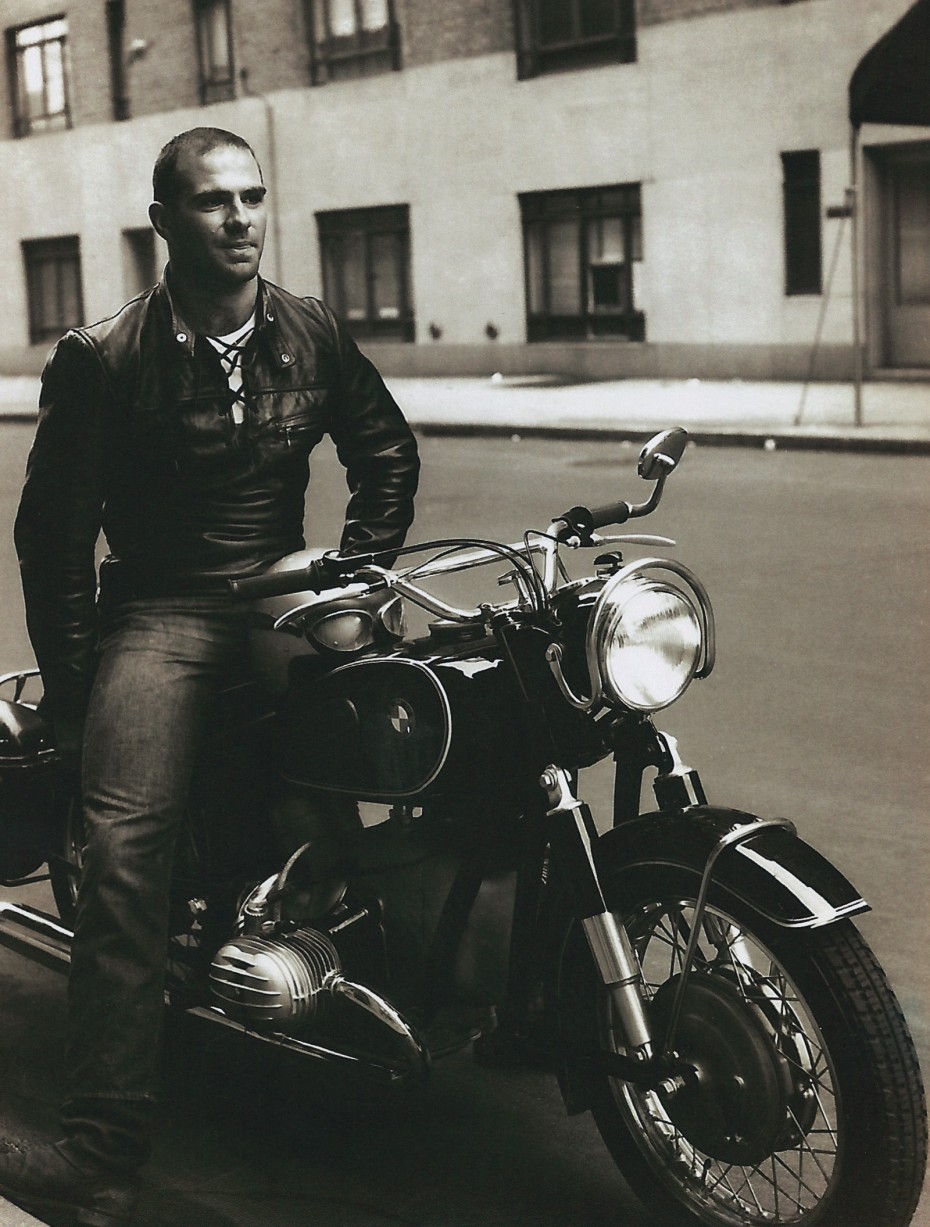 |
| Oliver Sacks |

BETH
So I hear you’re a big fan of “Sex in the City.”
EMILY
Yeah. How about you?
BETH
I only watch cop shows. Where girls like Carrie end up on the slab. After falling off of their five-inch high heels.
