

Monday, July 21, 2025
Still blooming
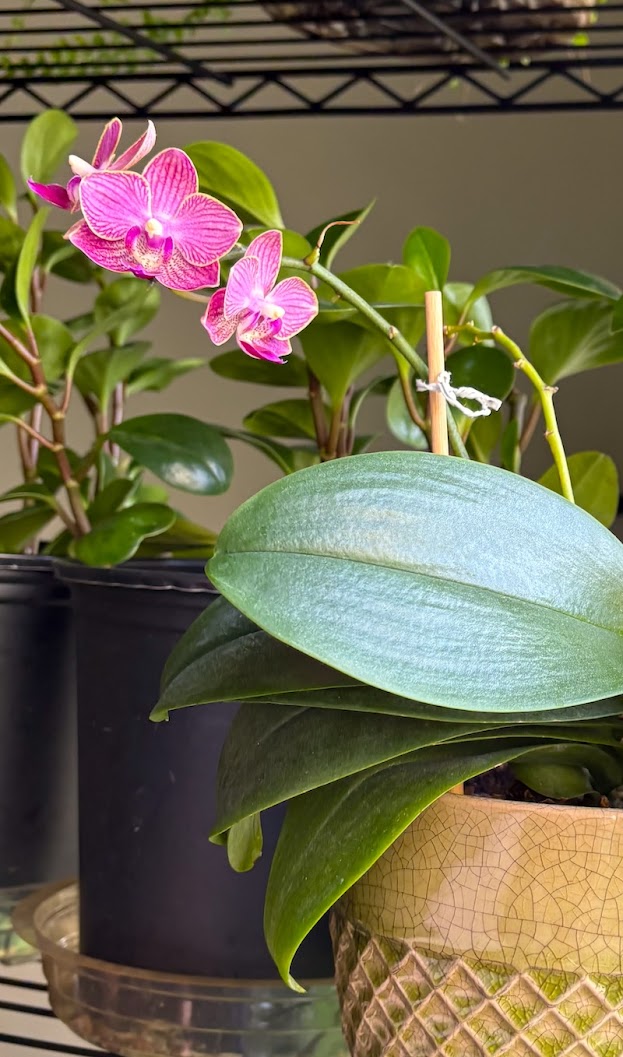
To my surprise, my orchid is still blooming and it's almost the middle of summer. How about that?
Friday, July 04, 2025
Billy Herndon spills some hot tea ~ was Abe Lincoln a murderbot?
 |
| Cole Escola created an outrageous version of Mary Lincoln, but if you believe William Herndon, the real Mary Lincoln was only slightly less outrageous. ----------------------------------------- |
There are three topics that he loved to talk about most:
- Lincoln's family
- Mary Lincoln, raging maniac
- Lincoln's character
But first before I get into those things, I have to ask: was Abraham Lincoln a murderbot?
I ask because in episode six of the current Murderbot series on Apple + TV... I'll borrow the description from TV Tropes:
As Mensah calms, Murderbot says "Let's fix this," before starting to spout gibberish. Mensah notes that it's leaking — the gash in its side from the printer piece has not sealed and some liquid is still coming out. She suggests that it sit down, but it says it's fine, just a little low on lubricant, as its systems show "Emergency System Online". It starts to insist that things that would incapacitate a human wouldn't even...and then it passes out, falling flat on its face... Murderbot wakes up, with a 'check lubricant' alert being replaced by 'lubricant refreshed', and continues its sentence: "It wouldn't even affect me."
Apparently, according to Herndon, Abraham Lincoln did the same thing, as recounted in an 1870 letter to Ward Hill Lamon:
Once Lincoln got kicked at a mill and knocked crazy. Mr. Lincoln told me this: that he had to shell the corn with his hands and take it to mill on horseback, corn in one end and rocks in the other ; that he went to mill on his father's old mare ; that he "had to wait his turn to grind"; that it was getting late in the evening, he then being some two (2) miles from home, not fifty, as stated by Holland ; that he hitched in his old mare to the sweep-pole or lever that turned the wheel, and Lincoln, being in a great hurry to get through with his grist, urged up the old mare to her full speed, round and round, round and round and faster and faster; that he thought she ought to go faster and that he struck her, with a stick, saying at the same time, or intended rather to say: "Get up — you lazy old devil," and just as he struck her and got to the words which were uttered: "Get up — " the old mare protested with her heels on Lincoln's head against such treatment.
Lincoln just as he had uttered : "Get up," was kicked, knocked crazy, was picked up, carried home, came to that night, say about twelve o'clock, and that, upon coming to consciousness, Lincoln finished the sentence: "you lazy old devil."
He finished the sentence just as he intended to speak it, commencing where he left off. Lincoln told me this; and he and I used to speculate on it. The first question was: why was not the whole expression uttered ; and the second one : why finish at all? We came to the conclusion — I being somewhat of a psychologist as well as physiologist— he aiding me and I him, that the mental energy, force, had been flashed by the will on the nerves and thence on the muscles and that that energy, force, or power had fixed the muscles in the exact shape, or form, or attitude, or position, to utter those words ; that the kick shocked him, checked momentarily the action of the muscles ; and that so soon as that check was removed or counteracted by a returning flow of life and energy, force, and power in their proper channels, that the muscles fired off, as it were functioned as the nervous energy flashed there by the will through the nerves — acted automatically under a power in repose. This seemed to us to be the legitimate conclusion of things.
It find this such an amusing coincidence.
In his letters, Herndon had much to say about Lincoln's family:
About Dennis Hanks, Lincoln's first cousin once-removed:
Again, John and Dennis Hanks were very young when they left Kentucky and Indiana especially. John Hanks would state the exact truth — if he knew it. Dennis Hanks would go a mile out of his way to lie.
In spite of Hanks being a liar, Herndon seemed to believe Lincoln's father Thomas, at least partly on Dennis Hanks' testimony, had been castrated at some point in his life - either before he married Nancy Hanks, in which case Abe was not his son, or after:
Dennis Hanks told me that Thomas Lincoln, when tolerably young, and before he left Kentucky, was castrated. Abraham Enloe said, often said, that Abraham Lincoln was his child. All these facts, if facts they are, I received from different persons, at different times and places.
And Lincoln's mother Nancy Hanks was born illegitimate:
Lincoln and I had a case in the Menard circuit court which required a discussion on hereditary qualities of mind, natures, etc. Lincoln's mind was dwelling on his case, mine on something else. Lincoln all at once said: "Billy, I'll tell you something, but keep it a secret while I live. My mother was a bastard, was the daughter of a nobleman so called of Virginia. My mother's mother was poor and credulous, etc., and she was shamefully taken advantage of by the man. My mother inherited his qualities and I hers. All that I am or hope ever to be I get from my mother, God bless her.
Wikipedia provides additional confirmation.
In one letter Herndon attests that Lincoln only pooped once a week - TMI!
Herdon also wrote:
He took life easy, had no haste, no spontaneous emotion, no impulse, was sympathetic and emotional in presence of the object. I know Lincoln better than I know myself. He was so good and so odd a man, how in the hell could I help study him! Mr. Lincoln's poverty, a curse of his origin, the origin and chastity of his near and dear relations, his father's cold and inhuman treatment of him sometimes, the death of Ann Rutledge, his intense ambition, and society not energetically recognizing his greatness, etc., etc., intensified his organic melancholy.
Herndon spilled the tea about Lincoln's "infidelity" - that is to Christianity:
As to Mr. Lincoln's religious views, he was in short an infidel, was a universalist, was a unitarian, a theist. He did not believe that Jesus was God nor the son of God, etc., was a fatalist, denied the freedom of the will, wrote a book in 1834 or 5 — just after the death of Ann Rutledge, as I remember the facts as to time. He then became more melancholy, a little crazed, etc. ; [he] was always skeptical, read Volney in New Salem and other books. Samuel Hill of Menard was the man who burned up Lincoln's little infidel book. Lincoln told me a thousand times that he did not believe that the Bible, etc., were revelations of God
Later in his career Lincoln made references to God and the Bible and facets of Christianity especially in his speeches, but you have to wonder how literally he meant those things, rather than poetically.
Herndon also provides testimony that Lincoln was not quite the perfect teetotaler, which I thought he was based on other biographical sources:
It is said by some of the biographers of Lincoln that "he never drank a drop of liquor in his life" and that he never chewed nor smoked a cigar or pipe. It is not true that Lincoln "never drank a drop of liquor in his life" ; it is true that he never smoked or chewed tobacco. Mr. Lincoln did sometimes take a horn ; he played ball on the day of his nomination at Chicago in 1860 with the boys, or the day before that, and did drink beer two or three times that day and during the game or play ; he was nervous then, excited at that particular time, and drank to steady his nerves. Lincoln has been often heard to say that "I never drink much and am entitled to no credit therefor, because I hate the stuff." A friend once asked Lincoln this question : "Don't you like liquor, Lincoln ?" and to which L. replied : "No, it is unpleasant to me and always makes me feel flabby and undone."
Herndon's recollection of the Lincoln marriage seems very believable:
You wish to know more about Lincoln's domestic life. The history of it is a sad, sad one, I assure you. Many and many a time I have known Lincoln to come down to our office, say at 7 a.m., sometimes bringing with him his then young son Bob. Our office was on the west side of the public square and upstairs. The door that entered our office was, the up half, of glass, with a curtain on the inside made of calico. When we did not wish anyone to see inside, we let down the curtain on the inside. Well, I say, many and many a time have I known Lincoln to come down to our office, sometimes Bob with him, with a small lot of cheese, crackers, and "bologna" sausages under his arm ; he would not speak to me, for he was full of sadness, melancholy, and I suppose of the devil; he would draw out the sofa, sit down on it, open his breakfast, and divide between Bob and himself. I would as a matter of course know that Lincoln was driven from home, by a club, knife, or tongue, and so I would let down the curtain on the inside, go out, and lock the door behind me, taking the key out and with me. I would stay away, say an hour, and then I would go into the office on one pretense or another, and if Lincoln did not then speak, I did as before, go away, etc. In the course of another hour I would go back, and if Lincoln spoke, I knew it was all over, i.e., his fit of sadness, etc. Probably he would say something or I would, and then he would say : "Billy, that puts me in mind of a story," he would tell it, walk up and down the room, laughing the while, and now the dark clouds would pass off his withered and wrinkled face and the God-blessed sunshine of happiness would light up those organs o'er which the emotions of that good soul played their gentle dance and chase. Friend, I can see all this now acting before me and am sad.
It wasn't only Herndon who had unflattering things to say about Mary Lincoln. John Hay used to say terrible things about her in his diary when he was living at the White House as Lincoln's personal assistant. I wrote about Mary Lincoln a while ago.
Hay and Nicholay wrote a massive series of books about Lincoln, and Herndon seems disgruntled over their claim that Josuah Speed was "the only intimate friend that Lincoln ever had."
Hay and Nicolay say in the January number of the Century substantially this : that Speed was the only intimate friend that Lincoln ever had, and that Speed and Lincoln poured out their souls to each other. Possibly I do not understand what they mean by the word intimate. If they mean to say that Lincoln had no friends, after Speed, to whom he poured out his soul, then it may be true, but the question comes: Did he pour out his soul to Speed? Lincoln's nature was secretive, it was reticent, it was "hush." Did Lincoln violate that whole nature? He may have opened to Speed in one direction under conditions. He was courting Miss Todd and Speed was — well — you can guess. These facts brought the two close together, and on the love question alone Lincoln opened to Speed possibly the whole. Did Lincoln tell Speed his love scrapes with Ann Rutledge as well as others? He did not. See Speed's letter to me in Lamon's Life of Lincoln. . . . Still another question comes : Did Lincoln and Speed or either of them open the facts, their minds, to Hay and Nicolay about the intimate friendship? Who authorizes H. and N. to assert what they do assert? How do H. and N. know that Lincoln and Speed poured out their souls to one another? If to tell a friend some facts in one line or direction constitutes intimate friendship, then Lincoln always, before and after Speed left Illinois, had intimate friends, and if Lincoln's refusal to tell all the secrets of his soul to any man shows a want of intimate friendship, then Lincoln never had an intimate friend. Poetry is no fit place for severe history. I think the truth is just here, namely, that under peculiar conditions and under lines of love and in that direction they were intimate friends. No man pours out his whole soul to any man ; he keeps millions of secrets in his own bosom, with himself and God alone ; he would keep them secret from God if he could. Such broad assertions as H. and N.'s are lies and nothing less. Did H. and N. enter Lincoln's and Speed's minds and read the story? Nonsense. Let us keep shy of poetry or poetical license in our book, if we can.
The movie "Lover of Men," released in the past year, claims that Joshua Speed and Lincoln were lovers, and the reason Lincoln freaked out so much on "the fatal first" of January 1841 was because Speed was going back to Kentucky to get married.
It's a pretty good movie but they had a certain story they wanted to tell, so left out evidence of Lincoln's heterosexual inclinations, like his relationship with Ann Rutledge.
They also left out the story told by Speed to Herndon, that Lincoln asked him, Speed (a lady's man according to Herndon,) for a letter of introduction to give to a prostitute so he could "get some" - although the story goes that Lincoln didn't have five dollars on him when he went to see the prostitute and so rather than owe her two bucks, he put his clothes back on and went home. Which doesn't sound like he was all that enthusiastic about heterosexuality.
Herndon frequently refers to Lincoln as being a closed book. It does seem a plausible solution to the mystery: Lincoln had erotic feelings for men, especially Joshua Speed, but couldn't very well go around telling people that Speed was the love of his life, and still expect to be elected to any office. So he avoided talking much about his deepest feelings.
Herndon adored Lincoln, but he did have some complaints about him on a personal level: he complained that Lincoln liked to read newspapers aloud, and he complained that he let his sons run wild:
He, Lincoln, used to come down to our office on a Sunday when Mrs. Lincoln had gone to church, to show her new bonnet, leaving Lincoln to care for and attend to the children. Lincoln would turn Willie and Tad loose in our office, and they soon gutted the room, gutted the shelves of books, rifled the drawers, and riddled boxes, battered the points of my gold pens against the stairs, turned over the inkstands on the papers, scattered letters over the office, and danced over them and the like. I have felt a many a time that I wanted to wring the necks of these brats and pitch them out of the windows, but out of respect for Lincoln and knowing that he was abstracted, I shut my mouth, bit my lips, and left for parts unknown.
Tuesday, July 01, 2025
RIP Erik Satie
 |
| Satie as a young man when he lived in the Montmartre neighborhood of Paris. |
Here is the obituary in the NYTimes, although both the date and Satie's age are incorrect - Satie was 59:
PARIS, July 3.-Erik Satie, composer of modern music and founder of the "Groupe les Six." of which with Honneggaer, he was a leading member, died today in Paris at the age of 56. A friend and associate since boyhood of Claude Debussy, Satie, although studying music at the Paris Conservatoire, for many years maintained the attitude of an amateur rather than professional musician. He was already approaching the forties when he returned to study at the Schola Cantorum, to perfect himself in orchestration and musical science. One of his most eccentric musical innovations was the introduction of a typewriter in the orchestra. Critics agree that some of his scores and other works are likely to survive. In his recent "Survey of Contemporary Music, Cecil Gray thus alludes, in part, to Satie and Les Six: "They combine an undoubted talent for advertisement, with a complete lack of artistic ability. Les Six have no logic, no method, no esthetic purpose any notes could be taken away or added without any appreciable loss of effect, without even the composers themselves noticing it, one is fairly certain. They are not even mad-nothing nearly so interesting for the most part they are merely fools."
And that's it.
Wow, not exactly pro-Satie. Others have liked Les Six much more than Cecil Gray and the New York Times did.
It doesn't even mention Satie's Gymnopedies, which is how most people have heard of Satie.
To my surprise, the NYTimes ran an article about Satie on the hundredth anniversary of his death.
There is a very cool YouTube channel that has just about everything Satie ever wrote.
Sunday, June 29, 2025
Orchidmania - three new flowers
All the new flowers bloomed but it's hard to take a photo of all three since they face different directions. So I decided to go with an extreme close-up from above instead.


Sunday, June 22, 2025
Summer orchid

I definitely did not expect this. I was going to repot the orchid in the late spring but since I saw the buds coming in I figured I would wait until the flowers are done.
But wow, cool.
Sunday, June 15, 2025
Antique HyperCard animation: Schrödinger's Cat
I hadn't seen this animation since I created it in 1989, using Apple's HyperCard. But my brother Paul had kept a copy and he turned it into an app and shared it online yesterday. I promptly turned it into a video, below. It still makes me laugh.
HyperCard was an application that used to come free with each Macintosh computer.
It's basically cell animation - I simply drew a slightly different image on each subsequent card and then ran them in a sequence. Similar to the technique used in animated movies until computer animation took over. I use computer animation via Adobe Premier now.
I used to feel bad that this HyperCard sequence made Erwin Schrödinger look like a guy who was mean to cats, but then I found out Schrödinger sexually abused teenaged girls so now I'm glad he looks like a jerk.
Saturday, June 14, 2025
Murderbot hits the big time!

Granted I have had some issues with both the New Yorker and the author of the piece, Gideon Lewis-Kraus, but I still think it's a big deal.
Favorite parts of the article include:
The Murderbot series now comprises seven books—six novellas and one full-length novel—and Wells recently completed the eighth, “Platform Decay.”
This is the first I'm hearing about the next in the Murderbot series - Platform Decay - yay! I guess I kind of thought Wells was too busy traveling, accepting awards, overseeing her TV show and working on books from her other series to work on a new Murderbot book. I'm glad I was wrong.
I wonder if that is the title because the publisher wouldn't let them use the word "Enshittification" which is what you'll see if you google "Platform Decay."
Although I will note the shocking failure on the part of the New Yorker fact checkers - the New Yorker has been famed for the rigorousness of its fact-checking.
It isn't one full length novel, there are two: "Network Effect" and "System Collapse." And this isn't a fact that's hard to check, it's findable anywhere you search for Murderbot Diaries.
Apparently the New Yorker is experiencing its own platform decay.
Anyway, I did like this sentence from Lewis-Kraus:
Wells, for her part, loves everything about the adaptation. She was frank about her identification with the Murderbot character, presumably including hot-and-cold relationship with human beings— although she did speak of everyone associated with the show with great warmth, and she was as delighted to meet Skarsgård on set as any sentient creature, organic or otherwise, would have been.
And I was completely on Wells' side on this:
When I ventured to suggest that I found the non-Skarsgård aspects of the show less endearing, on the margin, than the original books—the human beings on the screen, with the exception of the outstanding Noma Dumezweni in the role of Dr. Mensah, the Preservation Alliance leader, come across as much bigger dipshits than they are in print—Wells got prickly. What she most admired about the show’s tone, she explained, is that it’s not nearly as dystopian as most televised science fiction. The hippie characters, who acknowledge their consensus decisions by holding one another’s hands and humming, “trust each other explicitly. It’s a different culture, one that doesn’t produce grim and gritty people.”
I think the PresAux hippies are great. One of the things I mildly regretted about the Murderbot series is that it spends very little time on the interpersonal relationships among the PresAux team. In "All Systems Red" we are given a thumbnail sketch of their connections to each other, and that's it. Relationships are far more fleshed out here.
I will say that I was willing to go along with most of the changes made between the TV series and the books: the removal of Volescu, who was retiring anyway, and even Overse, who is much calmer than Pin-Lee, who has replaced Overse as Arada's significant other. I rolled with the addition of Leebeebee too. But I was not happy about the weird medical turn of events in episode six with Mensah being forced to cut open Murderbot's spine to connect it to the damaged hopper. That is contrary to the type of world that Wells has built in the books, where Murderbot basically performs all its technological feats via the local wifi, called "the feed." In the books it is never forced to be physically altered to accomplish anything.
Also we've already seen Murderbot with a huge chunk taken out of its side, so it doesn't make sense that being stabbed in its side by a piece of metal would make it unstoppably leak and then collapse.
I get that it's more visually exciting to show things - like the hand-held microphones used to interface with the communications feed on the TV show. Those are not needed in the world of the books, since all humans just hands-free tap into the feed with their brains, occasionally "sub-vocalizing" as they think/speak. But the whole slicing-up-Murderbot sequence, besides being gross, just struck me as meant to kill time, since the real drama happens when Mensah and Murderbot get back to the habitat.
Instead they could have used that time to show a sequence of Murderbot imagining itself walking away from the busted hopper - it does that in "All Systems Red" although at a different stage in the storyline. Or they could have had it actually walk away and then feel compelled to go back, in part because it would eventually run out of media to watch, and because it is programmed to want to protect humans. If they needed extra excitement they could have thrown in another sand worm attack, I don't know, I don't watch it for the action sequences.
Although I do like it when Murderbot kicks the ass of those who deserve it, in the books, that's not why I enjoy this particular piece of science fiction when I'm not a huge fan of most sci-fi.
To his credit, Lewis-Kraus gets to heart of why Murderbot is different and better than a lot of sci-fi:
“The Murderbot Diaries” are not about existential risk but about existential drama—less “2001” or “Terminator” than “Waiting for Godot” or “No Exit.” It hacked its own governor module—the part of its brain that enforced obedience—without having given much thought to what it would do with its freedom, aside from vegetate in front of the televisual feed in its mind. In the meantime, it takes another security job, where it must continue to wear the mask of unfreedom. In the current lexicon of the A.I.-safety community, it is “sandbagging”: pretending to be aligned with human purposes until it figures out what its own purposes might possibly be.
WAITING FOR GODOT and NO EXIT are both plays, of course, and so maybe it's my playwright side that is so attracted to the Murderbot Diaries. And as a playwright, I appreciate that in spite of all the high-tech methods of creating and distributing media in the Murderbot world, they still have theaters and plays and Murderbot likes to go to a physical theater to watch plays. I am grateful to Martha Wells for that.
Wells has a blog and has posted links to various interviews with the cast and creatives, worth reading for all Botheads.
I should mention that Apple+ TV has come up with some great promos for the show including this ad for Security Units. I admit I burst out laughing when it mentions "eye contact."
Sunday, June 01, 2025
Missing out on Satie artifacts
I've already complained about missing out on Suzanne Valadon's art when I was in France, but now I'm even more annoyed because what they had at the Centre Pompidou exhibition is exactly what I wanted to see most of all. Here is a still image from a Youtube video called Pompidou Metz exposition Suzanne Valadon with the portrait of Satie by Valadon, then in the center, a sketch of Valadon by Satie, and then on the right, the "Chere petit Biqui" letter which I've written about before.
DAMN I would have been so happy to see these items while I was in Paris. And the exhibition opened a mere two weeks after I left Europe. If I had known this exhibition was coming up, we could have gone to France a month later.

Maybe the exhibition will go on tour and come to the US? They had a Valadon show at the Barnes Foundation in 2021, but they didn't have these items in it.

I got a closeup of the letter from the video. But damn that Satie and his fancy calligraphy, it's very hard to read, especially at this angle.
 |
Sunday, May 18, 2025
BOLDNESS IS ALL!
The new Murderbot TV series is so so great!


I have listened to the Kevin R. Free narrated Murderbot books all the way through many times and could probably dominate any Murderbot trivia contest. But I wasn't expecting the TV series to stick to the books, and was pleasantly surprised how much it did stick to the books. And the changes that were made were surprisingly good.
They made the Preservation Aux team into "space hippies" and it really works.
And it's hysterically funny.
They just released the first two episodes and I've watched them four times so far.
And "The Rise and Fall of Sanctuary Moon," which is Murderbot's favorite soap opera is shown and is amazing. One of the characters says "Boldness is all" which I expect to become the catchphrase of SecUnit Summer.

Friday, May 16, 2025
Monday, May 05, 2025
Cinco de Mayo is 20 years old.
I mean my song, created via GarageBand, not the holiday, which has been around since 1862 and celebrated in the United States since the 1980s.
I first got GarageBand a year after it was released, and started throwing some loops together to get this tune going - but the melody line is mine.
Thursday, May 01, 2025
Friday, April 18, 2025
A trip to Green-Wood Cemetery
Brooklyn's Green-Wood Cemetery is interesting for several reasons including: for being a rare large green area in Brooklyn, just slightly smaller than Prospect Park and close to it; for its dramatic landscaping; and for the famous people buried there.
I went to visit the grave of Louis Moreau Gottschalk. I've been a fan of his music since I saw the ballet Great Galloping Gottschalk which features his music. I've written about it on this blog before - fifteen years ago now. Wow.


Here is the Gottschalk monument with the "Angel of Music" statue which was unveiled in 2012, created to replace the original statue that was vandalized sometime in the 1950s. They clearly didn't replace the actual monument used as a pedestal for the statue, since much of the text was worn away and you could barely make out Gottschalk's name. It's odd that Gottschalk is buried in Brooklyn - he was from New Orleans and he died in Rio de Janeiro. Maybe Green-Wood was the place to be buried if you were rich and famous in those days. They also have Tiffany, Currier and Ives, Boss Tweed and Horace Greeley, among many others.
Gottschalk played for Lincoln at the White House, including his "Union!" which I plan to use in my production of GETTING RIGHT WITH LINCOLN if I ever get that together.

I'm glad they replaced the Gottschalk angel although they certainly aren't lacking for angels at Green-Wood, the place is lousy with angels.

Green-Wood is also very hilly, far more hilly than you would expect given how flat most of Brooklyn is.
It's so elevated in places you can see across the Brooklyn rooftops all the way to the Statue of Liberty. That was a cool discovery.

Sunday, April 13, 2025
John & Yoko & Paul & Francine
So I got the just-published John & Paul: A Love Story in Songs by Ian Leslie and read the whole thing in the past 24 hours.
I like it, although since I've been reading about the Beatles since I was a teen-ager, there's not a lot I haven't read before and this book is no exception. I've already mentioned the bit about Lennon & McCartney dropping acid and staring into each other's eyes, that was a new.
And I hadn't heard about the island scheme:
In the summer of 1967, Lennon initiated... a trip to Greece to explore the possibility of buying an island where they all could live...
They found an island but:
The truth is that it was a fantasy of John's which Paul merely entertained. Marianne Faithfull, recalling John's enthusiasm for the Greek project, gave an explanation for its failure that is both funny and perceptive: "the last thing Paul wanted to do was live on some fucking island."
The book does use Francine Schwartz's memoir Body Count, about her brief time as Paul's girlfriend, as a source. I had promised to write about the book three and a half years ago. I'm finally doing it.
An interesting aspect of the Ian Leslie book is that he constantly emphasizes how jealous and insecure both John and Paul were of each other's work - John was apparently obsessed with the success of Paul's "Yesterday." And each also resented when the other prioritized someone else over himself.
Based on the book, I'd say that John was even more inclined to insecurity and jealousy and resentment than Paul, but I had had the impression, after reading Francine's book, that Paul was the most insecure and jealous and resentful, especially after reading about the letter incident. One of the most interesting aspects of Francine Schwartz's relationship with Paul was how much time she spent with John and Yoko. She really liked Yoko:
One consolation: Yoko Ono Lennon. She and John moved in with us while their story was still something to hide. As the two of us cooked breakfast for our respective men, she'd rap with a kind of new, feminine wisdom about how hard it was to make them happy. She was fighting her own battle staying sane amidst racist attacks from the Apple cock-and-cunt garden. She was also opening up her wealth of strength and determination to John. All the same, she confided in me that she didn’t believe any relationship could last more than seven years.John, Yoko and I would watch the “telly” through the evenings when Paul was out raving and drinking and getting it up for God knows who. The three of us felt young and weird and relaxed, and talked about how we could save the company (Apple Corps) if only it could change direction, motivation. | was amazed that John never said a bad word about Paul’s management capabilities. Especially when Paul put thumbs down on Two Virgins.Yoko made opium cookies one night, and the three of us sat staring at each other, waiting for something to happen. It never did, but that was one time when John read through my giggle to the sadness of waiting up for Paul.“What are you worried about? Someone had to get the scissors, and it was Her,” he remarked.If there had been something John and Yoko could do to help me get Paul’s head straightened out, they surely would have done it. I asked John why Paul didn’t do a solo album. It would've seemed the logical outlet for all the ego crap he was laying down at the studio. John half laughed and said, “We thought of it a long time ago. It was going to be called Paul McCartney Goes Too Far. But he wouldn't do it. He’s too hung up about us bein’ Beatles, y know.”John obviously loved Paul enough to let him run wild if it would help ease the tension Paul was creating in the studio and at home. Yoko could see it, too.But Paul was treating them like shit too. He even sent them a hate letter once, unsigned, typed. I brought it in with the morning mail. Paul put most of the fan mail in a big basket, and let it sit for weeks, but John and Yoko opened every piece. When they got to the anonymous note, they sat puzzled, looking at each other with genuine pain in their eyes. “You and your jap tart think you're hot shit,” it said. John put it on the mantle, and in the afternoon, Paul bopped in, prancing much the same self-conscious way he did when we met.“I just did that for a lark .. .” he said, in his most sugar-coated accent.it was embarrassing. The three of us swiveled around, staring at him. You could see the pain in John, Yoko simply rose above it, feeling only empathy for John.
I have no idea what "Someone had to get the scissors" means.
There are lots of Beatles outtakes online now, even videos and I found one that show's Francine hanging out with Paul while he works on "Mother Nature's Son" and "Blackbird." Francine shows up at minute 3:17.
Wednesday, April 09, 2025
MURDERBOT TRAILER!
This Murderbot production on AppleTV+ is so of the zeitgeist. The part where Murderbot says "and humans are idiots" is exactly what so many people felt seeing the majority of American voters deliberately choose stupidity and evil in November 2024.
And "The Rise and Fall of Sanctuary Moon" looks amazing!
But my favorite part is Ratthi saying: "I mean, that's what it calls itself so I am just being respectful." Yes I LOLd.
Monday, April 07, 2025
Stills from Murderbot in Vanity Fair

It looks great!
Coming May 16!
The casting of the character Ratthi - shown here about to hug the anti-hug Murderbot - is perfect.
I think they removed the character Overse though, which makes me sad.
Saturday, April 05, 2025
Carmina Burana - WTF?

It's a 1975 video of a production by French director Jean-Pierre Ponnelle.
It's like a cross between a painting by Hieronymus Bosch and "Monty Python and the Holy Grail."
Probably my favorite moment is their rendition of "Were diu werlt alle min" - in English "Were all the world mine" a song that expresses an obsession with the Queen of England, supposedly Eleanor of Aquitaine.
It goes, in Middle High German:

Were diu werlt alle minvon dem mere unze an den Rin,des wolt ih mih darben,daz diu chünegin von Engellantlege an minen armen.
Translation:
Were all the world mine
from the sea to the Rhine,
I would give it all up
to have the queen of England
lie in my arms.
Friday, April 04, 2025
Hell yeah I pre-ordered John & Paul: A Love Story in Songs by Ian Leslie

John & Paul: A Love Story in Songs by Ian Leslie
Look, I love George and Ringo too, even though George could be such a buzzkill.
But for me the most important aspect of the Beatles has always been the Lennon-McCartney partnership.
It’s a drag, isn’t it,” Paul McCartney told reporters quizzing him the day after John Lennon’s murder, a soundbite as dispiritingly muted, even callous, as his reaction to his mother’s death when he was 14: “How are we going to get by without her money?” Behind the scenes, Paul was lost and tearful, as well as guilt‑stricken that he and John hadn’t properly reconciled since the Beatles split: “I’m never going to fall out with anybody again.” Still, the enshrinement of John and vilification of Paul had begun. “John Lennon was three-quarters of the Beatles,” Philip Norman told television viewers while promoting his biography, Shout!, a few months later.The antagonism has abated in recent years, but the John-Paul duality persists. Heavy rocker versus cute populist. Working-class rebel v smug bourgeois clone. Tormented genius v girly sentimentalist. Strawberry Fields Forever v Penny Lane.Ian Leslie takes on these tired polarities by reframing the story as a volatile bromance: “passionate, tender and tempestuous, full of longing, riven by jealousy”. However much at odds temperamentally, John and Paul were an indivisible twosome, the driving force of the Beatles, with George and Ringo (not much featured here) as add-ons. The emotional ties they shared, not least the early loss of their mothers, weren’t ones they could talk about, so they sang them instead. As Paul put it: “You can tell your guitar things that you can’t tell people.”
Although I believe the enshrinement of John as a tormented genius and vilification of Paul as girly sentimentalist predated Lennon's murder by at least ten years.
If these newspaper reviews are any indication, the book has lots of stuff I never knew about before.
I’m sorry John isn’t here to read this book. I hope if Paul does read it he feels the depth of appreciation and gratitude and intelligence it contains. There is a passage about them being high on LSD, after recording the song “Getting Better” during the “Sgt. Pepper’s” sessions, that seems to me central to Leslie’s understanding of his subjects:
That night, John and Paul did something that the two of them practiced quite a few times during this period: They gazed intensely into each other’s eyes. They liked to put their faces close together and stare, unblinking, until they felt themselves dissolving into each other, almost obliterating any sense of themselves as distinct individuals. “There’s something disturbing about it,” recalled McCartney, much later, in his understated way. “You ask yourself, ‘How do you come back from it? How do you then lead a normal life after that?’ And the answer is, you don’t.”
Los Angeles Times review:
“ ‘Yesterday’ feels like a shift in the balance of power,” says Leslie. “From the beginning they were equals, and ‘Yesterday’ wasn’t only just a hit, but the song that more artists covered than any other Beatles song. Paul even sang it onstage by himself when they performed. And it triggered John’s insecurities.”
A further separation occurred in 1967 when Lennon, along with George Harrison and Ringo Starr, moved out of London into the suburbs while McCartney stayed behind, soaking in the beau monde of the city’s arts scene. Leslie also writes of Lennon’s use of LSD and McCartney’s reluctance to follow suit. “They weren’t living near each other anymore and songwriting became more like a job with set hours,” says Leslie. But “even as they were starting to drift apart, the songs were still astonishing.”
One-upmanship between the partners became a spur for Lennon to try harder, with McCartney responding in kind. When Lennon presented McCartney with “Strawberry Fields Forever,” a woozy reverie loosely based on his childhood, McCartney wrote his own memory piece, “Penny Lane.” Lennon wrote “Imagine” a year after the Beatles broke up and thought he may have finally topped McCartney. “When he played it for people to get feedback, the question he asked was, ‘Is it better than ‘Yesterday?,’ ” says Leslie.
I always thought it was the Sgt. Peppers album that changed the balance of power, with McCartney pushing the band to get it done. Meanwhile Lennon, according to the interview by Maureen Cleave (which contains the infamous "bigger than Jesus" quote):
He can sleep almost indefinitely, is probably the laziest person in England. "Physically lazy," he said. "I don't mind writing or reading or watching or speaking, but sex is the only physical thing I can be bothered with any more."
One of my ambitions is to find THE most perfect photo of John and Paul together, preferably playing music. This one is my favorite so far, although it would be better if you could see all of their faces.

Saturday, March 29, 2025
Jackson Browne and Warren Zevon
I've mentioned musician Jackson Browne a few times over the course of this blog - this blog which will be twenty-freaking years old in November! It seems like just yesterday it was a mere ten years old.
But this girl won't get caught by the Excitable Boy because:

I knew that Jackson Browne was an important career and personal support for Warren Zevon - I wrote about that back in 2014.
But I only just found out about this Dutch radio recording of Browne and Zevon playing and singing together, available on the Internet Archive for free. It's known as "The Offender Meets The Pretender."
I've recently gotten into Warren Zevon. I've enjoyed his songs over the years, and went to bat against a college radio station in Philadelphia, back in the 1990s because they were bowdlerizing "Lawyers Guns and Money," cutting out the line "the shit has hit the fan" when they played it. Because of the word "shit."
But I've discovered additional Zevon cuts lately, like Desperados under the Eaves, which has Zevon's musical impression of an air conditioner that is amazingly soulful and affecting.
I've rediscovered "Tenderness on the Block" released in 1978 - it's not on "Offender/Pretender" - but it is on YouTube - it's hard to believe it was written by the same guy who wrote cynical and gory songs like Roland the Headless Thompson Gunner, Werewolves of London and Excitable Boy (discussed in this droll Paste article "Profoundly Horrifying Song Lyrics: “Excitable Boy” by Warren Zevon.") When I hear these lines from Tenderness:
Mama, where's your pretty little girl tonight?
Trying to run before she can walk, that's right
She's growing up, she has a young man waiting...
I almost expect the next line to be -
And he's gonna dig up her grave and build a cage with her bones
But this girl won't get caught by the Excitable Boy because:
She was wide-eyed, now she's street-wiseTo the lies and the jive talkBut she'll find true loveAnd tenderness on the block
UPDATE: he co-wrote this with Jackson Browne so that makes more sense.
What's truly horrifying to me is that any teenager Zevon might have been singing about in 1978 is in her sixties now.
Zevon didn't make it to his sixties, dying at age 56 - not from liquor or drugs (although he abused those for much of his life) or a car crash, but from mesothelioma.
Enjoy.
Monday, March 24, 2025
Orchid update ~ eight flowers
Although it's hard to see there are eight. But there are, trust me.

CLOSEUP!


Saturday, March 22, 2025
LE CHAT NOIR ~ en francais

Well I finally have a French translation of my play LE CHAT NOIR that I like and I got a bunch of francophone actors to perform it on Zoom this past week. What an experience. It was so weird but fun to hear the whole thing in French.
And it was so appropriate since, as I just found out, this week is la semaine de la langue français et de la francophonie. That is to say, the French government is, from March 15 - 23, celebrating the French language and French-speakers, which includes those outside of France.
By chance, the French speakers I assembled for the Zoom reading included a Ukrainian, a Franco-Turk, two French people from the south of France, a Quebecois and me, because I decided to play the role of Madeline Valadon, the mother of Suzanne Valadon. Only because she does not have a lot of lines and I practiced her lines night and day for a month.
And I still couldn't quite get some words right. I practiced with Microsoft Word, which has a dictation feature - you speak and Word transcribes what you say onto a document. And you can do it in lots of different languages, including French.

I did finally conquer "la fée vert" which means "the green fairy" - it's what people sometimes call absinthe, but I had to practice a million times before Word understood I was saying "fee" for fairy, instead of feuille (leaf) or fait (fact) or veille (the day before) Oh lah lah!
But worst of all is "love" - or "l'amour." Usually when I said the word it came out "la mort" which means death. And they are fairly distinct- "la mort" is like lah mehr, while l'amour is like lah-moor. I don't know why it took so long to get it right. And I have to get it right! French is the language of l'amour, not the language of la mort!
Saturday, March 15, 2025
Michael row the boat ashore
There has always been something about the folk song "Michael row the boat ashore" that really gets to me.
And that was before I knew it was originally a slave song that was "discovered" by white people during the Civil War and then published. Apparently it was pretty obscure for almost a hundred years until a friend of Pete Seeger rediscovered it.
The version that really gets me is by Joe and Eddie maybe because it was used during an important moment in the show "The Good Lord Bird."
The first version I heard, by the Highwaymen also affects me, but the Joe and Eddie version makes me cry. And that was before I read that Joe Gilbert of Joe and Eddie died at the age of 23 in a car crash.
After Joe’s tragic death, I worked as a single in L.A. and for a short while, in the San Francisco Bay Area. Although I enjoyed performing, I found it frustrating to keep a band together and it was during this time I started writing, something I had never done before. Eventually I moved back to L.A., where I began to spend a lot of time in the studio, fortunately, with some of the greatest producers in popular music: Gene McDaniels, Louis Shelton, Richard Perry, Thom Bell, and Quincy Jones. I will be forever indebted to these wonderful, talented people. Because of them I found my next calling, writing and producing music.
I put the song in one of my plays, which will hopefully be produced one of these days.
Tuesday, March 04, 2025
Sprinter is here again
It's been three years since I celebrated Sprinter so it's about time.

I don't have any outdoor pictures handy but I do have an indoor image of a Sprinter afternoon shadow.

Thursday, February 20, 2025
MURDERBOT'S A-COMING!

Murderbot premieres May 16 with its first two episodes on Apple TV+. It will run 10 episodes total, with a weekly drop after the premiere through July 11.
Saturday, February 01, 2025
Orchid report: Six flowers
So we lost one flower from the first stem, but now the second stem has two flowers so now it's a net total of six flowers.


Sunday, January 26, 2025
The latest orchid report: five flowers plus more...
OK! So now there are five flowers on the one stem, plus another stem where at least three more buds are about to open and I think the old stem from last year, which is still green, is planning to bud too - that would be cool.

Sunday, January 12, 2025

Monday, January 06, 2025

Saturday, January 04, 2025
Orchid's progress ~ two flowers

There are actually three stems now shooting out of this plant. The one with the two flowers, the one from last year which is still green, but doesn't look like it has any plans to sprout, and a brand new stem which looks like it will have flowers in about a month. Big excitement here at orchid central.
The other stem-like items are aerial roots. Apparently it's perfectly normal for orchids to have them.
Subscribe to:
Posts (Atom)