Wednesday, February 22, 2023

Hudes, or Change: Kathy Chang(e) and my ex-husband

As mentioned in the previous post, I've become interested in the work of Pulitzer Prize-winning playwright Quiara Alegría Hudes due to a woman named Kathy Chang(e).

I did not spend a lot of time with Chang, but I made some graphics contributions to the underground newspaper that she created with my ex, before I knew they were living in an abandoned building.

In 1982, Chang and my ex-husband were part of a loose organization of people who were squatting in West Philadelphia. They called themselves People for Peace and Justice and they were funded by Chang, who had decided to squander her inheritance (I assume from her grandfather who died in December, 1980) on the building.

I was sharing informal, non-court-appointed custody of our three-year-old with my ex (he wasn't officially my ex at that point) and when my ex told me he had moved to a new place in West Philadelphia, of course I assumed his new place would reasonably accommodate a three year old. So when I walked into his residence I was flabbergasted. The Philadelphia Inquirer was absolutely right to call it a "dilapidated hovel" (see below.) 

So I revoked our informal arrangement until our daughter was old enough to watch out for herself. My ex refused to pay child support and I was forced to accept welfare for a couple of years to get by.

Now Kathy Chang was not directly at fault. She didn't force my ex to live in a dilapidated hovel while being responsible for a small child. My ex was certainly capable of fecklessness without her help. But still, her decision to fund the project had an impact on my life. 

The Inquirer article below mentions their newspaper, but it does not mention the office they had rented for the newspaper. It was in Center City on, if memory serves, Walnut Street. Chang undoubtedly paid for that too. But for decades I had no idea she was funding everything - I certainly would not have guessed that anybody had spent thousands of dollars on improvements to the building. Then I happened to see her obituary in the New York Times, 12 years after she died, and I put the pieces together:
For many years, she seemed content dancing for her cause at Penn or at the art museum, spending a $30,000 inheritance to renovate and illegally live in an abandoned building in West Philadelphia...
For perspective on that amount, $30K in 1982 would be worth $93K now. According to the real estate site Redfin the abandoned house is worth $47K now

She could have bought a house with cash, and had housing security the rest of her life. She was already in her thirties by the People for Peace and Justice era. She could have even rented out some rooms and had a guaranteed income. 

Hell, she could have gone back to San Francisco where she had lived for at least five years and bought a house there, which would now undoubtedly be worth millions.

Instead she threw her money away on a building she did not own, and when her money ran out, she continued to live in sketchy housing and couldn't get money for the dental care she needed:
But last year, Ms. (Anita) King and other friends remember, she seemed to start losing heart. A huge blow, they said, came last fall when she called her father for help paying a dental bill. He refused. Not long after, when Ms. Chang was living in a converted warehouse with Ms. King and others, they smelled gasoline in the house. They found a leaking jar in Ms. Chang's backpack, and had to talk her out of killing herself.
As my ex wrote on his blog:
 With her money gone and no job, she was dependent as well. She wasn’t always treated well by the men she chose to live with.
I assume Anita King met Kathy Chang through my ex, since Anita and he had been friends since they attended the same high school in Pennsauken NJ. Although I don't think King ever lived at the squat. I think her acquaintance with Chang came later.

I found a couple of articles in the Philadelphia Inquirer about the squat and its demise. There was a big article on December 19, 1982. My ex-husband and Chang are both in the image below.


The article continues...
...and banging on walls well past midnight. Spray-painted messages such as "Don't Pay Rent" and "This is a Free House" began appearing on nearby abandoned buildings.

"That's when we got more than a little question in our minds about what kind of people they are," said Costa. So when the new residents introduced themselves, Costa said, he was pretty blunt. "I said to them, 'If you're all living like pigs and disturbing the neighborhood, then you're not welcome here.'"

Costa soon discovered that the new neighbors, who came together during a protest at the Federal Building last spring, had illegally entered 432 N 33rd Street and made someone else's house - the property is owned by the city - their home. They had done it for two reasons: They needed a place to live, preferably for free, and they wanted to make a political statement on behalf of squatter's rights. After moving in, two of the squatters - Kathy Chang, 32, and Philip Spinelli, 24 - applied for city gift property on the block, but in both cases, they were too late.

The squatters, whose ranks change from time to time, call themselves People for Peace and Justice; on occasion, they stand on the porch or walk around the block, but with a bullhorn, broadcasting their political opinions against the establishment and for economic revolution, against bureaucracy and for anarchy.

The Peace and Justice philosophy on housing is that everyone has a "birthright" to it, real estate speculation puts all but the wealthy out of the market, many landlords are corrupt profit-mongers, and gentrification is a form of genocide because it destroys communities of people. The city, they say, should welcome squatters and buildings that have been vacant a long timed should provide the tools for rehabilitating the buildings.

"Buildings that are empty belong to the people," said Zvi Baranoff last week, as he and eight other squatters, most of them out-of-work musicians, huddled near a wood stove they installed in the building's kitchen. The kitchen walls had been covered with plywood, burlap and leaflets for a variety of political causes.

"Save Fuel, Burn a Bureaucrat," said a hand-scrawled sign on one wall. On another, the eyes of a painting of Pope John Paul II had been pieced with the staves of two Bicentennial flags.

"There are 50,000 abandoned houses in this city," continued Baranoff, 25, twisting his beard with two fingers, "and it's our interest to take them over and give them to the people who need housing."

For many homeowners and tenants in Mantua and nearby Powelton Village - 80 of them have signed a petition seeking eviction of the squatters - the politics and the lifestyles of the new neighbors are echoes from two blocks away and four years ago.

In 1978, a series of confrontations between city officials and the members of MOVE - a group that denounced bureaucracy and amassed weaponry - culminated in a shoot-out at the house MOVE owned at 3300 Pearl St. The incident left one police officer dead and three seriously wounded, and two neighborhoods shaken.

Although Mantua residents say they do not believe that their new neighbors are stockpiling weapons - and the squatters are emphatic in saying they are not - the memories of street-corner diatribes and back yard trash are still fresh.

"We have lived with this situation before," said Ben Blakey, who has lived on the 400 block of North 33rd Street for nearly 30 of his 65 years. 

"The MOVE situation has been here, and that was a ticklish situation until someone had got killed. This place was under siege."

Beyond the regular appearances that police make in response to complaints about the squatters, it seems almost certain that this new collision of values on North 33rd Street will force another confrontation with city officials in the coming weeks.

The building that the squatters moved into is gift property owned by the city's Office of Housing and Community Development (OHCD). Soon after they took over the building, the squatters expanded their living space by knocking out the first and third-floor brick wall between 432 and 434 N. 33rd St. The latter building is owned by the Redevelopment Authority (RDA), which dispenses federal home rehabilitation funds funneled through OHCD.

The city's Licenses and Inspections Department (L&I) has toured both buildings and cited them for numerous violations of building and fire-code regulations; the 434 building was declared "unfit for human habitation" and when a masonry section of the front wall of that building was removed, L&I declared the building "imminently dangerous." The masonry section was restored.

In October, RDA obtained an eviction order for 434 N 33rd St; on Friday, the OHCD filed its petition for 432. At the hearing, three squatters told Common Pleas Court Judge Charles Lord that they wanted time to obtain legal counsel. He scheduled a hearing on the city's petition for Tuesday.

Several weeks ago, when RDA and other city officials went to the 434 address and asked the squatters to leave, they refused, then barraged the officials with political rhetoric.

Reuben Mimkon, supervisor for the L&I's district office, recalled that one of the female members of Peace and Justice "came out on the porch with a bullhorn and started shouting, 'Come on, take my clothes off!" I don't know what she was talking about." A resident of the street said one of the squatters yelled, "This is our Vietnam, and we're willing to die for it!"

Before seeking to evict the squatters, RDA has decided to wait until OHCD obtains its eviction permit. When it does, both agencies, backed by police, will ask the squatters to leave.

What will happen then is anybody's guess. City officials are not sure how far they will push the issue; the squatters say they have not decided what they will do.

But the squatters express dismay that the city might throw them into the street in the thick of winter. They don't say with finality that they will not leave, but they don't say they will. They may invite all their friends for an Eviction Day party. They may demand that the city give them somewhere else to live.

They will not, they insisted, resort violence. "Guns is what destroyed MOVE," said Spinelli. "We're not going to make the same mistake."

To city officials, the situation is a simple legal matter: Breaking and entering, squatting, living among housing and fire code violations, and breaching wills without a permit.

To People for Peace and Justice, those laws are hardly relevant. "Laws are not made for safety," said Baranoff. "They're made to complicate things, to maintain an oppression." Building codes "should certainly be taken into consideration" but for safety reasons not because they have the weight of law behind them. Said Sandy McCroskey, 27: "It would seem to be in the city's best interest if they would make their laws accomodate us."

A few of the block's residents side with the squatters. "Shouldn't there be a certain period of time, " said Sarah Rose, who lives on the block and visits regularly with the squatters, "when nobody's moved into an abandoned building, that it's turned over to people? I think it would be wonderful to cooperate with the city on making something like that work."

At the same time, Ms. Rose said, she understands the neighborhood's apprehension. "We don't look like them, we don't act like them, and we haven't interacted with them. This neighborhood is like a tight family. There are a lot of people who have lived here for a long time, so I think it's a natural reaction."

Why haven't the squatters reached out to the neighborhood more? "It's been very hard, " said Spinelli "for us to get ourselves together. We have to do that first."

As for their neighbor's complaints, the squatters have some responses. Because he owns two buildings on the block, Spinelli said, Dennis Costa "is a speculator pig" Dumping excrement, Baranoff said, was the work of "a couple of crazies" who were asked to leave the group last summer. The squatters play music in early morning hours, Spinelli said, because they are musicians, "and our hours are off other people's." McCroskey said that the squatters thought their rooftop nudity could not be seen elsewhere and that no one ever complained to them about it.

The squatters seem to be having a good time trying to put together a communal lifestyle. Some pick up a little work now and then. One 21-year-old member, who uses the stage name Christina Wilde and whose hair is cut Mohawk-fasion and dyed orange-pink, works as a burlesque dancer in Philadelphia and New Jersey. Spinelli, a jazz percussionist, and Paul Jaffie, a rock guitarist and singer, occasionally get jobs playing music.

On a chilly afternoon last week, some of the members gathered in their living room with guitars. Their view of the world was reflected in an excerpt from their "anthem," written by McCroskey:
Look at them running of to work, Just watch them jump and jerk.
They're keeping the wheels of industry in motion. Just why they do it, they don't have the foggiest notion.
The squatters spend time working on the buildings, smoking marijuana, organizing political events and trying to publish Community newspaper, which says it "serves the interests of those struggling for Land, Liberty, Peace and Justice."

The members say they are not of a common stripe in politics and philosophies. Some are hard-core naturalists and won't use soap when they bathe, others do. Some are dressed neatly and fashionably; others look as if they just emerged from a bog. Some are glib; others stare off into space. A few say they are anarchists and atheists; some say they don't know what they are.

Most of their money has come from one member, Kathy Chang, who is trying to organize a "national moratorium on business-as-usual" during which "basic goods and services would be supplied to the people free of cost." Her inheritance is now gone, she says.

For $800, the squatters say, they hired a plumber to hook up the building; how they were able to get electricity is a mystery. Costa said he saw one member tapping power lines to bring pirated electricity into the building. When he called Philadelphia Electric Co. (PE), he said, instead of disconnecting the lines, the company installed a meter.

Ron Harper of PE's corporate communications department said that the meter was installed at someone's request but that no one at the building has ever filled out the proper forms. Because the squatters have refused to respond to hand-delivered mail and a telegram from PE, he said, the utility's computers show nothing.

The squatters refuse to discuss it. "We're skipping that subject," Baranoff says.

Although the squatters have done some work inside the buildings, they appear to remain dilapidated hovels. In the four rooms that the squatters allowed a reporter and photographer to visit, holes in the floors required circumnavigation, and windows are covered in plastic to break cold winds. The living room - where the squatters' amplified, often cacophonous music vibrates the wall that abuts Costa's home - is furnished with three cushioned sofas, a raggy carpet, cluttered stacks of books and magazines, and piles of junk.

An office is littered with the mechanical components of pamphleteering: a printing press, a duplicating machine, typewriters, all unplugged but ready for cranking up when the group wants to publish another issue of Community newspaper.

Ms. Wilde's bedroom is in the 434 building. The entrance is through the breached wall on the first floor. She calls it the "womb room." She said she used to sleep in a coffin.

The squatters say they have arrested the deterioration in the two buildings and have made them livable and safe. "This was a real hole in the wall. "Now it has a hole in the wall," Baranoff said, laughing. He used a sponge to clean crumbs from a plastic table top in the kitchen. "We've made the place habitable."

I have to admit I laughed out loud at this bit:

Some are dressed neatly and fashionably; others look as if they just emerged from a bog.

Also

...one of the female members of Peace and Justice "came out on the porch with a bullhorn and started shouting, 'Come on, take my clothes off!"

That has got to be Chang.

That article was on December 19. On December 31 the Inquirer ran this story:
Two people were arrested yesterday as sheriff's deputies and police evicted a group of squatters from a city-owned house the city's Mantua section, official reported.

The two arrested were charged with disorderly conduct when they argued with officers, the officers said, but there were no serious incidents. The eviction ended a standoff that some neighbors had feared might turn violent.

The squatters, who have occupied the house since the spring, call themselves People for Peace and Justice and have leveled political rhetoric at neighbors and defiance at authorities.

Yesterday, about 10 a. m., officers removed five adults from the house, at 432 N. 33rd St, which is owned by the city's Office of housing and Community Development.

The two arrests came about 12:30 p. m. after two men argued with officers. Police said George "Sandy" McCroskey, 27 a ride off the house, and Robert Harris, 30, of the 3700 block of Barin Street, were charged with disorderly conduct and released pending a hearing. Harris was identified as a friend who was helping the squatters remove their belongings.

After the group moved into the vacant house last spring, officials said, they broke into the empty house next door, which is owned by the Philadelphia Redevelopment Authority. Monday, a Common Pleas Court judge ordered the squatters out of the city property immediately. Chief Deputy Sheriff Pasquale Scarpello said five deputies had been sent to execute the order, accompanied by uniformed police officers and Police Department Civil Affairs Unit officers. A moving company hired by the city removed the squatters' belongings and put them in storage. Scarpello said the goods could be claimed by the group at any time.

Scarpello said police detained several of the people briefly for questioning, after shotgun shells swords and knives were found in the house. No firearms were found, he said.

One of the squatters, Zvi Baranoff, 25, said he "woke up with police in my bedroom." He said he and the other people evicted would be staying with friends but hinted that the group would illegally occupy other vacant houses.
Zvi should have been grateful that's all that happened. Their neighbors had a petition against them and they were being compared, in the press, to MOVE. The cops hated MOVE in 1982 because of the 1978 shoot-out that resulted in a cop being killed.

The next time the cops had an encounter with MOVE, in 1985, they firebombed them into oblivion.

The People for Peace and Justice saga is ancient history now, I'm probably the only person outside of the actual participants who has any interest in it, and Kathy Chang self-immolated in 1996. But she continues to capture the imaginations of people in the arts, as I wrote about in 2015. So I wasn't especially surprised to learn that Quiara Alegría Hudes had included a character based on Chang in her play "Daphne's Dive" which premiered in 2016.

Hudes does not completely romanticize Chang. The character, called Jenn Song in the play, becomes estranged from the hero of the play, Daphne:
RUBY: Has she been around at all? Still picking fights with Acosta I trust?

PABLO: He kicked her out of the squat.

RUBY: No one tells me anything.

PABLO: Your mom (Daphne) stopped bailing her out and Jenn took it real personal.

...

PABLO: You know she started protesting outside the bar? Shouting. With a megaphone. "Wake up! Wake up!" Your mom had to call the cops, a few times.
After the end of the squat, my ex bailed Chang out. He wrote on his blog:
One night I got a phone call from her, a call from the police station. She had been picked up by the Philadelphia police because she had been walking in West Philly – naked. The police were quite willing to send her on her way if she would simply get dressed before leaving. Of course, I had to argue with her to accept this social compromise. My landlady and I begged her, and finally convinced her, to put some clothes on and leave with us. She seemed to not understand what the problem was with her late night stroll. 
Clearly Kathy Chang had a serious mental illness. But not everyone with a mental illness who commits suicide gets an obituary in the NYTimes. And I think the unusually brutal and public method of suicide she chose is only part of the reason for Chang's obituary. Another part, and the reason people in the arts are so taken with her was because she talked big. 

More in the next post.


Tuesday, February 21, 2023

More theater thoughts

I have written quite a bit about theater on this blog over the years, although very little in the past few. 


One of my earliest Heavens to Mergatroyd blog posts was a defense of Our Town. Five years later I said it was a better play than Hamlet. 

I have had thoughts about the work of Annie BakerTom Stoppard's ARCADI, Adam RappBruce Norris and Tony Kushner. I was not thrilled with Kushner's THE INTELLIGENT HOMOSEXUAL'S GUIDE TO CAPITALISM AND SOCIALISM WITH A KEY TO THE SCRIPTURES, but in general my love for Kushner is second only to my love for Shakespeare and Thornton Wilder, primarily because of Angels in America and the screenplay for the movie Lincoln

And of course I've written about how much I hate David Mamet.

Anglo-Irish playwright Martin McDonough has always gotten on my nerves, much like Tracey Letts does, and for the same reason - for their plays that traffick in female suffering for the entertainment value. I've complained about them both.

Although to be fair, the helpless suffering of women has been a staple of The Theatre since The Trojan Women. You kind of can't go wrong with women wallowing in squalor.

Way back in 2005 I was thrilled by a take-down of McDonagh by Charles Isherwood in The New York Times. Re-reading it now, I am struck by how much our current moment of "woke" theater is the pendulum maxiuma from the nihilistic anti-political theater of two decades ago:
Mr. McDonagh's view of theater is all about the medium, not the message. Here's Katurian again: "I say, keep your left-wing this, keep your right-wing that and tell me a story!" (I've elided one of Mr. McDonagh's trademark expletives.) "No ax to grind, no anything to grind. No social anything whatsoever."

This is a popular idea at a time when many serious artists seem to have ceded the landscape of ideological entertainment to the likes of Mel Gibson and Michael Moore. It is taken for granted that a movie's opening weekend box office, its stylistic allusions to other movies or the potential romantic alliance of its stars are more relevant topics for discussion than any artistic aspirations it might have. The same mindset infects Broadway, now a tag-along, unhip member of the culture clan, on a smaller scale.

But is this a healthy ideal? Entertainment can, after all, aspire to do more than merely serve up narratives diverting enough to keep us hooked for a couple of hours. (Or in the case of the egregiously overwritten "Pillowman," three.)
And recently I read one of the best descriptions of McDonagh of all time, written by Mark O'Connell for SLATE:
And this is characteristic of McDonagh in general; for all its reputation for darkness and perversity, his work is expertly crafted light entertainment passing itself off, sometimes almost convincingly, as provocative, serious art.

Fortunately women have made progress in the theater since two decades ago, although the window for white women was from about How I Learned to Drive to The Flick. Since then, white women have been pretty much lumped in with white men as beneficiaries of ages of white privilege in the theatrical Anglosophere, who should step aside now. Of course it's true that non-white playwrights have been shut out for centuries - it's just that white women have too, and a couple of decades of white women writers being in vogue isn't quite enough to make us the dominant demographic.

I'm certainly not the only woman in theater who has complained about men running the show. Theresa Rebeck has courageously gone into battle on behalf of women, time and again.

More recently, well, 2018, Quiara Alegría Hudes has had interesting things to say: https://www.americantheatre.org/2018/09/27/high-tide-of-heartbreak/

I've gotten interested in Hudes recently because she included a character, based on a woman I knew, Kathy Chang, in a play of hers called Daphne's Dive, and I've been thinking about writing a play about my misspent youth, including the impact that Chang had on my life, for over a decade now.

I should be interested in Hudes because she won the Pulitzer Prize in Drama in 2012 for a different play, Water by the Spoonful, but I'm terrible at keeping track of which playwright won which award when. 

I'll have more to say about Hudes soon, specifically her memoir, "My Broken Language."

Wednesday, February 01, 2023

Factsheet Five #23 - found it!

I mentioned last year that I had discovered some of my artwork from the last century, which I had created for the 'zine cataloging publication Factsheet Five

But while I remembered doing three covers for FF, I only found the covers from FF #34 and FF #26 I had done an earlier one. Unlike the later two, the first one was only black line, not spot color. 

I didn't find this online, I found it in my box of memorabilia. I received this in the mail, as the mailing label attests.


Wednesday, January 25, 2023

Octopus Barbie represents women lawgivers


The New York Times headline says it all:

Move Over Moses and Zoroaster: Manhattan Has a New Female Lawgiver

Men are represented by actual men.

Women are represented by a "female" and to underline the fact that women don't get to be represented by actual women, the artist hung Ruth Bader Ginsburg's collar on Barbie.
(the) shimmering, golden eight-foot female sculpture, emerging from a pink lotus flower and wearing Justice Ruth Bader Ginsburg’s signature lace collar.

Staring regally ahead with hair braided like spiraling horns, the sculpture, installed as part of an exhibition that opened last week, is the first female to adorn one of the courthouse’s 10 plinths, dominated for more than a century by now weathered statues representing great lawgivers throughout the ages — all of them men.

The artist Shahzia Sikander claims:
“She is a fierce woman and a form of resistance in a space that has historically been dominated by patriarchal representation,”
Nothing says fierce resistance like a Barbie body but with no arms or feet.

This is bullshit.

As soon as I saw it, I was reminded of this statue from an episode of Buffy the Vampire Slayer when Willow Rosenberg tried to destroy the world.

Although to be fair, the evil statue from Buffy has muscular arms and six-pack abs and wears a snake, so actually looks powerful.


There is a statue of Ruth Bader Ginsberg in Brooklyn.


I'd rather have women represented by Ruth Bader Ginsburg than by Octopus Barbie.

The city of New York hasn't made such a bad artistic choice since they hired Sophie Blackall to create art that took the place of perfectly good subway graffiti.

I first learned about Octopus Barbie via Instagram and the comments about Octopus Barbie were overwhelmingly negative, but of course the Art Experts had to come to the rescue.

The response of the Art Experts was the same as the time I criticized Sophie Blackall's work. It always goes like this:

                    ART EXPERT

Art is an individual experience and we all have our preferences so there is no right and wrong.

                    RANDOM PERSON

I don't like that piece of art you consider good.

                    ART EXPERT

YOU STUPID IGNORANT PHILISTINE!!!

Monday, January 16, 2023

Cool new pic at the Frick


Really striking Renaissance portrait recently acquired by the Frick Museum. 


The painting, an anomaly among Renaissance portraits of women, which tended to promote a more modest and restrained image, is the most significant Renaissance painting acquired in more than half a century by the Frick, which is known for its Old Master paintings and European fine and decorative arts, Ng said. It is a gift to the museum from the trust of a longtime board member, Assadour O. Tavitian, who died in 2020.

Neither the identity of the woman nor the purpose of the portrait is known, Ng said, and it does not seem to clearly fit into any of the reasons for which portraits were often made of women: betrothals, engagements or a couple’s move to a new, grander house.

“The demureness of what was much more of a quote-unquote feminine expectation is sort of out the window here,” she said. “Whoever is looking at her is definitely getting judged back.”

What makes it so riveting, I think, is the combination of the super-realism of her very 16th century garb combined with the 21st century gaze of the subject. Good job Frick.

Monday, December 19, 2022

I ♥ Martha Wells

I've read science fiction now and then, and I'm a big fan of The Hitchhiker's Guide to the Galaxy, but I wouldn't say I'm a huge sci-fi fan. 

But I've gotten into the work of Martha Wells in the past year, specifically her Murderbot Diaries and the series is really great. I even wrote a one-act play based on it, but I couldn't get permission to perform it from Wells' literary rep. Supposedly Murderbot has been optioned for a TV series, so maybe that's what the problem is.

The protagonist, Murderbot is:

...a security unit, or SecUnit, in a future where corporations dominate space exploration. Companies lease SecUnits as bodyguards. But even though SecUnits are self-aware and have emotions, they’re not trusted. Instead they’re considered dangerous and companies install “governor modules” to punish or kill them if they step out of line.

But Murderbot has a secret. It can step out of line if it wants to. Having hacked its governor module, it could go on a murder spree without punishment.

Fortunately for humanity, Murderbot would much rather watch entertainment. In the over 35,000 hours since it hacked its module, it’s partaken of a little under 35,000 hours of movies, plays, books and music.

To be honest, I haven't read Murderbot so much as listened to it on Audible. The actor/narrator, Kevin R. Free, is really great. You can listen to an excerpt here.

In addition to liking her work, Wells is close to my age, and I relate to her career-wise, in that she struggled along as a writer for many years without having a lot of success, but finally she broke through with Murderbot. I haven't had a career breakthrough but I appreciate Wells continuing on even when she considered giving up.

Wells, like all forward-thinking people, has quit Twitter and joined Mastodon at @marthawells@wandering.shop.

This is an advantage to her fans, like me, because she doesn't have nearly so many followers on Mastodon as she did on Twitter - it takes time to build up followers on any social medium - and so she's more likely to give her new Mastodon followers attention.

Which is what happened today when she liked my toot. I'm so proud!

Saturday, December 17, 2022

#TUSKNOTMUSK

Tuesday, November 15, 2022

The bastards got another tree

What is it with me and trees? It seems like whenever I have a view out my apartment window of trees, sooner or later assholes will start chopping them down.

I was working from home and I heard the noise of the chainsaws in the morning, but didn't look out the window. The next time I looked out the window -  one of the trees was cut down! The one that was lit up in red, just a few weeks ago.


Bastards.


In the before and after pictures, you can see there appears to be nothing wrong with the tree they killed. And of course nobody ever bothers to provide an explanation for why they cut down a tree. Like it's no big deal.

Look at how tall the red tree is. It must have been growing there for at least 20 years. It could have been there for another 20, but no, when I move in it's killed.

True, unlike my last apartment, there are many other trees out my window, so it isn't quite the shock I had when transient renters on the first floor killed the pine tree so they could barbecue, or when the two creeps from one floor below me killed the elm tree so they could have a sun deck and do their chubby middle-aged man yoga.

But still. It's upsetting.


Monday, October 17, 2022

RIP Geri Harkin-Tuckett

Geri Tuckett, October 19, 1987
©NG McClernan
I wrote a post about Geri Harkin-Tuckett back in 2015, when I hadn't had contact with her for over 20 years. 

Our relationship had always been a bit of a roller-coaster since we met at the Philadelphia College of Art (now the University of the Arts) but it was pleasant after we re-connected on Facebook, shortly after I wrote that blog post.

But poor Geri had a horrible condition: hyperacusis and was basically house-bound - even without the pandemic - for the last seven or so years of her life.

But we chatted now and then on Facebook. 

She died last week and I didn't realize it until today when I decided to check in and see how she was doing.

Her niece Julia posted the news on Facebook.  

Then she told me via Facebook Messenger that it was lung cancer that got Geri.

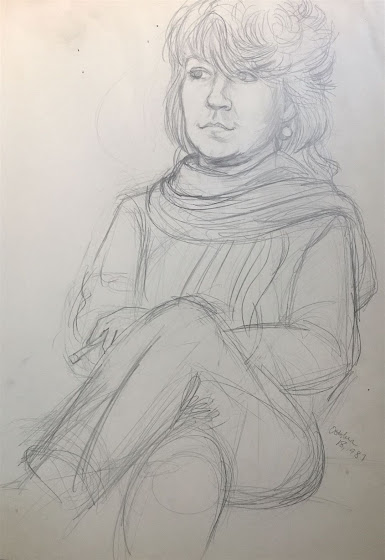
Considering that both the portraits I drew of her include a lit cigarette, I guess it isn't a surprise. I wonder now if somehow the hyperacusis was another symptom as the mass in her lung grew. 


Saturday, October 15, 2022

You're a Big Girl Now

Blood on the Tracks by Bob Dylan was one of the first albums I owned. This was back in the last century, when music was recorded onto waxed discs and had to be purchased one album at a time, or even one single song at a time. You had to go to a physical store and hand over your cash money. Or in one case, I shop-lifted the single "Hurricane" - also by Bob Dylan - from the Cherry Hill Mall Sound Odyssey.

I didn't steal Blood on the Tracks, I won it in a game of chance on a boardwalk at the Jersey shore. Since it was one of the very few albums I owned, I listened to it a lot. Then I forgot about it and didn't really think about it again until last week, when I decided to listen to the whole thing through. Because nowadays you can basically listen to any song ever recorded, either for free on Youtube or inexpensively through an Apple Music account or something similar.

While listening to Blood on the Tracks, I was pretty surprised to find that I still knew the lyrics to Rosemary, Lily and the Jack of Hearts perfectly. But what surprised me most was the song "You're A Big Girl Now." It barely made an impression when I listened to it last century, but last week it blew me away.

I don't know if being almost a half century older makes the difference, or if the sound quality is just that much better, but I really loved it. Dylan's whooooahs! just grab me. And the guitars are wonderful.


Sunday, October 09, 2022

You're welcome NYC!

I will always think of these two as my signs
Last year I had a bad experience on the MTA - what a surprise.
.


It wasn't due to a public masturbator but rather because of bad signage. I went into the subway station at 14th St. and 6th Avenue and was looking for the stairs to the uptown F train. But all the signs said downtown. I ended up walking a city block to the 15th Street entrance looking for a sign that said Uptown F train. Not finding one, I walked all the way back only to see the sign - but you couldn't see it unless you were walking in that direction towards 14th Street.

I mentioned this to the surly guy in the booth who implied that the fault was mine rather than the bad signage.

I wrote to the MTA and complained about the situation and lo and behold, three months later I got an email from the MTA that said: "a member of our Signage team conducted an inspection and based on your helpful feedback we will be adding a sign above the staircase to the downtown F /M platform directing customers to use that stairway to access uptown..."

And the other day I happened to travel to a store near 14th so I checked it out - and there it was! 

You can fight city hall.


Thursday, September 22, 2022

Happy Autumn Equinox 2022


I have discovered multiple Instagram tags  & accounts that are devoted exclusively to displaying images of autumn. 

Wednesday, September 07, 2022

Earl Rich ~ one quarter century gone

I've been trying to write the perfect essay about Earl Rich for all these years.

This image, via Google Street View, is where Earl died on September 7, 1997. A guy named John Pluta (died in 2013) was driving in the opposite direction and suddenly turned left into the side street, his pickup truck becoming a wall of death at the instant Earl barreled into that t-intersection.

Just a few seconds either way and Earl would have been fine.


I've written about Earl on this blog many times, usually on the anniversary of his death. I did miss observing the anniversary in 2006, 2011, 2012, 2013, 2014, 2016 and 2018. But I've had this blog for about seventeen years now, so not a bad record. And I've written about him a few times on other dates besides the anniversary, so that kind of makes up for it.

It seems to me that more people should know about Earl. He was a sort of celebrity in his own world, which is probably common for very attractive people. He resembled a young Warren Beatty. Earl's father-in-law (died in 2019), an editor at the Philadelphia Daily News, was quoted in the newspaper, saying that Earl was "one of those guys you got to know within minutes and felt like he was your buddy."

Who was Earl Rich, to the world at large? He was a nobody, a tax-paying citizen with a 9 to 5 job and a mortgage. For all his exceptional beauty and charm, his legacy is little more than my binder full of emails and this minimalist web site.

But Earl could write an elegant turn of phrase, as in this email:
Dearest Nancy,

You are the swizzle-stick of my eight-hour cocktail. I hope I didn’t upset you today with that email stuff. No more from me, I promise. You have your hands full. It seems that everyone wants a piece of Nancy!

I hope you re-read Confederacy (of Dunces). I doubt very much that you can enjoy or appreciate it fully in a one-sitting reading. But who knows? You never cease to amaze me.

I’ll leave you with this quote from the Journal of Religious Thought: “Chance is a statistical concept which ‘explains’ deviation within certain patterns of probability. “ Hey – it beats the hell out of confession.

Hoping to see you shortly,
Your Friend and Fellow Co-Worker,
E.B. Weatherington, IV

Now nobody wanted a piece of Nancy. But that's how Earl made you feel, like you were as fabulous as he was. And that line: "You are the swizzle-stick of my eight-hour cocktail." I'd had many different jobs up to that time (and many more after) and neither before nor since have I had a co-worker who could write a sentence like that. Nor want to write such a sentence to me.

Part of my problem in writing an essay about Earl is that I feel I have to tell everything - as if he was a celebrity and I must brag about every time we connected, like smoking a joint in my car in Valley Forge, or when he loaned me his surfboard, or the time he pretended to be in love with my sister and called her on a dare. Or the time he was vacationing in Key West and tracked down my ex-husband, who lived there at the time.

Since Earl had the knack of making everybody feel fabulous, I often wondered if our friendship meant anything to him, or whether I just happened to be there and he would have established such a connection with anybody else. But his widow seemed to confirm that I had been special to Earl when she invited me to meet with her and Earl's sister at his favorite Cape May restaurant, on the first anniversary of his death.

After writing about thirty different versions of my Earl essay, both on this blog and off, I think I must resign myself to focusing on only two main themes: how our co-worker Lisa was obsessed with him and sexually harassed him - this was the 1990s, her behavior would never fly today; and the ESP incident.

Because Earl really was, technically, a nobody, no matter how special to me. If I want others to care about his existence the essay itself has to be notable. So the quest continues.

Friday, August 05, 2022

Why Publish?

Factsheet Five and its related booklet, Why Publish are significant now because that whole world of self-publishing on paper came to an end when the Macintosh computer came along. Well technically it was the beginning of the end - people switched to doing their artwork and layouts on the computer - "desktop publishing" - but then printed and distributed the results. It wasn't really until the Internet became available to most people - first via AOL (I had an AOL account in 1989) and then thanks to the Netscape browser in the mid-90s. The rest is history.

Sigh. My life is now part of antiquity

I did get a chuckle out of one of my illustrations for "Why Publish." Ah, the late 1980s.


Thursday, August 04, 2022

I've been archived!

Out of idle curiosity I Googled "Factsheet Five" a magazine devoted to cataloging 'zines - self-published
printed periodicals of the 1980s. I had contributed art for several covers of Factsheet Five.        Well lo and behold one of my covers was on display in 2016 in the NY State Library, in its Factsheet Five collection

That's my work in the lower-left corner. It's a student in math class getting a detention slip for reading an issue of Factsheet Five behind her algebra book.

This particular layout is meant to display how the Factsheet Five art changed over the years. My art uses the spot color printing technique - and I had to do the spot color separations myself. Hey, at least my one year spent at the Philadelphia Printing School was good for something.

Then they went into 4-color printing process work but I had moved on by then, having gotten my very own Macintosh computer in 1988.

Another one of my covers was apparently chosen for the "Factsheet Five Archive Project." Presumably because they like the logo I created for the t-shirt. I couldn't help but leave a comment.

Damn they also made it their banner art on Twitter.


AND some Factsheet Five issues are at archive.org.

And here's issue #34 at the Poopsheet Foundation site - it actually mentions my name, for a change.

I'm pretty sure I did a third cover, which was an allusion to the Pandora myth. I haven't seen it online - I think that was probably my best cover too. I'll have to look around in my paper-based archives and see if I can find it.

I actually did previously mention my connection to FF on this blog back in 2008.

Wednesday, July 20, 2022

Sunday Philosophy Club #14

I've had an off-again, on-again relationship with the Sunday Philosophy Club, the series written by Alexander McCall Smith, best known for The No. 1 Ladies Detective Agency series, now on its 23rd installment.

A few times I've vowed to stop listening to SPC - I always consume it via audio book - because of the Men are from Mars gender essentialism that crops up too often. In fact it crops up in this latest installment. *

But I keep coming back. 

Partly I suppose because I am interested in philosophy - that is why an actor friend told me about the series in the first place - because I was working on a play that had a philosopher character who was a devotee of Arthur Schopenhauer. 

That's been my most successful play so far, in my non-impressive theater career. I think my latest play, LE CHAT NOIR (currently being translated into French), is better, but who knows whenever that will see the light of day. 


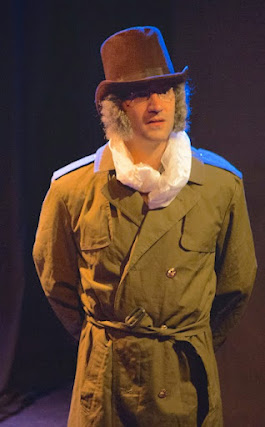
Matt DeCapua portrays Schopenhauer 
in a dream sequence from
  JULIA & BUDDY


In between the thirteenth and fourteenth installments of SPC, I briefly explored The No. 1 Ladies Detective Agency, both in audio book form and the regrettably short-lived, one-season-only television series.

The concept behind the Ladies Detective Agency series is truly original and I really enjoyed the television series. But to my surprise I got bored during the first Ladies Detective book and stopped listening.

This recent installment of the SPC saga, The Sweet Remnants of Summer, has an unsurprising name - every book in the series is set during the summer. 

Even more notable is the temporal laxity of the series. The first book was published in 2004, and the protagonist, Isabel Dalhousie, was said to be in her early 40s (I was the same age at the time) and Jamie, her niece's ex-boyfriend back then, in his early 20s. The series doesn't normally reference current events so the fact that Isabel doesn't seem to age isn't noticeable - until this latest installment. The book mentions the Scottish independence movement, but really that could be almost any time. But at one point, Isabel mentions Pope Francis, although not by name, who became pope in 2013. So the series is now set at least nine years after it began - assuming the first book was set the same year it was published and not retroactively moved into the future.

So if it began in 2004, Isabel is now at least in her early fifties, but age hasn't seemed to have had any impact on her and nobody seems to think it surprising that she has two children around kindergarten age. But then, she got pregnant twice, in her early-mid 40s with no trouble at all, at an age when many women need help from fertility drugs.

Unlike Precious Ramotswe, the protagonist of Ladies Detective Agency, whose appearance is constantly discussed, and even referenced in a title, "Tea Time for the Traditionally Built," Isabel's appearance is never described. Is she supposed to be a brain in a vat, imagining her perfect placid life with her handsome young husband in Edinburgh?

Anyway, one thing I liked about this installment of SPC is that it treats the characters of Jamie and Isabel's housekeeper Grace differently than in previous ones. Although the point of view of the series has always been third-person omniscient, it has stuck closely to Isabel's point of view, with only occasional brief descriptions of the inner thoughts of other people (and one very memorable time, a fox.) But for this book, we get long passages of Jamie's and Grace's points of view, including a very amusing segment in which Grace imagines the personal lives of Aristotle and Kant. It really opened things up, I thought.

The plots of the SPC are never exciting, and very little changes, especially after the early days of the series when the Isabel-Jamie relationship evolved from friendship to marriage. In this book the most exciting plot point was that Isabel's oldest son has been biting people. But it's not about the plots, but rather Isabel's flights into philosophical thought, which are sometimes funny, even laugh out loud funny on a few occasions. In fact, if the plots did become more exciting, it would feel like a betrayal. I've come to expect placid, non-consequential plots set in an idyllic Edinburgh summer, spiced with the occasional philosophy.

And there has yet to be a meeting of this so-called Philosophy Club - on any day of the week. If there ever was a meeting, that would be a huge deal.


* Even worse, this book makes a positive reference to the dreadful, misogynist, Islamaphobic Richard Dawkins.

Wednesday, June 22, 2022

Yoko, bright and dark

The New Yorker recently published an article about Yoko Ono, focusing on her art, and it seems to present more evidence for my belief about Yoko's relationship with the three non-John Beatles. I wrote:
Hess compares Ono's behavior to a performance piece, but there's a more likely, if prosaic explanation: Ono was from a family of wealthy Japanese aristocrats. The Beatles were working-class musicians. In the world that Yoko came from, you didn't worry about the feelings of the people you outranked. Why should she care if she was irritating the fuck out of everybody? 
The New Yorker piece is written by Louis Menand, who wrote my favorite review of all time of the work of Steven Pinker, also in the New Yorker, 20 years ago.

This new piece, Yoko Ono's Art of Defiance is generally very positive about Ono and refers to her "Cut Piece" as a work of genius.

But it does say this:
...when she graduated she was admitted to Gakushuin University as its first female student in philosophy.

She left after two semesters. She said the university made her feel “like a domesticated animal being fed information.” This proved to be a lifelong allergy to anything organized or institutional. “I don’t believe in collectivism in art nor in having one direction in anything,” she later wrote. A classmate offered a different perspective: “She never felt happy unless she was treated like a queen.”

And the article points out that Ono, unlike the Beatles, was very well-educated (Ringo never even finished high school) and could read music. More evidence that the real issue in the Get Back recording sessions was that Ono felt she outranked the Beatles. And since they were used to being treated like gods by that point, you could see why they would resent that.

Recently I discovered The Making of 'The Beatles First US Visit', and it's great. The original film was made by the Maysles brothers, and Albert, the surviving brother (he died in 2015) discusses various outtakes from the film. 

There are two highlights for me. The first, at minute 15:00, shows Paul trying to help the Maysles get into the Ed Sullivan Theater. Such a nice man! And the second highlight, at minute 30:05, shows the Beatles being very interested in the relatively cutting-edge technology the Maysles were using.

So the Maysles made "The Beatles First US Visit" in 1964. In 1965, they filmed Yoko Ono's "Cut Piece." That was a year before Yoko met the Beatles. The entire Maysle movie does not appear to be available online, but here is a long excerpt.

In spite of my criticisms of Yoko Ono, I do appreciate some of her work. She was a pioneer in conceptual art and some of her ideas were very interesting. And recently I read something by her that I thought was very inspiring and comforting, and you can't ask for more than that from a conceptual artist. I can't find where I saw it, dammit, but it went something like this:
Don't feel alone. Having time to yourself is a blessing. Think of all the great books that could never have been written except for all that lonelines.
Thank you Yoko.

Friday, June 17, 2022

Happy Watergate 50th Anniversary

 It was fifty years ago today that security guard Frank Wills noticed something funny at the Watergate hotel - a door had been taped open. He removed the tape and when he came back later and the tape had been replaced he called the cops.

I am celebrating by watching "The Post" which is about the fight to publish The Pentagon Papers, followed by "All the President's Men" which I must have seen at least ten times by now and is of course about Watergate, which happened shortly after the events of "The Post."

Woodward and Bernstein, the reporters most well-known for their articles on the Watergate investigation, recently published a piece in The Washington Post, comparing Nixon to Trump - both evil men. From the piece, I learned something new about Watergate and I thought I'd heard it all:

In one of the strongest and most effective espionage efforts, Elmer Wyatt, a Nixon campaign operative, was planted in Muskie’s campaign, where he became the senator’s chauffeur. Wyatt was paid $1,000 a month to deliver copies of sensitive documents he transported between Muskie’s Senate office and his presidential campaign headquarters. It was a spectacular yield. The volume was so great that Wyatt, code-named “Ruby I,” rented an apartment midway between the two offices, equipped with a photocopying machine.

As evil as Nixon was, Woodstein clearly believe Trump is even worse:

As reporters, we had studied Nixon and written about him for nearly half a century, during which we believed with great conviction that never again would America have a president who would trample the national interest and undermine democracy through the audacious pursuit of personal and political self-interest.

And then along came Trump.


Thursday, May 05, 2022

Happy Cinco de Mayo

The first music I ever created - with the aid of GarageBand - is this piece, which I titled Cinco de Mayo. This is from 2005! Seventeen years ago! I can't believe it. Tempus fugit.


Sunday, April 17, 2022

West Moon Street Manhattan


Saturday, April 02, 2022

Bonjour Biqui, Bonjour - happy 129th anniversary!

According to Wikipedia:

When Pierre-Daniel Templier (1905-1987) published the first Satie biography in 1932, Valadon was still living, and the author omitted any direct mention of her relationship with the composer. He simply noted, "Women did not play an important part in Satie's life. As a mature man, he was not known to have had any affairs."
 
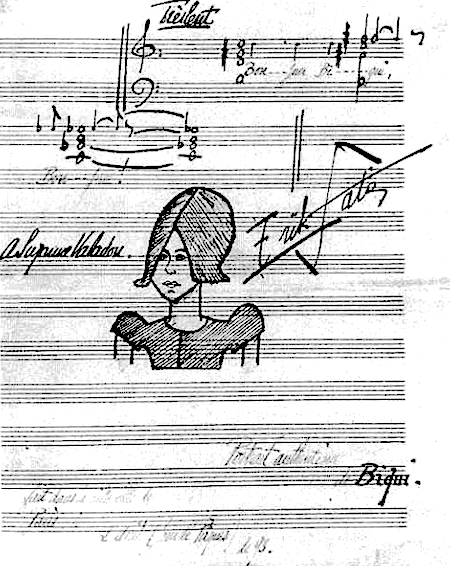
However, Templier included a facsimile of the complete Bonjour Biqui, Bonjour! manuscript - its first appearance in print - which by its intimate nature served as a tacit acknowledgement of this youthful liaison. The facsimile was republished in Rollo H. Myers' English-language biography (1948), but as Valadon had died in 1938 Myers felt free to identify her as Satie's one "affaire du coeur" ("affair of the heart").

I take issue with this passage in the Wiki page:

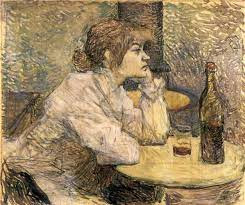
(the score is) accompanied by a drawing of an innocent-looking Valadon Satie subtitled an "Authentic Portrait of Biqui". One need only compare it to Valadon's self-portrait of the same year or her depiction in Toulouse-Lautrec's painting The Hangover (c. 1889) to appreciate the extent of Satie's idealization. The sketch and Satie's bold, angular signature beside it dominate the composition, in which the different elements (music, text, drawing) are carefully arranged on the page for visual effect.

I don't think the cartoony sketch of Valadon on the manuscript of "Bonjour Biqui, Bonjour" is in any way "idealized."


 She looks like a queen from a deck of playing cards, but with a weirdly elongated head and her shoulders and arms hanging far away from her body. This is the Queen of Clubs from a deck from around 1900.


And what an unfair comparison - a cartoony sketch as the idealized version, versus the author's representation of a "non-idealized" version, a profile view of Valadon in a picture called "The Hangover." 


In my play LE CHAT NOIR, Bonjour Biqui Bonjour was written before the Cher Petite Biqui letter, but BBB, based on the date on the manuscript came after. April 2, 1893 was Easter Sunday.

Which is a good time to mention the David Sedaris piece that discusses how the French celebrate Easter. An excerpt:


"Easter is a party for to eat of the lamb," the Italian nanny explained. "One, too, may eat of the chocolate."

"And who brings the chocolate?" the teacher asked.

I knew the word, and so I raised my hand, saying, "The Rabbit of Easter. He bring of the chocolate."

My classmates reacted as though I'd attributed the delivery to the Antichrist. They were mortified.

"A rabbit?" The teacher, assuming I'd used the wrong word, positioned her index fingers on top of her head, wiggling them as though they were ears. "You mean one of these? A rabbit rabbit?"


"Well, sure," I said. "He come in the night when one sleep on a bed. With a hand he have the basket and foods."

The teacher sadly shook her head, as if this explained everything that was wrong with my country. "No, no," she said. "Here in France the chocolate is brought by the big bell that flies in from Rome."

I called for a time-out. "But how do the bell know where you live?"

"Well," she said, "how does a rabbit?"

It was a decent point, but at least a rabbit has eyes. That's a start. Rabbits move from place to place, while most bells can only go back and forth--and they can't even do that on their own power. On top of that, the Easter Bunny has character; he's someone you'd like to meet and shake hands with. A bell has all the personality of a cast-iron skillet. It's like saying that come Christmas, a magic dustpan flies in from the North Pole, led by eight flying cinder blocks. Who wants to stay up all night so they can see a bell? And why fly one in from Rome when they've got more bells than they know what to do with right here in Paris? That's the most implausible aspect of the whole story, as there's no way the bells of France would allow a foreign worker to fly in and take their jobs. That Roman bell would be lucky to get work cleaning up after a French bell's dog--and even then he'd need papers. It just didn't add up.